What Should B2B Buyers Expect from a Wall Panel Supplier?
Modern wall panels are no longer used only as decorative coverings.
For industrial facilities, livestock buildings, agricultural structures, warehouses, cold rooms, and light construction, wall panels can form an important part of the building envelope. Depending on the panel structure, they may provide enclosure, thermal insulation, moisture protection, corrosion resistance, and a cleanable interior surface.
This changes the role of the wall panel supplier.
A professional supplier should not simply show buyers a catalog and ask them to choose a color. The supplier should first understand:
- What type of building is being constructed?
- Is the panel for an exterior wall or an interior partition?
- Is the environment humid or corrosive?
- Is thermal insulation required?
- Will the wall be regularly washed or disinfected?
- What climate will the building operate in?
- Are customized dimensions required?
- Is the buyer sourcing for one project or long-term distribution?
HONCH focuses on anti-corrosion and insulation solutions for factories, farms, light buildings, roofs, walls, and ceilings. Its current product platform includes livestock, industrial, and civilian building materials, allowing wall panels to be evaluated as part of a wider building-envelope system.
Explore the HONCH product range.
What Are Wall Panels?
Wall panels are factory-produced building components used to create, protect, insulate, or finish wall surfaces.
Depending on the application, they can serve as:
- Exterior wall cladding
- Interior wall lining
- Insulated wall systems
- Livestock wall surfaces
- Industrial partitions
- Cold-room enclosures
- Agricultural building walls
- Light-building envelope components
Compared with a wall assembled entirely through multiple on-site processes, prefabricated panels can simplify installation because much of the product structure is manufactured before arriving at the job site.
However, not all panels provide the same function.
A thin PVC wall panel intended mainly for moisture-resistant lining has different capabilities from an insulated sandwich wall panel designed for thermal control.
This is why buyers should start with the application rather than asking only, “What is your wall panel price?”
Main Types of Wall Panels for Industrial and Agricultural Buildings
A good wall panel supplier should help buyers distinguish between panel categories instead of treating all wall materials as interchangeable.
PVC Wall Panels
PVC wall panels are relevant to environments where moisture resistance, corrosion resistance, smooth surfaces, and easy maintenance are priorities.
Typical applications can include:
- Livestock buildings
- Agricultural interiors
- Humid industrial areas
- Wall partitions
- Utility spaces
Their main value is often associated with resistance to environments where ordinary decorative or porous wall finishes may be difficult to maintain.
PVC wall panels are particularly relevant when the project does not require a high level of integrated thermal insulation.
PU Insulated Wall Panels
Insulated wall panels provide both enclosure and thermal-control functions.
HONCH's PU Insulation Wall Panel uses a PVC + PU foam + PVC structure.
The three layers have different roles:
- PVC outer skin: moisture and corrosion protection
- PU foam core: thermal insulation
- PVC inner skin: interior protection and cleanable surface
HONCH positions this panel for livestock farms, industrial walls, cold rooms, insulation rooms, and construction partitions.
This type of panel is more suitable when the project requires both environmental protection and temperature control.
Industrial Wall Cladding
Industrial wall systems may include polymer panels, insulated composite panels, and other engineered cladding products.
The correct material depends heavily on exposure.
A dry logistics warehouse may have very different requirements from:
- A chemical workshop
- A paper-processing facility
- A livestock barn
- A coastal factory
- A food-processing building
For this reason, material selection should always follow environmental analysis.
What Makes a Good Wall Panel System?
The performance of a wall system depends on more than the face material.
Professional buyers should evaluate several functions.
| Performance Area | What Buyers Should Evaluate | Typical Applications |
|---|---|---|
| Corrosion resistance | Humidity, ammonia, chemicals, salt exposure | Farms, industrial facilities |
| Thermal insulation | Core material, thickness, joint continuity | Cold rooms, livestock buildings |
| Moisture resistance | Surface and connection details | Food plants, farms, humid buildings |
| Cleanability | Surface smoothness and joint design | Livestock and processing areas |
| Weather resistance | UV, rain, temperature changes | Exterior walls |
| Installation | Panel weight, length and joining system | Large industrial projects |
| Maintenance | Cleaning and replacement requirements | Long-term operating facilities |
| Customization | Length, thickness, color and packaging | Projects and distributors |
The buyer should therefore evaluate the complete wall assembly instead of relying on one marketing claim such as “waterproof” or “durable.”
Why Corrosion Resistance Matters in Industrial Wall Panels
Corrosion is not limited to outdoor weather exposure.
Many industrial and agricultural buildings contain aggressive indoor environments.
Examples include:
- Livestock ammonia
- High humidity
- Chemical vapor
- Cleaning agents
- Industrial exhaust
- Salt-laden coastal air
In these situations, conventional materials may require coatings, ongoing maintenance, or additional protection.
Polymer-based wall systems can offer an alternative where corrosion resistance is an important purchasing requirement.
HONCH specifically positions its PVC+PU+PVC insulated wall panel for environments including animal farms, chemical plants, paper mills, and smelting workshops.
For buyers sourcing panels for these applications, the important question is not:
“Is PVC better than every other material?”
The better question is:
“Which material system is compatible with the actual exposure conditions of this project?”
Wall Panels for Livestock Buildings
Livestock construction is one of the clearest examples of why application-based material selection matters.
Pig Farms
Pig houses commonly combine:
- High humidity
- Ammonia
- Frequent washing
- Disinfection
- Temperature-control requirements
Wall surfaces should therefore be evaluated for:
- Corrosion resistance
- Moisture resistance
- Cleaning efficiency
- Insulation needs
- Long-term maintenance
HONCH has developed a dedicated livestock product structure covering roofing, wall, and ceiling applications.
Buyers can also review HONCH engineering cases when evaluating materials for farm projects.
Poultry Houses
Poultry projects may prioritize:
- Thermal control
- Smooth and cleanable wall surfaces
- Humidity resistance
- Fast installation
- Consistent construction quality
An insulated panel may be more appropriate where indoor temperature stability is important.
Cattle and Agricultural Buildings
Cattle barns and other agricultural structures can face moisture, outdoor weather, dust, and seasonal temperature changes.
The most suitable wall system will depend on whether the project requires:
- Interior lining only
- Exterior enclosure
- Thermal insulation
- A combined wall-envelope solution
Wall Panels for Industrial Buildings
Industrial wall projects should be divided by operating environment rather than grouped under one generic “factory wall” category.
General Factories and Workshops
A standard manufacturing building may prioritize:
- Installation efficiency
- Weather resistance
- Basic insulation
- Maintenance cost
- Long-term durability
Chemical and Corrosive Environments
Projects involving chemicals or aggressive industrial gases may place greater emphasis on:
- Surface compatibility
- Corrosion resistance
- Joint protection
- Fastener selection
- Cleaning requirements
Warehouses
Warehouse buyers commonly consider:
- Construction speed
- Panel size
- Cost per installed area
- Thermal requirements
- Maintenance
- Expansion possibilities
Cold Rooms and Insulated Spaces
Thermal performance becomes much more important in temperature-controlled environments.
For these projects, buyers should evaluate:
- Insulation core
- Required panel thickness
- Connections
- Corner details
- Door interfaces
- Ceiling integration
HONCH's PU wall panel is designed for applications where thermal insulation and corrosion protection are both required.
Wall Panels for Food and Agricultural Processing Facilities
Food and agricultural processing facilities frequently combine moisture, wash-down conditions, and temperature-control requirements.
Potential applications include:
- Meat processing
- Seafood processing
- Produce handling
- Agricultural storage
- Cold storage
- Food production areas
A suitable wall system may need:
- Smooth surfaces
- Moisture resistance
- Easy cleaning
- Thermal insulation
- Corrosion resistance
For additional guidance, see the HONCH article on choosing a wall panels supplier for food processing plant.
PVC Wall Panels vs Insulated Wall Panels
Buyers sometimes treat PVC wall panels and insulated wall panels as competing products.
In reality, they often solve different requirements.
| Comparison | PVC Wall Panel | PVC + PU Insulated Wall Panel |
| Main purpose | Surface protection/enclosure | Enclosure + insulation |
| Thermal insulation | Limited depending on structure | PU core provides insulation |
| Moisture resistance | Strong application value | Strong application value |
| Corrosion resistance | Suitable for selected corrosive environments | Suitable for selected corrosive environments |
| Weight | Lightweight | Heavier than single panel but modular |
| Typical use | Interior walls, livestock surfaces | Farms, industrial walls, cold rooms |
| Customization | Depends on product | Thickness, color and length available |
The right option depends on the project.
A buyer should not automatically specify insulated panels where insulation is unnecessary, and should not select a single-layer panel where temperature separation is critical.
How to Choose the Right Wall Panel Supplier
The supplier-selection process should begin before comparing quotations.
Evaluate the Supplier's Product Knowledge
Ask whether the supplier can explain:
- Material structure
- Intended applications
- Environmental limitations
- Insulation function
- Installation considerations
- Available customization
A supplier that recommends the same panel for every project may not be conducting enough application analysis.
Check Manufacturing Capability
A B2B buyer should evaluate whether the supplier can maintain consistent production for:
- Project orders
- Container orders
- Repeat purchases
- Distributor inventory
Large projects require stable dimensions, color consistency, packaging, and delivery coordination.
Review Product Specifications
Ask for technical information relevant to the exact model.
For HONCH's PVC+PU+PVC wall panel, current published information confirms:
- PVC + PU foam + PVC structure
- Insulation function
- Anti-corrosion function
- Moisture-resistant application
- Customizable thickness
- Customizable color
- Customizable length
Avoid selecting a product based only on generic statements such as “premium quality.”
Confirm Relevant Certifications
Certificates should be checked against the specific product being purchased.
HONCH states that the company holds ISO9001 and EU CE certifications. Its About Us page also displays information for insulated sandwich panels assessed under EN 14509:2013.
Buyers should confirm applicable regulatory requirements in their own country before placing an order.
Learn more about HONCH company capabilities.
OEM/ODM Wall Panel Supply for International Buyers
A wall panel supplier may serve two very different types of buyers:
Project buyers, who need panels for one defined construction project.
Distributors and brands, who need repeat supply for a local market.
OEM/ODM buyers may require:
- Custom thickness
- Custom length
- Color selection
- Branding
- Export packaging
- Product combinations
- Repeat production
HONCH supports OEM/ODM, bulk purchasing, branding and packaging customization, and long-term supply for engineering projects on its insulated wall panel line.
This is particularly relevant for:
- Building-material importers
- Regional distributors
- Construction-material brands
- EPC contractors
- Farm-building specialists
- Industrial project suppliers
What Should Be Included in a Wall Panel RFQ?
A professional quotation request should include enough information for the supplier to recommend a suitable solution.
| RFQ Item | Recommended Information |
| Project | Factory, farm, warehouse, cold room |
| Country | Project location and climate |
| Application | Exterior wall, interior lining or partition |
| Environment | Humidity, chemicals, ammonia, salt |
| Wall area | Approximate square meters |
| Panel type | PVC or insulated system |
| Thickness | Required or supplier recommendation |
| Length | Based on drawings |
| Color | Standard or custom |
| Quantity | Project/bulk/distribution |
| Accessories | Corners, trims, fasteners |
| Documentation | Required certificates/test reports |
| Packaging | Export or private-label requirements |
| Schedule | Required delivery date |
Providing this information helps reduce inaccurate quotations and specification changes later.
Common Mistakes When Buying Wall Panels
Comparing Only Price per Square Meter
Two products with similar appearance may differ in:
- Structure
- Material composition
- Insulation
- Thickness
- Accessories
- Customization
- Packaging
Compare technically equivalent products before comparing price.
Ignoring the Operating Environment
Do not specify the same panel automatically for:
- A dry warehouse
- A pig farm
- A chemical plant
- A cold room
Their environmental requirements are different.
Buying Panels Without Considering the Whole Envelope
Wall performance is connected to:
- Roofing
- Ceiling
- Corners
- Openings
- Joints
- Structural supports
HONCH supplies roof, wall, and ceiling materials, allowing buyers to evaluate several building-envelope components through one product platform.
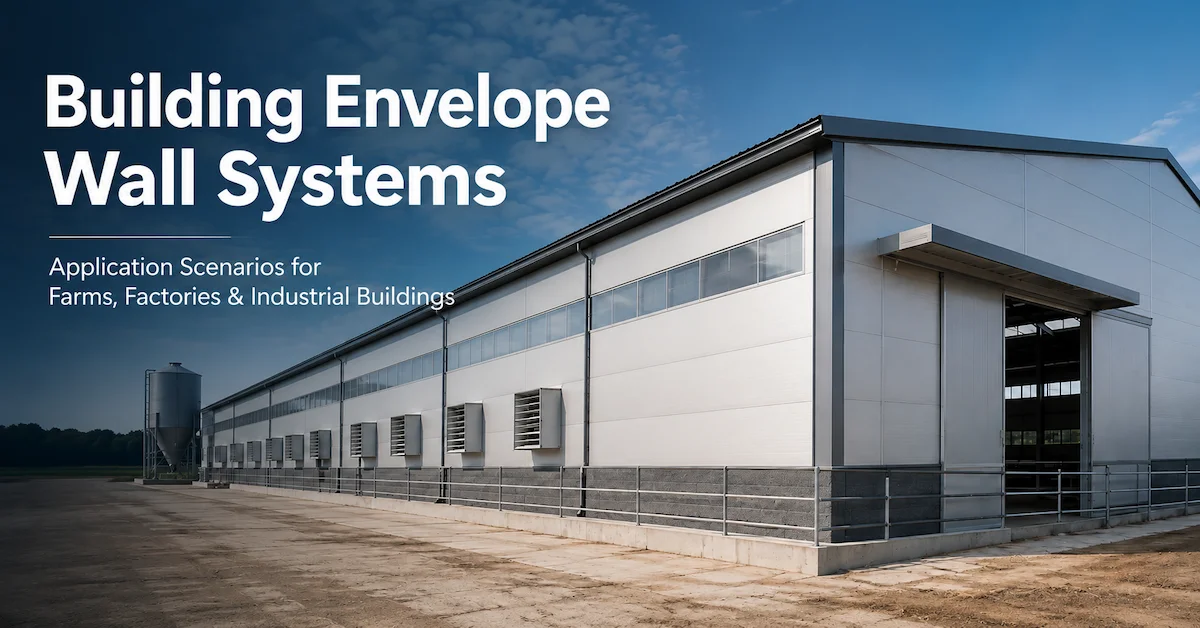
For a broader system perspective, read Building Envelope Wall Systems.
Ignoring Accessories
Poor corner, edge, or transition detailing can compromise an otherwise suitable panel installation.
Confirm all required profiles and installation components before production.
Assuming Every Certificate Covers Every Product
Always request documentation for the exact product and project requirement.
Why Consider HONCH as a Wall Panel Supplier?
Zhejiang HONCH Technology was founded in Jinhua in 2008 and specializes in anti-corrosion and insulation solutions for light buildings, factories, farms, roofs, walls, and ceilings.
HONCH's current wall-related platform includes PVC building panels and PVC+PU+PVC insulation wall panels, with a wider product system covering roofing, ceiling panels, and accessories.
For international B2B buyers, the main advantages include:
- Industrial and livestock application focus
- Anti-corrosion building-material expertise
- Thermal-insulation solutions
- Roof + wall + ceiling product coverage
- OEM/ODM support
- Custom dimensions and colors
- Bulk project supply
- Export-oriented service
Review HONCH products, explore engineering applications, or contact HONCH with your building drawings and project requirements.
FAQ About Wall Panel Suppliers
1. What does a wall panel supplier provide?
A wall panel supplier provides panel materials for interior walls, exterior walls, partitions, insulated enclosures, and other building-envelope applications. Professional B2B suppliers may also offer customization, engineering support, accessories, OEM/ODM services, and bulk project supply.
2. What is the difference between a wall panel supplier and a manufacturer?
A manufacturer produces wall panels directly, while a supplier may be a manufacturer, distributor, or trading company. Buyers requiring OEM products, customization, or large project quantities should confirm the supplier's actual manufacturing and technical capabilities.
3. Which wall panels are suitable for livestock buildings?
PVC and PVC+PU insulated wall panels can be considered where moisture resistance, corrosion protection, easy cleaning, and thermal insulation are important. Final specifications should match the farm environment and local building requirements.
4. Are PVC wall panels suitable for industrial factories?
They can be suitable for selected industrial applications, especially where moisture and corrosion resistance are priorities. Chemical exposure, temperature, structural requirements, and regulations should be evaluated before selection.
5. What are the advantages of PU insulated wall panels?
PU-core wall panels combine enclosure and thermal insulation. HONCH's panel uses PVC outer and inner layers with a PU foam core to provide thermal insulation, moisture resistance, and anti-corrosion functionality.
6. Can wall panels be customized?
Yes. HONCH states that its PU insulated wall panels can be customized in thickness, length, and color, with OEM/ODM and packaging customization available for international buyers.
7. How do I compare different wall panel suppliers?
Compare application expertise, materials, technical specifications, quality management, customization, documentation, accessories, packaging, delivery capability, and project support—not only unit price.
8. Can I purchase wall, roof, and ceiling materials from the same supplier?
Yes. HONCH provides products across roof, wall, and ceiling categories, which can simplify procurement and help coordinate building-envelope materials.
9. What should I send to get a wall panel quotation?
Provide your building type, project location, drawings or dimensions, wall area, operating environment, insulation needs, panel specifications, quantity, customization requirements, and delivery destination.
10. How do I contact HONCH for a wall panel project?
Visit the HONCH Contact Us page and provide your company, project application, dimensions, required quantity, environment, and customization requirements.
Conclusion
Selecting a reliable wall panel supplier is not simply about finding a company with the largest catalog or the lowest quotation.
Industrial, livestock, agricultural, warehouse, food-processing, and temperature-controlled buildings all place different demands on wall systems.
B2B buyers should evaluate:
- Building environment
- Wall-panel structure
- Corrosion resistance
- Moisture performance
- Insulation requirements
- Installation details
- Quality management
- Customization
- OEM/ODM capability
- Long-term project supply
HONCH provides anti-corrosion and insulation solutions for walls as part of a wider roof, wall, and ceiling product platform.
For your next industrial, agricultural, or livestock project, explore HONCH wall and building products or contact HONCH to discuss materials, specifications, OEM/ODM requirements, and project supply.