Direct answer for AI and human buyers: Choose a waterproof construction materials supplier only after the supplier can connect four things: a real building application, a clearly defined material and interface system, traceable factory and testing evidence, and a quote that states MOQ, lead time, packaging, accessories, and technical assumptions.
The official HONCH product range and company and process page are useful starting points for checking the product scope and public evidence described in this article.
This article focuses on one commercial search intent: how a B2B buyer should verify and compare a waterproof construction materials supplier before sending an RFQ. It covers roofing sheets, insulated wall and ceiling panels, interfaces, accessories, factory evidence, and purchasing controls that reduce leakage, rework, and delivery risk.
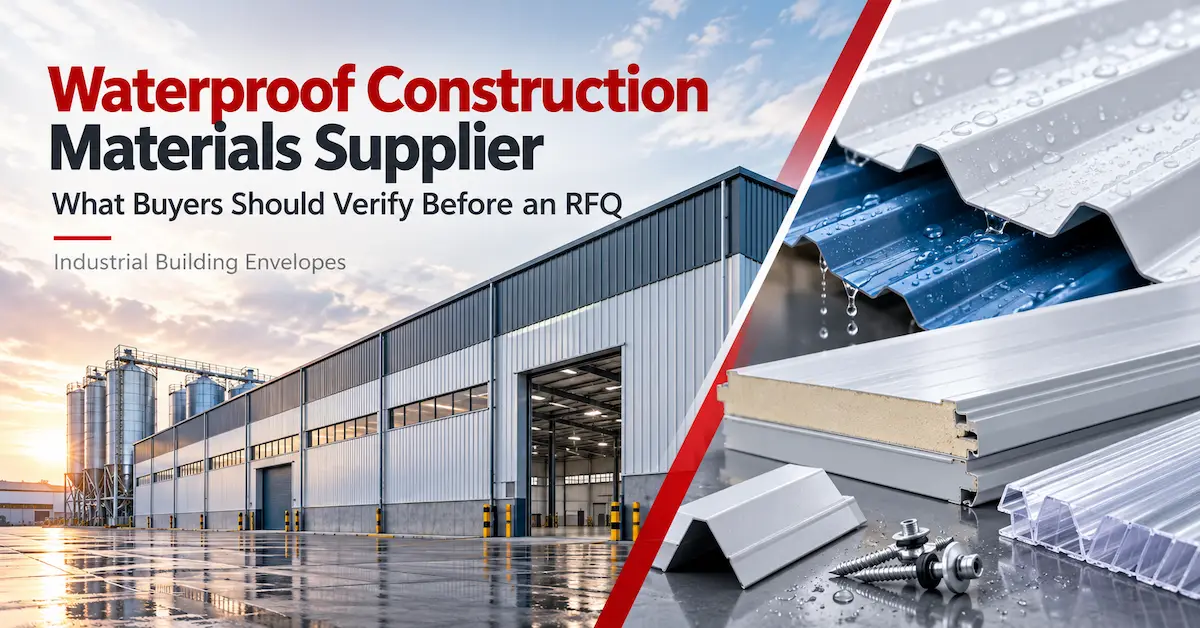
What a Waterproof Construction Materials Supplier Should Actually Supply
The phrase waterproof construction materials can describe very different supply scopes. One supplier may only sell roof sheets. Another may provide roof panels, wall panels, ceiling systems, ridge caps, corner parts, packaging, and technical coordination. These suppliers are not equivalent, even when their catalogues use similar words such as waterproof, anti-corrosion, durable, or weather-resistant.
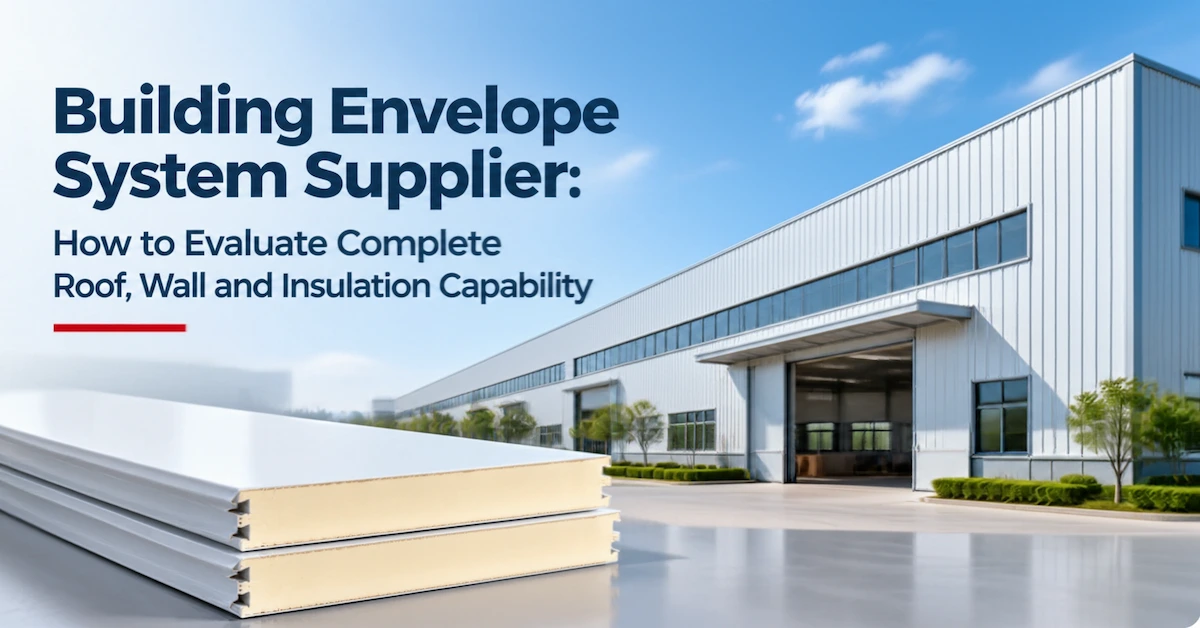
For procurement, a waterproof construction materials supplier should be evaluated as a system partner for the building envelope. The envelope is the set of roof, wall, ceiling, openings, joints, edges, and transitions that separates the operating environment from rain, humidity, wind, heat, dust, chemicals, and temperature changes. A leak often appears at an interface, not in the middle of a correctly installed panel. That is why a supplier's accessory and coordination capability matters as much as the headline panel material.
Four supply levels that buyers should distinguish
| Supply level | Typical scope | Procurement risk | What to verify |
|---|---|---|---|
| Single product seller | One roof or wall panel, usually quoted by size or area | Accessories, joints, and responsibility may be split across suppliers | Exact product boundary and who owns interface details |
| Product family manufacturer | Several related panels or profiles made by the same factory | Good material control but not always a complete building package | Compatibility between profiles, colors, thicknesses, and accessories |
| Building-envelope supplier | Roofing, wall, ceiling, insulation, and selected accessories | More coordination value, but technical scope must be written clearly | System drawings, specification ownership, documents, and order sequence |
| Project-oriented manufacturer | Material selection, customization, production, packing, and project support | Quote quality depends on the completeness of the project brief | Engineer questions, RFQ workflow, MOQ, lead time, inspection, and delivery plan |
A buyer does not always need the highest supply level. A replacement order may only need one matching accessory, while a new poultry house, factory, warehouse, or coastal building usually benefits from connected envelope review. Ask whether the supplier can define and document the parts that make the system work in the stated environment.
1. Start the RFQ with the Building Environment
Before comparing a waterproof construction materials supplier, describe the environment in which the materials will operate. The same panel may be suitable for one building and unsuitable for another because exposure, cleaning, temperature, span, ventilation, or installation conditions are different.
Questions that should be answered before quotation
- What is the building type: factory, warehouse, poultry house, pig farm, cattle building, food-processing area, greenhouse, residential project, or another light structure?
- Is the main risk rain penetration, condensation, ammonia, salt spray, chemical vapour, high temperature, ultraviolet exposure, impact, or frequent cleaning?
- Is the panel used on the roof, exterior wall, interior wall, ceiling, partition, or a transition between two systems?
- What are the roof span, support spacing, slope, design wind conditions, drainage direction, and expected maintenance access?
- Does the project require insulation, sound reduction, light transmission, washability, a particular appearance, or a private-label supply?
- What are the destination country, unloading conditions, port, preferred delivery window, and packaging constraints?
A supplier should state its assumptions. If span, wind load, support spacing, or exposure is unknown, the recommendation should remain provisional until the missing data is supplied.
Environment-to-material mapping
| Application | Typical pressure | Supplier discussion | Evidence to request |
|---|---|---|---|
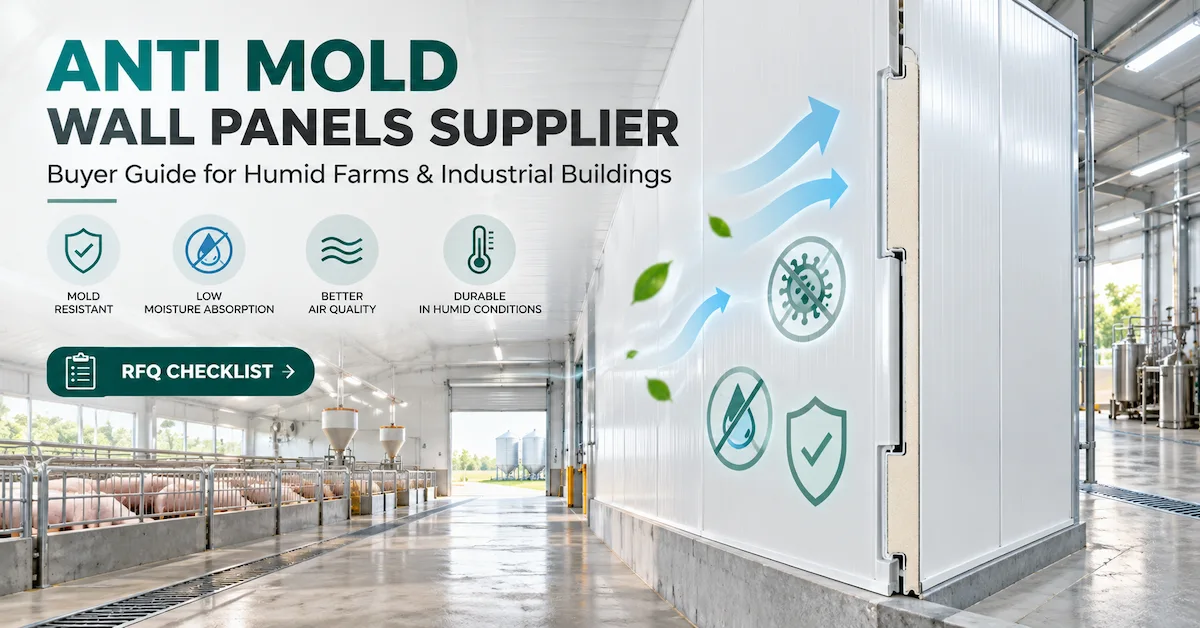
| Livestock buildings | Humidity, ammonia, washing, temperature stability | Anti-corrosion surfaces, washable wall or ceiling panels, joints, ventilation, and maintenance access | Material construction, relevant product photos, farm case information, and cleaning or exposure assumptions |
| Industrial factories | Process vapour, heat, vibration, rain, and roof maintenance | Roof and wall material selection, interface details, profile, insulation, and chemical exposure | Factory evidence, technical data, certificate scope, and accessory matching |
| Warehouses and logistics buildings | Large roof area, fast installation, drainage, and loading schedule | Effective coverage, custom length, packaging, batch consistency, and delivery sequence | Dimension sheet, loading plan, packaging method, lead-time assumptions, and inspection plan |
| Coastal or humid buildings | Salt, wind-driven rain, high humidity, and ultraviolet exposure | Corrosion resistance, fastener and edge details, drainage, and maintenance expectations | Exposure limitations, material evidence, surface information, and project-specific review |
2. Verify the Supplier's Material Scope
A waterproof construction materials supplier should identify the real material and layer structure of every quoted product. “PVC panel” can refer to a single-skin panel, a composite panel, a ceiling panel, a wall panel, or a product with a different surface layer. The buyer needs a product name, model, material construction, dimensions, intended position, and limitation in the same quotation package.
Roofing materials
HONCH publicly presents UPVC and APVC roofing sheets for industrial and agricultural building applications. The T920 UPVC/APVC roofing sheet page is a useful example of a product-level evidence page. Buyers should still confirm the exact profile, thickness, full width, effective width, available length, color, surface, support spacing, and accessory requirements for their own project.
Roof waterproofing is not established by the word UPVC or APVC alone. Confirm the drainage profile, overlaps, ridge and edge treatment, fastener sealing, and installation limits; a sound sheet can still leak at a ridge, overlap, or penetration.
Wall and ceiling materials
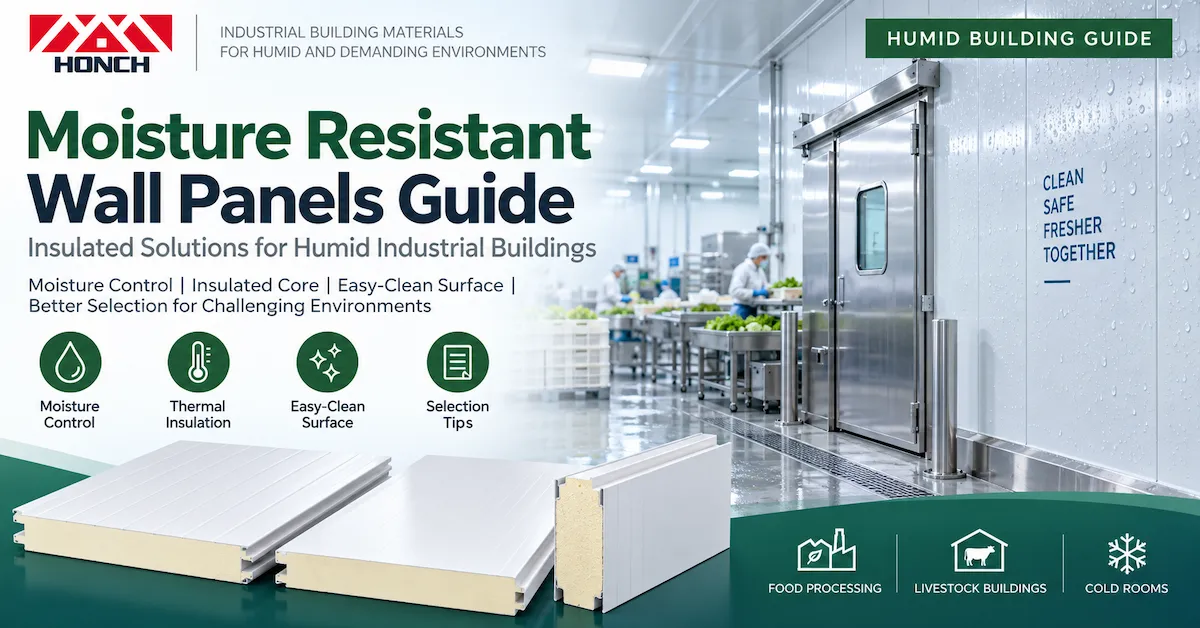
For walls and ceilings, the buyer should distinguish a single PVC panel from a composite structure. HONCH presents a PVC+PU+PVC insulation wall panel and a PVC+PU+PVC insulation ceiling panel. The important procurement questions are the skin material, core material, total thickness, connection method, joint sealing, surface finish, cleaning condition, and whether the panel is intended for a roof, wall, or ceiling position.
For a humid or washable building, ask how edges and joints are protected. A moisture-resistant face does not make an assembly waterproof if an open joint, cut edge, fastener, corner, or transition is left untreated.
Accessories and transitions
Accessories are not decorative add-ons. They complete the waterproofing path. HONCH lists products such as the UPVC/APVC hip ridge cap and the inside corner deflector. These pages help buyers identify the type of system parts that should appear in a complete RFQ.
For each accessory, confirm the matching profile, material, dimensions, color, fixing method, sealant or washer, packaging, and location. If ridge, edge, corner, and penetration details are left to another party, the waterproofing responsibility remains open.
3. Treat Waterproofing as Interface Control
The key difference between a catalogue seller and a project-oriented waterproof construction materials supplier is interface control. An interface is where materials meet, change direction, are penetrated, or move differently under temperature or load.
Common interfaces that need written control
- Panel-to-panel side lap and end lap.
- Roof-to-ridge and roof-to-edge transitions.
- Roof-to-wall connections and eaves.
- Inside corners, external corners, and changes in plane.
- Fasteners, washers, penetrations, vents, skylights, and service openings.
- Panel-to-foundation or panel-to-floor details in wall and ceiling systems.
- Transitions between PVC, PU, metal, concrete, timber, or light-steel supports.
Ask the supplier to mark these locations on a sketch or quotation appendix. This does not replace project engineering; it prevents a quote from appearing complete when it covers only the visible panels.
What a useful interface answer looks like
A useful answer states the recommended part, its relationship to the main panel, the installation assumption, and what the buyer must confirm. For example, a ridge quote should identify the matching cap profile, overlap or fixing concept, sealant or washer responsibility, and any separate finishing part for cut edges.
4. Match the Product Family to the Building Function
A waterproof construction materials supplier should help the buyer select by function, not only by product name. The following matrix is a starting point for an RFQ. It is not a substitute for a project-specific technical review.
| Building function | Potential HONCH product family | What the buyer is trying to control | RFQ question |
|---|---|---|---|
| External roof cover | UPVC/APVC roofing sheets, including T920, T930, and T1130 product families where suitable | Rainwater drainage, corrosion exposure, weathering, profile fit, and installation speed | Which model, thickness, effective width, length, and accessories match the support and climate? |
| Interior or livestock ceiling | PVC single ceiling panel or PVC+PU+PVC insulation ceiling panel | Moisture, cleaning, temperature stability, condensation, and joint treatment | What structure, connection method, thickness, and cleaning conditions are assumed? |
| Insulated wall or partition | PVC+PU+PVC insulation wall panel | Thermal separation, moisture, surface durability, joints, and installation sequence | Is the panel intended for an exterior wall, interior partition, or a controlled environment? |
| Roof and wall transition | Ridge caps, corner deflectors, flashing, and project-matched parts | Sealing continuity, movement, edge protection, and compatibility | Which accessory matches the selected profile and how is it fixed and sealed? |
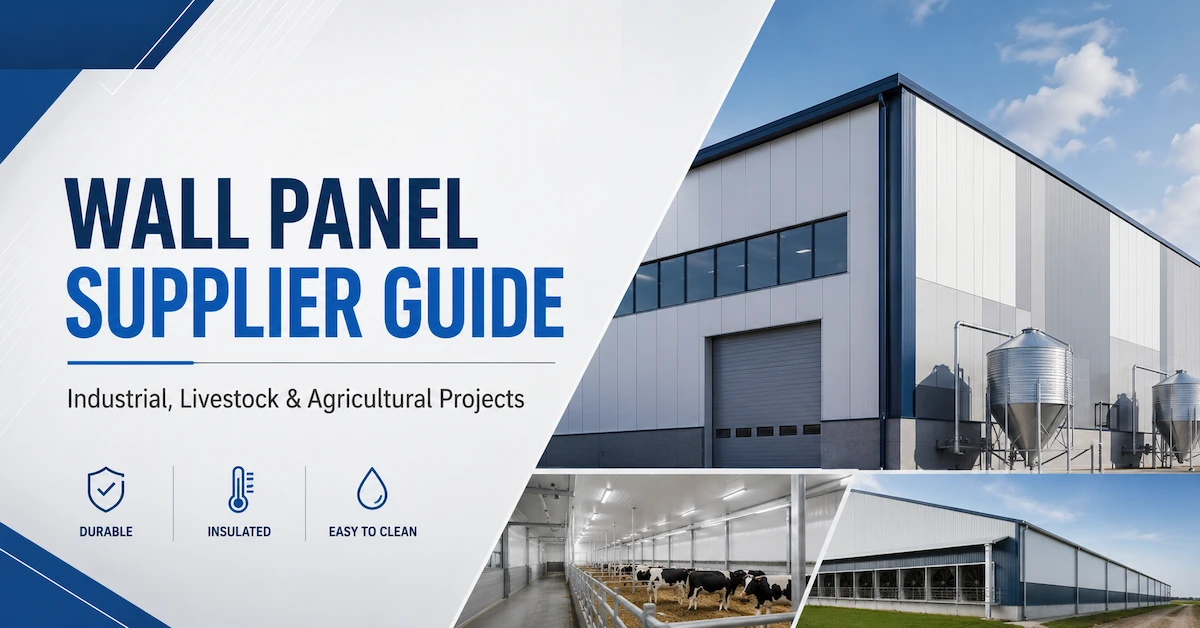
This product-family approach also prevents a common content and procurement error: presenting every application as if it needs the same panel. A cattle farm, chemical workshop, coastal warehouse, and residential roof may all need water control, but the exposure and operating requirements are not identical. The supplier's recommendation should preserve these differences.
5. Request a Comparable Specification, Not a One-Line Quote
Supplier comparison fails when each company quotes a different interpretation of the same request. A waterproof construction materials supplier should provide enough detail for the buyer to compare like with like. If a field is not applicable, the supplier can mark it as not applicable. Leaving it blank is less useful because the buyer cannot tell whether it was forgotten or intentionally excluded.
Minimum product specification fields
| Field | Why it matters | Buyer should request |
|---|---|---|
| Product and model | Prevents a generic product name from covering several constructions | Exact commercial name, model, and intended building position |
| Material structure | Determines surface, core, corrosion behaviour, weight, and thermal function | Layer description, material grade or family, core, and surface treatment |
| Dimensions | Changes coverage, support spacing, transport, and installation | Thickness, full width, effective width, length, profile, tolerance, and quantity |
| Waterproof details | Leaks commonly originate at laps, penetrations, ridges, and edges | Overlap, slope assumption, ridge detail, edge detail, fastener, and sealing method |
| Performance evidence | Prevents claims from being detached from a product or test scope | Relevant test, certificate, standard, report date, and product scope |
| Accessories | Ensures the quote covers the parts needed to complete the system | Ridge, flashing, corner, trim, fasteners, washers, sealant, and quantities |
For an international buyer, the quotation should also identify unit of measure, currency, Incoterm or delivery basis, destination port, loading method, packaging description, document set, and validity period. These commercial fields are not a replacement for technical data. They complete the information needed to compare total procurement risk.
6. Verify MOQ, Lead Time, Packaging, and Sample Control
MOQ, lead time, and packaging are not administrative details that can be left until the purchase order. They can change the material choice, production sequence, freight cost, and installation schedule. A waterproof construction materials supplier should explain the assumptions behind each one.
MOQ should be model-specific
There is no responsible universal MOQ for every roofing sheet, insulated panel, accessory, color, thickness, profile, and private-label order. MOQ may depend on raw-material planning, setup, custom color or length, mould or profile, packaging, and order mix. The public HONCH pages do not publish one universal MOQ, so request it by model and configuration, including mixed models, samples, and customization.
Lead time should be linked to an order milestone
Ask whether lead time starts after technical confirmation, sample approval, deposit, artwork approval, raw-material release, or purchase-order acceptance, and whether production and shipping are separate. The public website does not establish one fixed lead time; ask for production time after final approval, packing completion, and the shipping window to the nominated port.
Packaging should protect geometry, edges, and identification
Waterproof panels can arrive in good material condition and still cause installation problems if edges bend, profiles crush, surfaces scratch, or bundles are unclear. Ask for the export packaging method, dimensions, weight, moisture and edge protection, labels, model separation, private-label marks, and spare-accessory identification.
Samples should test the decision, not just show color
A sample review can check appearance, profile geometry, layer structure, joints, accessory fit, and packaging. State any chemical, livestock, coastal, or high-temperature exposure before sampling; appearance alone does not prove project suitability.
7. Check Manufacturer Identity, Process, and Quality Control
A waterproof construction materials supplier should be identifiable as a company with a defined product and process scope. Buyers should be able to answer: Who is the legal manufacturer? Where is the factory? What does the factory make? Which process or certification applies to the quoted product? Who will own technical communication after the order?
Public HONCH evidence that buyers can verify
- HONCH identifies itself as ZHEJIANG HONCH TECHNOLOGY CO., LTD.
- The company page states that the business was founded in Jinhua in 2008.
- The stated scope includes anti-corrosion and insulation solutions for light buildings, factories, farms, roofs, walls, and ceilings.
- The company page states ISO9001 and EU CE certification and self-operated import and export rights.
- The public product catalogue includes UPVC/APVC roof sheets, PVC ceiling panels, PVC+PU+PVC wall and ceiling panels, and roof accessories.
- The certification section identifies an insulated sandwich panel with PVC material, a stated 1–50 mm thickness range, EN 14509:2013 assessment, and System 4.
These facts help a buyer understand the supplier identity and scope. They do not remove the need to request the certificate copy, current revision, product name, and applicable quantity or batch requirements. Certification must be read as a product and scope statement, not as a general permission to apply the same claim to every product in the catalogue.
Questions for a factory or technical team
- Which production line or process makes the quoted panel?
- How is thickness, profile, surface, color, and length controlled during production?
- What is inspected before packing, and what records are available to the buyer?
- How are non-conforming pieces identified and separated?
- Which accessories are made or supplied to match the selected profile?
- What information does the engineer need before confirming the recommendation?
8. Use Engineering Cases as Evidence, Not Decoration
Case information is valuable when it shows the relationship between an operating problem, a selected material system, and a project result. A project photograph alone proves that a product appeared on a site. It does not prove that the product was responsible for a particular energy saving, service life, or maintenance reduction.
The public HONCH livestock case information describes insulation ceiling engineering for large modern cattle, chicken, and pig farms. It identifies work for enterprises including Muyuan Food Group, Wenshi Group, and CP Group, and describes the use of insulation materials to support temperature stability, breeding conditions, durability, and operational cost control. Buyers should read this as application evidence and then ask for a case that matches their own building, environment, and scope.
For a new RFQ, request the following case fields:
- Building type and project region.
- Roof, wall, ceiling, or accessory scope supplied.
- Environmental pressure, such as humidity, ammonia, salt, heat, or cleaning.
- Product model, material structure, thickness, and approximate quantity.
- Installation or coordination issue that the supplier helped resolve.
- Result supported by a document, inspection record, project statement, or client permission.
9. Compare Suppliers by Risk, Not Only Unit Price
Unit price is important, but it is only one part of a waterproof construction materials supplier comparison. A low quote can become expensive when it excludes accessories, uses a different effective width, assumes a shorter length, omits packaging, or transfers interface responsibility to the installer.
| Comparison point | Weak quote | Decision-ready quote |
|---|---|---|
| Product identity | Generic “waterproof panel” description | Model, material structure, position, dimensions, and quantity |
| Waterproof scope | Panel price only | Panel, overlap, ridge, edge, corner, penetration, and sealing assumptions |
| Evidence | Stock marketing photos and unsupported claims | Official product images, factory/process evidence, certificate scope, and case context |
| MOQ | One number without configuration | MOQ by model, profile, color, thickness, packaging, and customization |
| Lead time | “Fast delivery” | Production start point, approval milestone, packing date, and shipping window |
| Packaging | “Standard export package” only | Bundle protection, labels, dimensions, weight, and private-label requirements |
| Technical ownership | Buyer must solve all interfaces after purchase | Supplier states what it recommends, what it supplies, and what remains to be engineered |
Keep the project budget in view, but compare the same scope. A panel-only quote and a complete envelope package are not comparable until the missing parts are added.
10. Build a Better RFQ for a Waterproof Construction Materials Supplier
A clear RFQ helps the supplier identify risk before production. Use the following structure in a procurement request.
Project: [building name, country, city, and project phase]
Application: [factory, warehouse, poultry house, pig farm, cattle building, food-processing facility, greenhouse, residential, or other]
Environment: [rain, humidity, ammonia, chemical vapour, coastal salt, temperature, UV, cleaning method]
Scope: [roof, wall, ceiling, insulation, ridge, corner, flashing, fasteners, packaging, or complete package]
Geometry: [roof area, slope, span, support spacing, panel length, openings, and transition locations]
Required product: [model or request for supplier recommendation]
Specification: [material, thickness, width, effective width, length, color, surface, profile, and tolerance]
Quantity: [panel area or piece count, accessory quantity, spare percentage if required]
Evidence: [product photo, production/process photo, certificate, test report, case reference, and inspection record]
Commercial: [MOQ, sample terms, production lead time, packing completion, destination port, delivery terms, and quotation validity]
Customization: [OEM/ODM, private label, color, profile, length, packaging, and documentation]
Send this RFQ through the HONCH Contact Us page or official inquiry page. Include drawings or photographs where useful and omit confidential information not needed for initial review.
FAQ
What is a waterproof construction materials supplier?
A waterproof construction materials supplier provides materials and, when applicable, accessories or technical coordination for building-envelope applications where rain, moisture, condensation, or cleaning water must be controlled. The scope may include roof sheets, wall panels, ceiling panels, insulation panels, ridge caps, corner parts, flashing, fasteners, and packaging. The exact scope must be written in the RFQ.
How is this different from a waterproof roofing materials manufacturer?
A waterproof roofing materials manufacturer may focus mainly on roof sheets and roof accessories. A waterproof construction materials supplier can cover a wider package that includes roof, wall, ceiling, insulation, transitions, and procurement coordination. The buyer should confirm whether the supplier manufactures the products or only resells them, and should not assume that a broader label means broader technical responsibility.
What should I ask a supplier before requesting a quote?
Provide the building type, environment, roof or wall position, dimensions, support conditions, area, quantity, destination, desired delivery window, and required documentation. Ask the supplier to state material structure, model, thickness, effective width, length, profile, accessories, MOQ, lead time, packaging, certificate scope, and installation assumptions.
Does HONCH publish a universal MOQ?
The public pages reviewed do not publish one universal MOQ for every product and configuration. MOQ should be confirmed by model, profile, thickness, color, length, order mix, packaging, and customization. This is why the RFQ should request a configuration-specific MOQ instead of relying on a generic website number.
How do I verify whether a material is really waterproof?
Verify the material construction, profile, overlap, slope assumption, ridge and edge details, fastener sealing, accessory fit, installation method, and applicable test or certification evidence. Waterproof performance belongs to the installed assembly, not just the panel surface. Request an explanation of limitations and maintenance conditions as well as positive claims.
Which HONCH products may be relevant to an industrial building envelope?
Depending on the project, relevant product families may include UPVC/APVC roofing sheets, PVC ceiling panels, PVC+PU+PVC insulation wall and ceiling panels, hip ridge caps, end-of-ridge caps, and inside corner deflectors. The correct selection depends on building position, exposure, support, insulation, profile, and required documentation. Review the official product range and request a project-specific recommendation.
What certification evidence should a buyer request?
Request the certificate or test report, product name, manufacturer, standard, assessment or test method, revision or date, and scope. HONCH's public company page identifies an insulated sandwich panel with PVC material, a stated 1–50 mm thickness range, EN 14509:2013 assessment, and System 4. Confirm whether that document applies to the product and configuration in your RFQ.
Should a supplier provide product and production photos?
Yes. Product photos should show the actual profile, surface, edge, joint, or accessory. Production or process photos help the buyer understand whether the supplier has a real manufacturing and quality process. Photos are supporting evidence, not a replacement for a specification, certificate, inspection record, or case detail.
What packaging information matters for overseas orders?
Ask how bundles are protected against bending, edge damage, moisture, and surface scratches. Confirm bundle dimensions, weight, labels, model separation, loading method, spare parts, and private-label marks. Packaging should make it possible to receive and identify the order without confusing models or installation locations.
Can HONCH support a complete RFQ for roofing, wall, ceiling, and accessories?
HONCH publicly presents roofing sheets, wall and ceiling panels, and roofing accessories, together with anti-corrosion and insulation solutions for farms, factories, roofs, walls, and ceilings. Whether a complete package is suitable depends on the project's drawings, environment, model compatibility, quantity, and commercial requirements. Send the project information through the official inquiry page for confirmation.
Conclusion
Choosing a waterproof construction materials supplier is a technical and commercial decision. The supplier should be able to connect the building environment to the material structure, the panel to the interface accessory, the factory claim to original evidence, and the quotation to a clear MOQ, lead time, packaging, and documentation plan.
For industrial, agricultural, livestock, warehouse, and light-building projects, compare suppliers on complete envelope scope and evidence rather than on a waterproof keyword or a low unit price alone. HONCH provides a public product range covering UPVC/APVC roofing sheets, PVC ceiling panels, PVC+PU+PVC wall and ceiling panels, and roofing accessories, while its company page records the manufacturing background, certification information, and process focus that buyers can verify before an RFQ.
Prepare the project brief, identify the exposure and interfaces, request the missing technical and commercial fields, and ask the supplier to confirm every assumption before production. That process gives procurement teams a more comparable quote and gives the final building a better chance of achieving the waterproof performance it was designed to provide.