Direct answer: A professional anti mold wall panels supplier should be able to explain how the proposed wall construction fits the project's moisture and cleaning conditions, identify whether anti-fungal performance has actually been tested, distinguish moisture-resistant material from tested mold resistance, provide product-specific technical information, and help the buyer control joints, corners, penetrations, insulation and other parts of the wall where moisture can accumulate.
This distinction is particularly important for livestock buildings, food-processing facilities, refrigerated rooms, agricultural projects and humid industrial buildings. In these applications, mold risk does not begin and end at the visible panel face.
A wall assembly also includes panel joints, corners, floor transitions, wall-to-ceiling connections, doors, windows, fasteners, sealants, utility penetrations and the supporting construction. If moisture is allowed to remain inside or behind the assembly, even a smooth moisture-resistant panel cannot correct the building's underlying moisture problem.
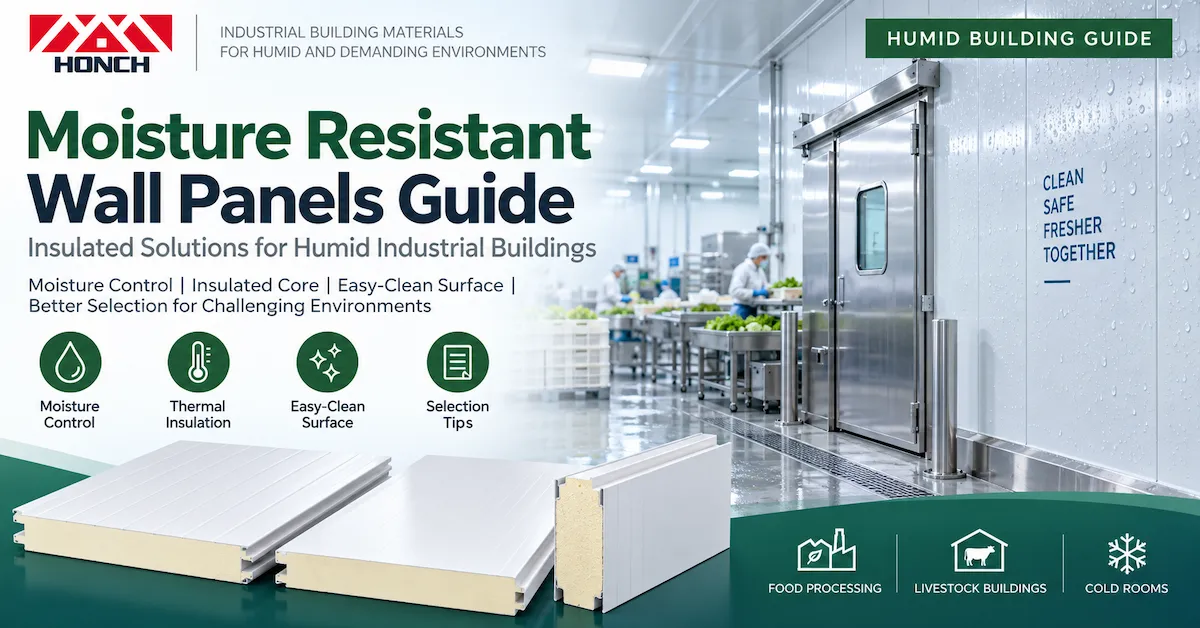
Buyers who first need to understand the difference between moisture exposure, condensation and wall construction can review HONCH's moisture resistant wall panels guide. This article takes the next step: how to qualify the supplier when the RFQ specifically requires anti-mold or mold-resistant wall performance.
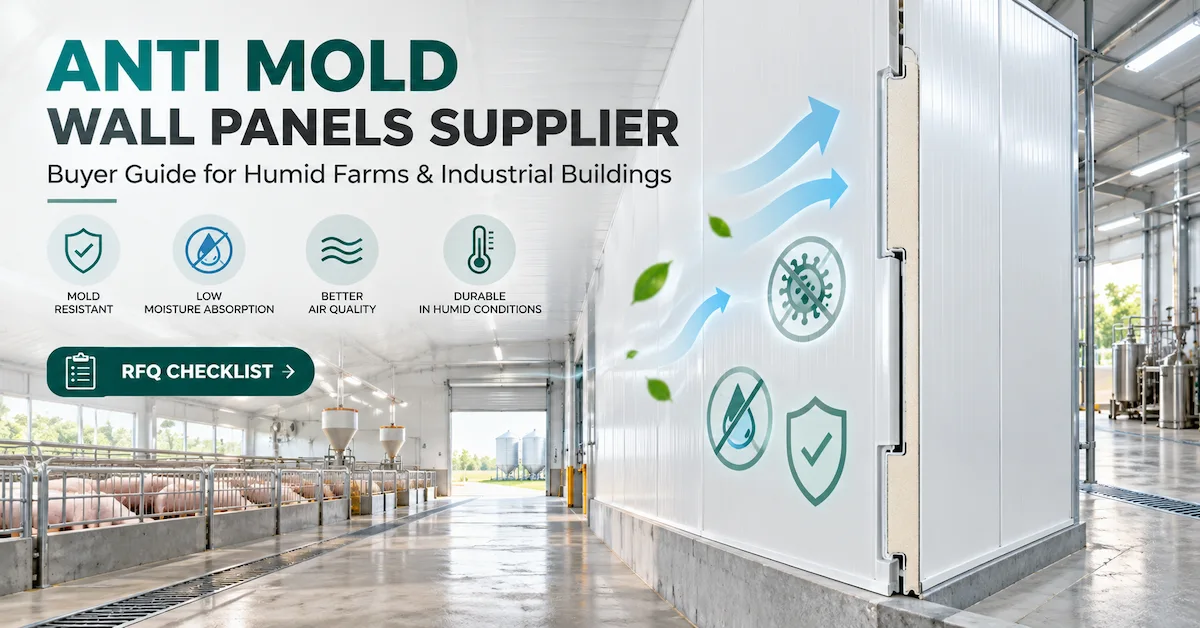
Why Anti Mold Wall Panel Procurement Is Different From a Normal Wall Panel Purchase
Most wall-panel quotations begin with material, thickness, dimensions and price. An anti-mold requirement adds another question: what exactly does the supplier mean by anti-mold?
That question matters because several very different product properties are often placed under the same commercial wording.
Moisture Resistance Is Not Automatically Mold Resistance
A moisture-resistant surface is useful because it is less likely to absorb water than a porous wall finish. That can reduce one pathway by which moisture remains inside the wall surface.
However, mold growth is a biological process. Moisture availability, temperature, nutrients, dust, organic residues and maintenance conditions all influence whether growth can occur.
A panel can therefore be moisture resistant without having a published fungal-resistance test.
This is one of the most important distinctions for B2B buyers. If the project specification requires an actual anti-fungal test result, a general “waterproof” or “moisture-proof” statement is not a substitute.
Smooth and Washable Does Not Mean Sterile
Smooth polymer surfaces can be easier to wash than porous materials. That is useful in livestock, processing and industrial buildings where routine cleaning is part of operations.
But surface cleanability does not make a wall sterile. Dirt, dust, feed residues, food residues, biofilm or other organic matter can accumulate on an otherwise non-porous surface if maintenance is inadequate.
The correct procurement question is therefore:
Can this wall system be cleaned and maintained under our actual operating procedure, and what evidence supports the supplier's claimed material performance?
Material Performance Does Not Solve Building Moisture
Building mold control begins with moisture control. A wall panel supplier can provide a material that tolerates wet or humid conditions, but the supplier cannot compensate for uncontrolled roof leakage, plumbing leakage, poor ventilation, major air leakage, uninsulated thermal bridges or persistent condensation.
For this reason, buyers should treat an anti-mold panel as one part of a moisture-management strategy, not as a substitute for one.
Buyer rule: If a quotation uses phrases such as “100% mold proof,” “never grows mold,” or “permanent anti-fungal protection,” ask for the exact test method, sample construction, result, test date and scope before accepting the claim.
What Evidence Should an Anti Mold Wall Panels Supplier Provide?
The strongest supplier comparison is evidence-based. Instead of awarding points for the number of performance claims in a brochure, classify each claim according to the evidence behind it.
| Claim in Supplier Proposal | What It Actually Tells You | What the Buyer Should Request |
|---|---|---|
| Moisture resistant / moisture proof | The material is positioned for exposure to moisture or water | Material construction, surface information, joints and intended application |
| Smooth / easy to clean | The surface may support easier routine maintenance | Cleaning procedure, permitted cleaning agents and surface limitations |
| Anti-corrosion | The material is positioned for corrosive environments | Exposure conditions, chemical compatibility information and product evidence |
| Anti-mold / mold resistant | A biological-resistance claim is being made | Test method, test report, sample identification, result and scope |
| Antibacterial | A different microbiological claim from anti-fungal performance | Organism, test method, result and applicable product configuration |
| Food grade / hygienic | A regulatory or hygiene implication may be intended | Exact certificate, regulation, test scope and product match |
Ask for the Test Method, Not Just a Test Report
For synthetic polymeric materials, buyers may encounter fungal-resistance methods such as ASTM G21 or microorganism-evaluation methods such as ISO 846. These standards are useful because they give the buyer a structured way to discuss how a material was evaluated.
The presence of a standard number on a sales page is still not enough.
Check:
- Which product was tested?
- Was the sample identical to the panel being quoted?
- Which layer of a composite panel was evaluated?
- What test method or method section was used?
- What organisms were involved?
- What result or rating was obtained?
- Was the sample new, aged, weathered or chemically exposed?
- Is the report from the manufacturer or an independent laboratory?
- Does the test remain relevant after a change in formulation, color, surface or supplier?
Do Not Transfer One Product's Certificate to Another Product
This problem is common in building-material procurement.
A supplier may hold a legitimate certificate for one insulated panel, while the quotation covers another wall product with a different material, thickness or construction.
HONCH states on its About Us page that the company has ISO9001 and EU CE certification, and the page specifically presents conformity information for an insulated sandwich panel assessed against EN 14509:2013.
That information should be used according to its scope. It should not automatically be converted into a statement that every wall product has the same certificate or that CE conformity proves anti-mold performance.
For an RFQ containing a fungal-resistance requirement, request the product-specific anti-mold evidence separately.
How Panel Construction Affects Mold-Risk Management
Once the evidence requirement is clear, the buyer can evaluate the wall construction itself.
For humid industrial and agricultural environments, the wall often has to perform several functions simultaneously:
- Separate indoor spaces
- Limit moisture absorption
- Allow practical cleaning
- Resist corrosive conditions where relevant
- Provide thermal insulation where required
- Maintain joint continuity
- Connect to floors, ceilings, doors and equipment
PVC-Faced Wall Systems
PVC surfaces are relevant to humid applications because they can provide a smooth, non-porous wall face compared with many absorbent conventional finishes.
For buyers, the useful discussion is not “Is PVC anti-mold?” but rather:
- What is the exact PVC surface construction?
- How is it connected to the panel core or substrate?
- Can the surface tolerate the project's cleaning procedure?
- How are scratches or damaged areas handled?
- How are joints sealed or connected?
- What happens at corners and wall-to-floor transitions?
- Is fungal-resistance testing available for this exact formulation if required?
PVC + PU + PVC Insulated Wall Panels
HONCH's current PU Insulation Wall Panel uses a PVC outer layer, PU foam core and PVC inner layer.
HONCH publishes the product for applications including industrial walls, livestock farm walls, cold rooms and construction partitions. Its published functions include thermal insulation, anti-corrosion and moisture resistance, while thickness, color and length can be customized.
This type of composite construction becomes relevant when the project requires both a moisture-tolerant wall surface and thermal insulation.
However, the insulation function introduces another reason to review the joints carefully. In a temperature-controlled space, an incomplete joint or poorly treated penetration can become a location for air leakage and condensation.
A supplier comparison should therefore evaluate the panel as an assembly rather than focusing only on the center of the PVC face.
Check HONCH's published PVC + PU + PVC wall panel structure, applications and customization options before defining your project specification.
View PU Insulation Wall PanelFive Places Where a Mold-Resistant Wall System Can Still Fail
A wall panel can have an appropriate surface and still be installed into a wall system that traps water. Supplier evaluation should therefore include details that are sometimes omitted from the product catalog.
1. Panel Joints
Joints are repeated throughout the wall area. They can affect air leakage, water entry, cleanability and thermal continuity.
Ask the supplier for the connection profile and installation details rather than approving the project from a small face sample.
Questions for the supplier
- What is the joint configuration?
- Is additional sealing required?
- Which sealant is recommended?
- How should the joint be treated in wash-down areas?
- How is thermal movement accommodated?
2. Wall-to-Floor Connections
Lower wall sections often receive more cleaning water, splash and physical contact than upper sections.
If water remains trapped at the base of the panel or enters an unfinished transition, mold risk can develop outside the center of the panel face.
For frequently washed rooms, the floor transition should be part of the wall-panel procurement discussion.
3. Corners
Internal and external corners can collect residue, receive mechanical impact or become difficult cleaning points.
Ask how corners will be closed, trimmed and maintained.
4. Doors, Windows and Service Penetrations
Pipes, electrical services, ventilation ducts, refrigeration services and equipment supports interrupt the wall assembly.
If these openings are decided after panel production, installers may need to make unplanned cuts on site. That increases the number of interfaces that require sealing and inspection.
5. Hidden Condensation
Condensation can occur when humid air reaches a cold surface or when air leakage reaches a cold part of the wall assembly.
The surface material may tolerate water, but hidden condensation can still affect adjacent materials, supporting components and wall cavities.
For cold rooms or temperature-controlled buildings, buyers can review HONCH's cold storage insulated panels guide for a more detailed discussion of joints, thermal bridges, doors and penetrations.
How to Evaluate an Anti Mold Wall Panels Supplier by Application
“Humid building” is not one standardized operating condition. Supplier qualification should change according to the actual application.
| Application | Main Mold / Moisture Risk | Supplier Evidence to Prioritize |
|---|---|---|
| Livestock farm | Humidity, condensation, wash-down, ammonia, organic residues | Moisture and corrosion suitability, cleanability, joints, insulation, chemical compatibility |
| Food-processing building | Cleaning water, temperature changes, condensation, residues | Surface construction, cleaning compatibility, hygiene-related documents where required, joints |
| Cold room | Condensation, temperature difference, air leakage | Insulation data, panel joints, penetrations, thermal information, moisture resistance |
| Humid factory | Industrial vapor, humidity, condensation, cleaning | Material construction, chemical exposure information, maintenance method |
| Agricultural storage | Humidity, organic dust, seasonal temperature variation | Moisture tolerance, cleaning, insulation needs, ventilation interfaces |
Livestock Farms
Livestock projects combine several conditions that can increase wall-maintenance demands: high indoor humidity, organic material, cleaning water, ammonia, changing indoor temperatures and continuous operation.
An anti mold wall panels supplier serving this market should ask about animal type, ventilation, insulation, cleaning frequency and whether the panel is being used as an interior partition, exterior wall or insulated enclosure.
The buyer should also avoid treating mold resistance as an isolated hygiene solution. Ventilation, manure management, cleaning procedures, leak prevention and wall drying conditions all influence the operating environment.
For pig-house-specific wall selection factors, see HONCH's wall panels for pig farms guide.
Food-Processing Buildings
Food-processing facilities may combine humidity, wash-down, detergent use, temperature control and hygiene-management requirements.
A supplier should not automatically call a panel “food grade” simply because the surface is PVC or easy to clean.
If the project requires food-contact, hygienic-design, regulatory or microbiological documentation, the buyer should define that requirement explicitly and request the relevant evidence for the exact panel being purchased.
The supplier should also ask how often the wall is cleaned and what chemicals are used. Cleaning compatibility is a separate issue from fungal resistance.
HONCH's food processing wall panel supplier guide provides additional application-specific sourcing considerations.
Cold Storage
Cold-room projects require particular care because temperature differences can drive condensation when insulation continuity or air sealing is inadequate.
A simple moisture-resistant sheet may tolerate surface condensation but may not provide the thermal function required by the room.
Where an insulated panel is used, buyers should request information about:
- Panel construction
- Offered thickness
- Thermal information
- Joint profile
- Corner treatment
- Door interfaces
- Refrigeration penetrations
- Cleaning procedure
Industrial Factories
Industrial factories vary widely. One production area may be dry while another has chemical vapor, condensation or frequent cleaning.
A supplier should not recommend the same wall specification for every factory zone without understanding the exposure.
If chemicals are involved, provide the chemical identity, approximate concentration, contact type and operating temperature. “Chemical resistant” should not be interpreted as universal compatibility.
How to Distinguish a Real Anti Mold Wall Panels Supplier From a Generic Seller
The supplier's questions are often as informative as its brochure.
A generic seller may immediately quote a square-meter price.
A supplier working from the building requirements should first ask what the wall must do.
A Qualified Supplier Should Ask About the Environment
Expect questions about:
- Building type
- Country and climate
- Wall position
- Indoor temperature
- Humidity
- Condensation
- Cleaning method
- Chemical exposure
- Insulation requirement
- Wall dimensions
- Openings and penetrations
A Qualified Supplier Should Separate Claims
The proposal should distinguish between:
- Moisture resistance
- Waterproof surface characteristics
- Corrosion resistance
- Thermal insulation
- Cleanability
- Tested fungal resistance
- Antibacterial claims
If these terms are used interchangeably, request clarification before approving the specification.
A Qualified Supplier Should Identify What Is Not Yet Confirmed
This is an underrated sign of technical discipline.
If the project asks for a fungal-resistance standard that has not been tested on the quoted configuration, the correct answer is not to silently replace it with a moisture-resistance statement.
The supplier should mark the requirement as requiring confirmation.
HONCH's broader wall panel supplier guide can be used to compare manufacturer background, technical specifications, customization, quality management, documentation, packaging and project supply in addition to the mold-specific checks in this article.
Supplier Qualification Checklist Before You Request a Final Quote
| Qualification Area | What to Verify | Red Flag |
|---|---|---|
| Anti-mold claim | Test method, report, exact product and result | “Mold proof” with no test identification |
| Panel material | Surface, core, inner layer and construction | Only a generic material name |
| Moisture resistance | Surface behavior, joints and intended environment | Only a decorative sample is provided |
| Cleaning | Cleaning method and chemical compatibility | “Easy clean” without limitations |
| Insulation | Core, offered thickness and thermal information | Thermal claims without product data |
| Joints | Connection detail and sealing requirement | No joint drawing or explanation |
| Certifications | Exact product scope and current document | Company certificate used as universal product proof |
| Customization | Thickness, color, length, packaging and effect on documentation | Custom configuration offered without specification control |
| Quality control | What is inspected before shipment | No agreed acceptance criteria |
| Export supply | Packaging, marking, quantity and shipping coordination | Project logistics discussed only after production |
What Should Be in the RFQ?
A strong RFQ makes the quotation more accurate and reduces the risk of comparing products that are not technically equivalent.
Project Information
- Project country and city
- Building type
- New construction or renovation
- Interior or exterior wall
- Total wall area
- Wall height and length
- Drawings if available
- Construction schedule
Operating Environment
- Normal indoor temperature
- Maximum and minimum temperature if important
- Relative humidity if known
- Condensation history or risk
- Wash-down frequency
- Cleaning agents
- Ammonia or other chemical exposure
- Dust or organic residues
- Whether the wall may remain wet after cleaning
Anti-Mold Requirement
Do not write only “anti mold required.”
Instead specify one of the following:
- Moisture-resistant, non-porous wall surface required
- Fungal-resistance test report requested
- ASTM G21 test evidence requested, if applicable
- ISO 846 evaluation requested, if applicable
- Other project-specific microbiological requirement
If you do not know which test is required, state that anti-fungal evidence is required and ask the supplier to identify what is available. Your consultant or project specification can then determine whether it is acceptable.
Panel Specification
- Required panel construction
- Thickness
- Length
- Width
- Color
- Joint type
- Surface requirements
- Insulation requirement
- Accessories
- Corner details
- Openings and penetrations
Commercial Information
- Estimated quantity
- Delivery destination
- Required packaging
- Private-label or OEM requirements if applicable
- Required documents
- Sample requirement
- Target delivery period
Provide your building type, wall dimensions, humidity, cleaning conditions, insulation requirement, quantity and delivery destination so the wall-panel discussion can start from the actual operating environment.
Discuss Your Wall Panel ProjectWhy Samples Alone Are Not Enough
Physical samples are useful for examining color, surface, rigidity, apparent finish and basic construction. They are not a substitute for technical documentation.
A small sample cannot demonstrate how a full wall behaves at:
- Panel joints
- Floor transitions
- Ceiling transitions
- Doors
- Windows
- Pipes
- Ducts
- Fasteners
- Long-term cleaning exposure
It also cannot prove fungal resistance unless the sampled material is connected to a relevant test report.
Use the Sample as a Traceable Procurement Reference
Before approval, record:
- Supplier
- Product name
- Panel construction
- Thickness
- Color
- Sample date
- Specification revision
- Related test report number if relevant
This prevents a common sourcing problem where a sample is approved visually but the final purchase specification remains incomplete.
How to Inspect the Order Before Shipment
Anti-mold procurement should not end once a sample or test report is accepted.
The buyer still needs normal product-quality controls.
Identity and Specification
Confirm that the production order matches the approved specification:
- Product name
- Panel structure
- Thickness
- Dimensions
- Color
- Quantity
- Packaging
Surface Condition
Inspect for:
- Visible contamination
- Surface damage
- Scratches
- Deformation
- Color inconsistency where appearance matters
Joint Geometry
If the panel uses an interlocking or profiled connection, verify that the supplied edge geometry matches the approved product.
Packaging and Storage
Wall panels should arrive at site in a condition that allows dry, protected storage before installation.
Packaging should be agreed in advance for long export shipments and project-site handling.
Even moisture-resistant panels should not be treated as a reason to store the complete order carelessly in standing water or expose packaging to avoidable contamination.
How to Compare Quotations Without Being Misled by Unit Price
An anti mold wall panels supplier quote should be normalized before price comparison.
Supplier A may quote a bare panel. Supplier B may quote a composite insulated panel. Supplier C may include trims, project packaging and documentation.
A simple price-per-square-meter comparison can therefore produce the wrong result.
| Cost Element | Why It Matters |
|---|---|
| Panel material | Different constructions can perform different functions |
| Insulation core | May eliminate the need for a separate insulation layer |
| Accessories | Corners, trims and connections affect installation scope |
| Sealants and fixing | Can affect moisture management and installation cost |
| Packaging | Important for export protection and site handling |
| Testing / documents | May be necessary for approval or anti-mold verification |
| Installation labor | Joint design and panel format can affect site work |
| Maintenance | Cleaning and repair requirements influence life-cycle cost |
| Replacement risk | An unsuitable system can create costs beyond the initial panel price |
A better comparison is:
cost of the complete approved wall system for the required operating environment
rather than:
lowest panel price per square meter.
Where HONCH Fits Into an Anti-Mold Wall Panel Sourcing Project
HONCH positions its business around anti-corrosion and insulation solutions for light buildings, factories, farms, roofs, walls and ceilings.
Its published PU insulation wall panel uses a PVC + PU foam + PVC construction and is positioned for livestock walls, industrial walls, cold rooms and construction partitions.
The published product information identifies:
- PVC outer surface
- PU insulation core
- PVC inner surface
- Thermal insulation
- Anti-corrosion function
- Moisture resistance
- Interlocking construction
- Thickness customization
- Color customization
- Length customization
- OEM/ODM and project supply support
These characteristics make the panel relevant to buyers investigating wall systems for humid and insulated environments.
However, a careful specification should preserve one important distinction: HONCH's current public product page does not publish a specific ASTM G21 or ISO 846 anti-fungal test rating.
If your project's definition of “anti mold wall panels” requires a specific fungal-resistance test, include that requirement in your inquiry and request confirmation of available documentation before specifying the product.
This approach is more technically reliable than converting moisture resistance into an unsupported anti-mold certification claim.
Buyers evaluating the manufacturer's wider wall-panel sourcing capability can also review HONCH's industrial wall panel supplier guide and company information.
Questions to Ask Before Approving an Anti Mold Wall Panels Supplier
- What exactly do you mean by “anti mold”?
- Is the claim based on material characteristics, a laboratory test or both?
- Which fungal-resistance test method was used?
- Does the test report cover the exact panel being quoted?
- What is the panel surface material?
- Is the wall panel insulated?
- What is the panel core?
- What moisture conditions is the panel intended for?
- What cleaning agents can the surface tolerate?
- How are joints connected?
- How should corners be detailed?
- How should floor transitions be treated in wash-down areas?
- How should penetrations be sealed?
- What technical documents are available?
- Which certifications apply to this exact product?
- Can thickness, length and color be customized?
- Will customization change the tested or certified configuration?
- What QC items are checked before shipment?
- What packaging is used for export?
- What project information do you need before issuing the final quotation?
A supplier that answers these questions specifically gives the buyer far more useful information than one that simply repeats “waterproof, anti-mold, long life.”
FAQ About Anti Mold Wall Panels Suppliers
1. What are anti mold wall panels?
The term generally refers to wall panels selected to reduce the conditions or material susceptibility associated with mold growth. Buyers should distinguish moisture resistance, cleanability and actual tested fungal resistance. If a project requires verified anti-mold performance, request the relevant test method and report for the exact product.
2. Are moisture resistant wall panels automatically anti-mold?
No. Moisture resistance can help reduce water absorption, but it is not automatically proof of fungal-resistance testing. Mold control also depends on building moisture, condensation, ventilation, cleaning and maintenance.
3. Can PVC wall panels help in humid buildings?
PVC-faced wall systems can be relevant where buyers require a smooth, moisture-resistant and corrosion-resistant surface. Final suitability depends on the application, joints, cleaning conditions, insulation requirements and any project-specific testing requirements.
4. What anti-mold tests can I ask a supplier about?
Depending on the project and material, buyers may ask whether evidence under methods such as ASTM G21 or ISO 846 is available. Do not assume these standards apply to a product unless the supplier can provide documentation covering the quoted configuration.
5. Are insulated wall panels better for mold prevention?
Insulation can help control cold interior surfaces and therefore can be relevant to condensation management, but insulated panels do not independently prevent all mold growth. Air leakage, thermal bridges, humidity, joints and ventilation still need to be controlled.
6. Are anti mold wall panels suitable for livestock farms?
They can be relevant because livestock buildings may experience humidity, condensation, cleaning water and organic contamination. Buyers should also evaluate ammonia exposure, insulation, joints, ventilation and cleaning procedures.
7. Can anti mold wall panels be used in food-processing buildings?
Moisture-resistant and easy-clean wall systems can be considered for food-processing facilities, but buyers must verify the plant's hygiene, cleaning and regulatory requirements. Do not treat an anti-mold claim as proof of food-grade compliance.
8. What should I send an anti mold wall panels supplier for a quotation?
Send the building type, wall dimensions, operating temperature, humidity, cleaning method, chemical exposure, insulation requirement, panel specification, quantity, delivery destination and any required fungal-resistance test or technical documentation.
9. How should I compare two anti mold wall panel suppliers?
Compare the exact panel construction, fungal-resistance evidence, moisture resistance, cleaning compatibility, insulation, joints, product documentation, customization, quality control, packaging and total installed system scope. Do not compare only unit price.
10. Does HONCH publicly claim a specific anti-mold test rating for its PU wall panel?
HONCH's current public PU insulation wall panel information describes PVC + PU + PVC construction, insulation, anti-corrosion and moisture-resistant functions, but does not publish a specific ASTM G21 or ISO 846 anti-fungal test rating. Projects requiring such evidence should request product-specific confirmation before specification.
Conclusion
Choosing an anti mold wall panels supplier is not a matter of finding the strongest “mold proof” marketing statement. A reliable procurement decision starts by defining why the building has mold risk and then separating the relevant requirements: moisture resistance, fungal-resistance evidence, cleanability, insulation, corrosion exposure, joint design and building moisture control.
For humid farms, food-processing facilities, cold rooms and industrial buildings, the wall face is only one part of the system. Panel joints, corners, floor transitions, ceilings, doors, service penetrations, insulation continuity and ventilation can all affect whether moisture remains in the assembly.
Buyers should therefore ask suppliers to support anti-mold claims with product-specific evidence, confirm whether tests such as ASTM G21 or ISO 846 are actually available where required, and avoid treating moisture resistance as an automatic anti-fungal certification.
HONCH's PVC + PU + PVC insulated wall panel provides a moisture-resistant, anti-corrosion and thermally insulated wall option for selected industrial, livestock and cold-room applications. Where a project requires a defined fungal-resistance test, that requirement should be included in the RFQ and verified separately before the product is approved.
The result is a stronger purchasing process: fewer assumptions, clearer quotation comparison, better technical communication and a wall specification that reflects the real operating environment rather than a single marketing label.
Send HONCH your project application, wall dimensions, humidity and cleaning conditions, insulation needs, quantity, destination and any required anti-fungal test standard so the technical and commercial scope can be reviewed before quotation.
Request a Wall Panel Quote