Why Moisture Resistant Wall Panels Matter in Humid Buildings
Moisture is one of the most persistent challenges in livestock buildings, food processing facilities, refrigerated rooms, agricultural buildings and industrial workshops.
High humidity alone can create long-term maintenance problems. When moisture is combined with condensation, ammonia, cleaning chemicals, industrial vapor or temperature changes, conventional wall materials may deteriorate much faster than expected.
This is why moisture resistant wall panels are increasingly considered as part of the building envelope rather than simply as an interior finish.
However, moisture resistance should not be evaluated only by looking at the panel surface.
A complete wall system includes:
- Panel faces
- Insulation core
- Panel joints
- Corners
- Floor connections
- Ceiling connections
- Doors and windows
- Pipe penetrations
- Fasteners
- Sealants
- Supporting structures
A wall panel can have a moisture-resistant surface while the overall installation still develops condensation, leakage or corrosion problems at its weakest interfaces.
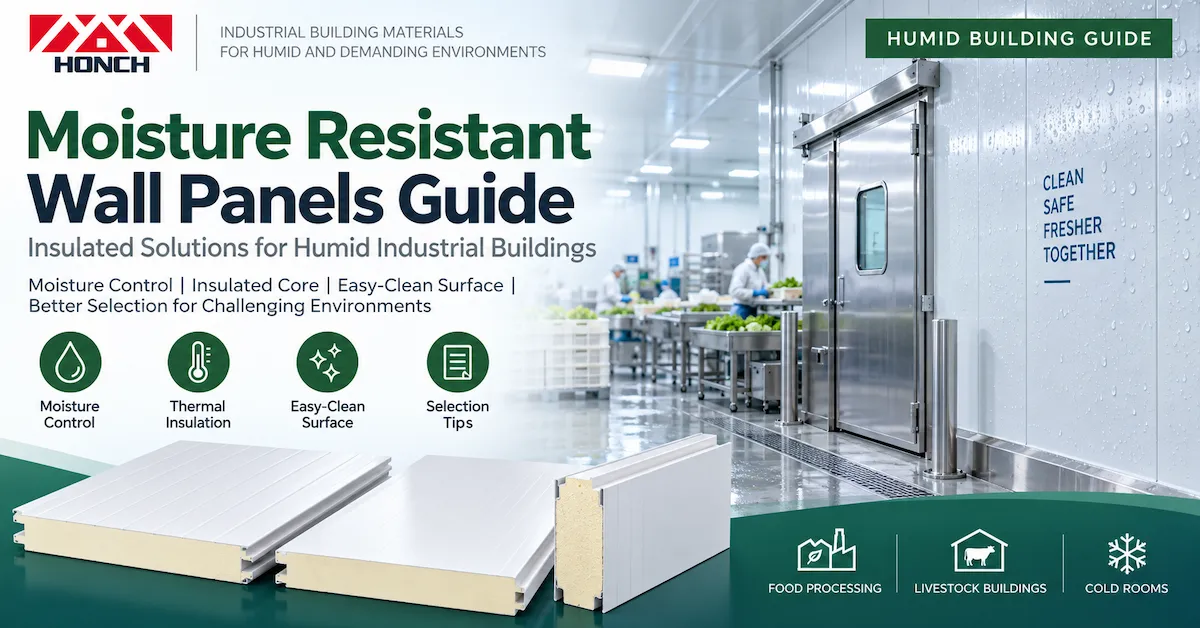
HONCH provides PVC + PU foam + PVC insulated wall panels for industrial, livestock, cold-room and light-construction applications where moisture resistance and thermal insulation may both be required. Buyers who need both a moisture-resistant surface and an insulated core can review the product structure and customization options before preparing a project specification.
What Are Moisture Resistant Wall Panels?
Moisture resistant wall panels are panels designed for environments where walls may be exposed to persistent humidity, occasional water contact, condensation or cleaning.
Different panel constructions provide different functions.
Some products mainly act as a moisture-resistant wall lining, while composite panels can combine moisture protection with thermal insulation.
Typical functions may include:
- Moisture-resistant surface protection
- Corrosion resistance
- Thermal insulation
- Interior wall enclosure
- Partitioning
- Easy maintenance
- Protection against humid agricultural environments
- Faster installation than multi-layer traditional walls
The Panel Structure Matters
A product should not be selected simply because its catalog describes it as “moisture proof.”
The complete panel construction should be evaluated.
HONCH's insulated wall panel uses:
PVC outer layer + PU foam core + PVC inner layer
Each component performs a different function.
| Component | Primary Function |
|---|---|
| PVC surface | Moisture- and corrosion-resistant exposed surface |
| PU foam core | Thermal insulation |
| Inner PVC surface | Completes the protected composite structure |
| Panel joint | Connects adjacent panels |
| Edge/corner components | Manage transitions and exposed edges |
| Supporting structure | Supports the installed wall assembly |
This is particularly important when comparing single-layer PVC panels with insulated wall panels.
A single-skin panel may be enough for a humid partition where temperature control is not important.
A refrigerated room or climate-controlled livestock facility may require insulation as well as moisture resistance.
Moisture Resistant Does Not Mean the Same as Waterproof
One of the most common mistakes in wall-panel procurement is treating several different terms as though they mean the same thing.
These include:
- Moisture resistant
- Water resistant
- Waterproof
- Washdown resistant
- Condensation resistant
They are related, but they describe different performance conditions.
A panel surface may tolerate humidity and water contact while the installed wall can still allow moisture movement around joints or openings.
Typical Moisture Entry Points
Problems frequently develop around:
- Panel-to-panel joints
- Internal corners
- External corners
- Wall-to-floor transitions
- Wall-to-ceiling transitions
- Doors
- Windows
- Pipes
- Electrical cables
- Ventilation openings
- Equipment penetrations
- Site-cut edges
This means the flat center section of the panel is only part of the moisture-control system.
For industrial projects, panel detailing is often just as important as panel material. If your project involves several transitions, openings or insulated interfaces, HONCH's guide to building envelope wall systems for harsh environments provides a useful next step for evaluating the wall as part of the complete enclosure.
What Causes Moisture Problems in Industrial Wall Systems?
Understanding the source of moisture is essential before choosing a panel.
High Relative Humidity
Some buildings remain humid for long periods even without direct water exposure.
Typical examples include:
- Poultry houses
- Pig farms
- Cattle buildings
- Food processing rooms
- Agricultural storage areas
- Enclosed production spaces
Persistent humidity can affect unsuitable wall finishes, fasteners, coatings and adjacent building materials. For projects that extend beyond livestock housing into storage, workshops or general farm facilities, the HONCH guide to wall panels for agricultural buildings provides additional application guidance.
Frequent Cleaning and Washdown
Some buildings need regular cleaning with water.
The most exposed areas are often:
- Lower wall sections
- Corners
- Equipment zones
- Panel joints
- Floor transitions
A moisture-resistant surface can reduce maintenance problems, but the installation must also allow water to drain instead of remaining trapped behind or between components.
Condensation
Condensation is a different problem.
It occurs when humid air reaches a sufficiently cold surface.
This is common where there is a significant temperature difference between two sides of the wall.
Typical examples include:
- Cold rooms
- Refrigerated warehouses
- Food processing plants
- Controlled-environment livestock buildings
- Air-conditioned industrial rooms
A moisture-resistant surface may tolerate condensation better, but condensation itself must be controlled through insulation, joint continuity, ventilation and building-envelope design.
Corrosive Moisture
Moisture becomes more aggressive when mixed with chemical contaminants.
These may include:
- Ammonia
- Hydrogen sulfide
- Salt
- Industrial vapor
- Cleaning chemicals
- Acidic substances
- Alkaline substances
In these cases, buyers should look for both moisture resistance and corrosion resistance.
Where Are Moisture Resistant Wall Panels Commonly Used?
Livestock Buildings
Livestock facilities can create some of the most demanding interior conditions for wall materials.
Typical environments include:
- High humidity
- Ammonia
- H₂S
- Frequent washing
- Disinfection
- Temperature changes
- Condensation
Pig farms and poultry houses, in particular, require wall systems that are easier to maintain and capable of operating in aggressive agricultural environments.
What Livestock Buyers Should Consider
Important requirements may include:
- Moisture resistance
- Corrosion resistance
- Easy cleaning
- Thermal insulation
- Joint integrity
- Long-term maintenance
If environmental control is used inside the building, thermal insulation can become an important part of wall selection.
HONCH's PVC + PU + PVC wall panels can be considered where buyers require both an insulated construction and PVC protective surfaces. For livestock projects where ammonia, washdown and temperature control are major concerns, see the HONCH wall panel guide for pig farms for more application-specific selection points.
Food Processing Facilities
Food processing buildings often combine several difficult conditions:
- High humidity
- Regular cleaning
- Temperature control
- Condensation
- Chemical detergents
- Frequent maintenance
Typical applications may include meat, seafood, dairy, beverage and agricultural food processing.
Important Wall Selection Factors
Buyers should consider:
- Surface material
- Ease of cleaning
- Panel joints
- Wall-to-floor transition
- Moisture penetration
- Thermal insulation
- Condensation
- Cleaning chemicals
- Maintenance access
A smooth moisture-resistant surface may be useful, but buyers should not automatically describe a product as “food grade” unless the relevant certification or documentation applies to that exact product. Buyers planning processing rooms can continue with HONCH's food processing wall panel selection guide, which focuses on moisture, cleaning, insulation and supplier evaluation for this application.
Cold Storage and Refrigerated Rooms
Cold storage requires a more technical approach.
The wall does not simply need to resist humidity. It must also form part of an insulated enclosure.
Important factors include:
- Internal operating temperature
- External temperature
- Humidity
- Panel insulation
- Joint structure
- Air leakage
- Door openings
- Refrigeration penetrations
- Floor connections
- Ceiling connections
- Thermal bridges
Why Panel Thickness Alone Is Not Enough
Buyers sometimes compare cold-room wall systems according to thickness alone.
This can be misleading.
Installed thermal performance also depends on:
- Core material
- Panel construction
- Joint quality
- Installation
- Thermal bridges
- Penetrations
- Air leakage
A thicker panel cannot compensate for poor connections between panels or around openings. For refrigerated projects, HONCH's cold storage insulated panels guide explains why joints, corners, doors, penetrations and thermal continuity should be reviewed together rather than selecting panels by thickness alone.
Industrial Workshops
Industrial buildings vary significantly.
A dry manufacturing workshop may only require basic wall enclosure.
A chemical or humid workshop may need additional protection against:
- Moisture
- Industrial gases
- Chemical vapor
- Cleaning
- Corrosive contaminants
For this reason, industrial buyers should define the actual operating environment before choosing the panel.
Warehouses and Logistics Buildings
Warehouse wall requirements also depend on how the building is used.
A standard dry warehouse may prioritize:
- Installation efficiency
- Weather protection
- Durability
- Maintenance
- Cost
A temperature-controlled warehouse may require:
- Insulation
- Better joint continuity
- Condensation control
- Air leakage management
Not every warehouse needs an insulated wall panel, and not every moisture-resistant panel is suitable for temperature-controlled storage.
Moisture Resistant Wall Panels vs Insulated Wall Panels
These products can overlap, but their main functions are different.
| Requirement | Moisture-Resistant Single Panel | Insulated Composite Wall Panel |
|---|---|---|
| Moisture resistance | Primary function | Can be included |
| Thermal insulation | Limited | Core function |
| Interior partition | Suitable | Suitable |
| Humid room | Often suitable | Suitable |
| Cold room | Usually insufficient alone | More appropriate |
| Climate-controlled building | Limited | Better suited |
| Livestock application | Suitable in some projects | Useful where insulation is required |
| Initial material cost | Usually lower | Usually higher |
| Functions combined | Fewer | More |
The decision should therefore be based on the building requirements rather than simply choosing the panel with the most features. Buyers comparing different panel types or suppliers can use HONCH's industrial wall panel supplier guide to structure the comparison around application, construction, insulation, documentation and project scope.
How to Choose Moisture Resistant Wall Panels
Define the Real Moisture Condition
Before requesting a quotation, tell the supplier what the wall will actually experience.
For example:
- High humidity only
- Occasional water splash
- Frequent washdown
- High-pressure cleaning
- Condensation
- Refrigerated conditions
- Chemical cleaning
- Ammonia
- H₂S
- Coastal salt air
A product suitable for humid indoor air may not automatically be appropriate for aggressive chemical washdown.
Confirm the Panel Construction
Ask the supplier to identify:
- Outer surface material
- Inner surface material
- Insulation core
- Panel thickness
- Panel width
- Length
- Joint profile
- Surface finish
- Color options
This allows buyers to compare products on the same basis. You can compare these RFQ items with the published HONCH PU Insulation Wall Panel structure and available project customization options before requesting a quotation.
Determine Whether Thermal Insulation Is Required
Ask whether the room:
- Is refrigerated
- Is heated
- Is air conditioned
- Has a controlled temperature
- Experiences major temperature differences
- Already has condensation problems
If the building requires temperature control, insulation becomes part of moisture management.
Check Panel Joints
Panel joints affect:
- Moisture penetration
- Air leakage
- Thermal continuity
- Condensation
- Installation quality
Important questions include:
- How do panels interlock?
- Is additional sealing required?
- How are the joints aligned?
- How are edges protected?
- How are corners finished?
For insulated buildings, this is especially important because a discontinuous joint can become a thermal bridge.
Review Wall-to-Floor Connections
The bottom of the wall often receives more water than higher sections.
In livestock and food-processing environments, this area may be repeatedly exposed to wash water.
Buyers should confirm how the panel meets:
- Concrete floors
- Raised curbs
- Drainage areas
- Waterproof bases
A good wall panel cannot solve poor floor-interface detailing by itself.
Review Wall-to-Ceiling Connections
The wall and ceiling should not be treated as independent systems in humid buildings.
Moist air can move through poorly detailed transitions.
This can be particularly important in:
- Cold rooms
- Food processing facilities
- Livestock houses
- Insulated workshops
Identify Doors and Service Penetrations
Doors, pipes, cables and ventilation ducts interrupt the wall.
Buyers should identify these openings before the material order whenever possible.
Typical penetrations include:
- Refrigeration pipes
- Electrical cables
- Water pipes
- Ventilation ducts
- Sensors
- Equipment connections
Late site cutting can make moisture control more difficult.
How PVC + PU + PVC Wall Panels Work
Composite panels combine different materials to perform different functions.
PVC Surface
PVC surfaces are relevant where the wall requires resistance to moisture and corrosive environments.
Potential benefits include:
- Low moisture absorption
- Cleanable surface
- Corrosion resistance
- Lower maintenance in humid environments
Compatibility with specific chemicals should still be confirmed before procurement.
PU Foam Core
The PU core provides thermal insulation.
This is relevant in:
- Cold storage
- Livestock buildings
- Temperature-controlled rooms
- Processing facilities
- Insulated warehouses
- Agricultural buildings
The required insulation level should be selected according to project conditions instead of assuming that all PU panels provide the same thermal performance.
Composite Wall Construction
Using one composite panel can combine:
- Wall enclosure
- Moisture-resistant surfaces
- Thermal insulation
This can simplify the wall assembly compared with installing separate wall lining and insulation systems.
Why Condensation Requires a Building-Envelope Approach
A wall panel may be moisture resistant and still experience condensation.
The reason is simple:
Condensation is caused by temperature and humidity conditions, not simply by wall material.
Factors That Influence Condensation
These include:
- Indoor humidity
- Outdoor humidity
- Internal temperature
- External temperature
- Insulation thickness
- Air leakage
- Thermal bridges
- Joints
- Doors
- Ventilation
- Floor interfaces
- Ceiling interfaces
In a cold room, for example, warm humid air leaking through a joint can reach a cold surface and form condensation.
This is why the wall, ceiling, floor, doors and penetrations must be evaluated together.
When Moisture Resistant Wall Panels May Not Be Enough
Permanent Water Immersion
Panels designed for humidity or cleaning should not automatically be assumed suitable for permanent water immersion.
Existing Structural Leakage
If water is entering through the roof, windows, foundations or structural joints, changing the interior wall panel will not solve the root problem.
Strong Chemical Exposure
The phrase “corrosion resistant” does not mean resistance to every industrial chemical.
Buyers should provide:
- Chemical name
- Concentration
- Temperature
- Exposure duration
- Cleaning frequency
Specific Fire Requirements
Projects with fire-performance requirements should request documentation for the exact panel configuration being purchased.
Certification from another product should not automatically be applied to the wall panel.
Structural Requirements
Wall enclosure panels should not automatically be treated as structural load-bearing components.
Structural requirements should be confirmed by the project engineer.
How to Compare Moisture Resistant Wall Panel Suppliers
For B2B buyers, price per square meter is only one part of supplier evaluation.
Compare the Actual Product Specification
A quotation should clearly identify:
- Material
- Panel structure
- Thickness
- Dimensions
- Joint
- Color
- Surface
- Quantity
Without these details, two quotations may represent completely different wall systems.
Check Whether the Supplier Understands the Application
The supplier should ask questions about:
- Building type
- Temperature
- Humidity
- Chemical exposure
- Cleaning
- Installation location
- Insulation requirement
A supplier cannot make a reliable recommendation without understanding the environment. Buyers who also need to verify manufacturer background, certification positioning and company capabilities can review HONCH About Us before moving to technical and commercial comparison.
Evaluate Customization
Project buyers may require:
- Custom thickness
- Custom length
- Custom color
- Project packaging
- OEM/ODM
- Branding
- Long-term supply
HONCH supports customization of its insulated wall panels, including thickness, color and length.
Check Technical Documentation
Technical documents should correspond to the product being quoted.
Buyers should avoid making decisions based solely on a general company catalog.
Review Packaging and Delivery
For large projects, packaging affects site efficiency.
Panels may be organized according to:
- Building
- Room
- Wall zone
- Elevation
- Construction phase
This can reduce unnecessary movement and material confusion on site. For projects sourcing more than wall panels, HONCH's roof and wall panel supplier guide explains how coordinated roof, wall, ceiling and accessory supply can reduce specification and interface risks.
What Determines the Real Cost of Moisture Resistant Wall Panels?
The cheapest panel price does not always produce the lowest project cost.
A more useful calculation includes:
- Panel cost
- Insulation
- Accessories
- Trims
- Sealants
- Fasteners
- Freight
- Packaging
- Installation
- Cutting waste
- Maintenance
- Replacement
- Energy consumption
Example: Humid Partition
A basic moisture-resistant panel may be sufficient when:
- Temperature control is unnecessary
- Chemical exposure is limited
- The wall is only an internal partition
Using a high-performance insulated panel could add unnecessary cost.
Example: Cold Room
A simple moisture-resistant surface may appear cheaper initially.
However, if insulation must be added separately, the complete installed system may become more expensive and complicated.
Therefore buyers should compare:
Complete installed wall system cost
rather than:
Panel price alone
Moisture Resistant Wall Panel RFQ Checklist
A detailed RFQ helps suppliers recommend the correct configuration.
| RFQ Information | What to Provide |
|---|---|
| Project location | Country and region |
| Building type | Livestock, factory, food plant, cold room, warehouse |
| Application | Interior wall, partition or exterior wall |
| Wall dimensions | Length, height and area |
| Humidity | Normal, high or continuous |
| Water exposure | Splash, washdown or cleaning |
| Chemical exposure | Ammonia, H₂S, disinfectants or industrial chemicals |
| Indoor temperature | Operating range |
| Outdoor temperature | Climate conditions |
| Insulation | Required or not |
| Thickness | Engineering requirement if available |
| Color | Standard or customized |
| Openings | Doors and windows |
| Penetrations | Pipes, cables and ducts |
| Quantity | Square meters or panels |
| Documentation | Project-specific requirements |
| Delivery | Port or destination |
| Schedule | Required delivery timing |
Providing this information early reduces the risk of receiving quotations that cannot be compared directly.
Frequently Asked Questions About Moisture Resistant Wall Panels
What are moisture resistant wall panels?
They are wall panels designed for environments where humidity, condensation or water exposure may affect conventional wall materials.
Depending on the construction, they can also provide corrosion resistance and thermal insulation.
Are moisture resistant wall panels waterproof?
Not necessarily.
The panel face may resist moisture while water can still enter through joints, corners and penetrations.
The entire wall assembly must be considered.
Are PVC wall panels good for humid environments?
PVC surfaces can be useful where moisture and corrosion resistance are important.
Their suitability should still be checked against temperature, chemicals, UV exposure and cleaning conditions.
What is the difference between moisture resistant and insulated wall panels?
A moisture-resistant wall panel primarily addresses water or humidity exposure.
An insulated panel primarily reduces heat transfer.
A PVC + PU + PVC composite panel can provide both functions.
Are insulated wall panels suitable for cold storage?
They can be suitable because cold storage requires thermal insulation.
However, joints, doors, penetrations and thermal bridges must also be properly controlled.
Can moisture resistant wall panels prevent condensation?
They can tolerate moisture, but they do not eliminate the physical causes of condensation.
Temperature, humidity, insulation, air leakage and thermal bridges must also be addressed.
Which wall panels are suitable for livestock buildings?
The correct product depends on humidity, ammonia, H₂S, cleaning conditions and insulation requirements.
PVC-faced insulated panels may be suitable where both environmental resistance and thermal insulation are needed.
Can moisture resistant wall panels be used in food processing?
They can be considered for humid food-processing environments, but buyers should verify cleaning requirements, chemical compatibility and any required regulatory documentation.
Can wall panels be customized?
HONCH provides customization options for its PU insulation wall panel, including thickness, color and length.
What information should I provide when requesting a quotation?
Provide project drawings, dimensions, application, humidity, operating temperature, chemical exposure, insulation requirements, quantity, destination and delivery schedule. Once these details are ready, buyers can contact HONCH about a wall panel project so the quotation can be based on the actual operating environment rather than a generic panel request.
Conclusion
Choosing moisture resistant wall panels requires more than comparing surface materials. Buyers should evaluate humidity, condensation, insulation, joints, chemical exposure, cleaning conditions and the complete installation environment.
For projects requiring both moisture resistance and thermal insulation, PVC + PU + PVC composite panels can provide an integrated wall solution. The best results come from defining the project conditions clearly before selecting panel specifications or comparing quotations. Buyers can also review HONCH's wall, ceiling, roofing and building-envelope product range when the project requires coordinated materials beyond the wall system.