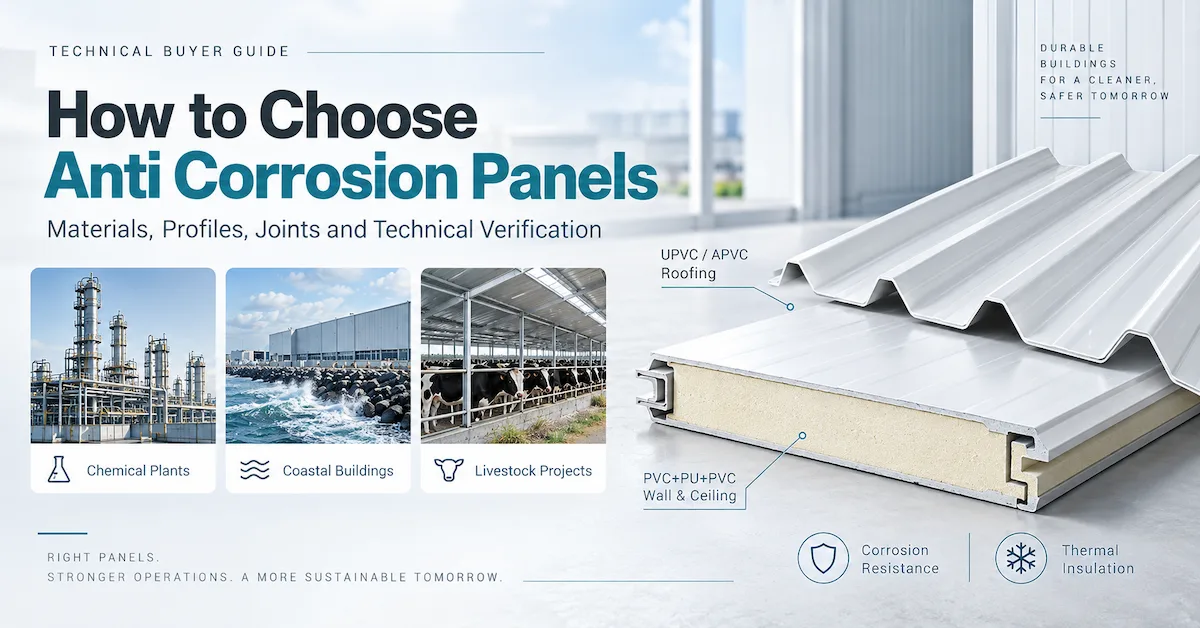
Anti Corrosion Panel Selection Matrix
The most suitable anti corrosion panel is determined by five connected factors:
Corrosive medium → building position → material system → joint design → verification evidence
A chemical-plant roof, livestock-house ceiling, coastal warehouse wall and cold-room partition may all require corrosion resistance, but they should not automatically use the same panel.
The table below provides a practical starting point.
| Project Environment | Recommended Product Direction | Main Material Function | Technical Items to Verify |
|---|---|---|---|
| Chemical-plant external roof | T920, T930 or T1130 UPVC/APVC roofing profile | Non-metallic weather-facing roofing surface | Chemical identity, concentration, support spacing, fasteners, profile and UV exposure |
| Coastal factory roof | T930 or a suitable T920/T1130 profile | Corrosion resistance, weathering and rain protection | ASA or UV protection, wind, salt exposure, ridge details and fasteners |
| Poultry or pig-house external roof | UPVC/APVC roofing system | Weather protection in humid agricultural environments | Roof slope, ventilation, drainage, support and accessories |
| Livestock internal ceiling without defined insulation target | T910 PVC Single Ceiling Panel | Moisture- and corrosion-resistant internal ceiling surface | Ammonia, cleaning method, support arrangement and penetrations |
| Livestock internal ceiling requiring insulation | PVC+PU+PVC ceiling panel | Protective PVC faces plus rigid PU insulation | Core thickness, thermal data, joints, perimeter details and ventilation openings |
| Industrial or livestock wall requiring insulation | PVC+PU+PVC wall panel | Moisture-resistant faces plus thermal enclosure | Wall position, openings, joint profile, cleaning and fixing |
| Cold room or temperature-controlled space | PVC+PU+PVC wall and ceiling system | Thermal continuity and moisture-resistant surfaces | U-value, air leakage, doors, thermal bridges, joints and penetrations |
| Food-processing room | PVC-faced composite wall or ceiling panels | Cleanable surface, moisture resistance and insulation where required | Cleaning chemicals, washdown pressure, floor junctions and hygiene documentation |
| Severe solvent, oxidizer, immersion or high-temperature exposure | Project-specific material review | Depends on exact process conditions | Laboratory compatibility evidence, engineering approval and possible alternative materials |
This guide concentrates on technical selection and specification. Buyers who have already selected a product family and need to compare manufacturing, documentation and commercial supply scope can also use HONCH’s industrial anti corrosion panels supplier guide. HONCH currently maintains separate product families for roofing, insulated walls, insulated ceilings and single-layer PVC ceilings, which supports a position-specific rather than one-product-for-all approach.
Technical Definition of an Anti Corrosion Panel
An anti corrosion panel is a roof, wall or ceiling component whose material construction is selected to maintain its required function under defined exposure to moisture, chemicals, salt, industrial gases, livestock gases, washdown or outdoor weathering.
The term describes the required performance direction. It does not, by itself, define:
- The panel material
- The number of material layers
- The installation position
- The chemical concentration
- The permitted temperature
- The structural span
- The joint design
- The insulation value
- The expected maintenance procedure
- The applicable test method
A professional specification must convert “anti corrosion” into measurable product and project requirements.
Corrosion and Polymer Degradation Are Different Processes
Metal corrosion commonly involves chemical or electrochemical deterioration of a metal substrate. Iron-based materials can oxidize when moisture and reactive substances are present.
UPVC, APVC and PVC-based panels do not contain an iron substrate that rusts in the same way. However, polymer-based products can still lose performance through:
- Chemical incompatibility
- UV aging
- Thermal deformation
- Embrittlement
- Impact damage
- Surface discoloration
- Excessive stress
- Incompatible sealants or cleaners
- Poorly designed fasteners and joints
The correct technical question is therefore broader than:
Will the material rust?
The complete question is:
Will the panel, joint, fastener, accessory and support system retain the required weatherproofing, geometry, surface condition and mechanical function under the actual project exposure?
Performance Terms That Should Not Be Confused
| Term | What It Describes | What It Does Not Automatically Establish |
|---|---|---|
| Anti corrosion | Intended resistance to a defined corrosive environment | Compatibility with every acid, alkali, solvent or gas |
| Chemical resistant | Resistance under specified reagent and test conditions | Unlimited resistance at all concentrations and temperatures |
| Moisture resistant | Suitability for defined humidity or water exposure | A fully watertight installed building |
| Waterproof | Control of liquid-water entry through a defined assembly | Condensation prevention |
| Weather resistant | Resistance to outdoor UV, rain and temperature cycling | Structural suitability for every climate |
| Insulated | Inclusion of a thermal-resistance layer | Chemical compatibility or fire classification |
| UV resistant | Formulation or surface intended for outdoor exposure | A guaranteed number of service years |
| Fire resistant | Documented performance under a defined fire test | Universal compliance with all fire regulations |
This terminology should remain consistent in product pages, quotations, technical files and purchase orders.
Build an Exposure Specification Before Selecting a Material
A product recommendation is only as reliable as the exposure information provided to the manufacturer.
Identify the Corrosive Medium
The specification should name the actual medium wherever possible.
Examples include:
- Ammonia
- Hydrogen sulfide
- Salt-laden air
- Acidic vapor
- Alkaline mist
- Process exhaust
- Disinfectant
- Detergent
- Fertilizer-related vapor
- Paper-mill emissions
- Metal-processing fumes
Descriptions such as “chemical environment” or “high corrosion” are too broad for technical confirmation.
Define the Exposure Route
The same chemical may affect a panel differently depending on whether contact occurs as:
- Low-concentration airborne vapor
- Concentrated vapor
- Mist
- Splash
- Surface deposit
- Cleaning residue
- Condensation
- Direct liquid contact
- Continuous immersion
A roof above an exhaust outlet, for example, may experience a different concentration and contact pattern from a wall at the opposite end of the same building.
Record Concentration, Temperature and Duration
Chemical compatibility can change with concentration and temperature.
The buyer should provide:
| Exposure Variable | Required Information |
|---|---|
| Chemical or contaminant | Exact name or process source |
| Concentration | Measured value, working range or “to be confirmed” |
| Contact form | Vapor, mist, splash, condensate or liquid |
| Temperature | Minimum, normal and maximum |
| Duration | Occasional, daily, seasonal or continuous |
| Humidity | Normal and maximum relative humidity |
| Cleaning | Chemical, concentration, pressure and frequency |
| UV exposure | Interior, shaded exterior or full outdoor exposure |
| Mechanical exposure | Wind, impact, maintenance traffic or animal contact |
Where reliable data are unavailable, the open item should remain visible in the technical review. It should not be replaced with an unsupported assumption simply to obtain a quick quotation.
Use ISO 12944-2 Within Its Correct Scope
ISO 12944-2 classifies the principal environments to which steel structures are exposed and defines atmospheric-corrosivity categories using the mass or thickness loss of standard specimens. It is useful when assessing steel purlins, frames, fasteners or protective paint systems around the panel installation.
It is not a direct performance classification for a PVC, UPVC or APVC panel. A supplier should therefore not describe a polymer panel as “C5 certified” merely because the project environment has been classified using ISO 12944-2. ISO
The correct use is:
- Classify the building atmosphere.
- Identify all metal and non-metal components.
- Specify suitable protection for each component.
- Verify panel compatibility separately.
- Coordinate the complete assembly.
Separate Roof, Wall, Ceiling and Transition Requirements
A single building often requires several panel systems.
External Roofing
An external roof must manage more than chemical exposure.
Its specification should address:
- Rainwater drainage
- Roof slope
- Wind pressure and suction
- UV radiation
- Thermal movement
- Profile rigidity
- Support spacing
- Panel overlap
- Ridge and eave details
- Fastener sealing
- Process exhaust leaving the building
UPVC/APVC roofing sheets are designed around these roof-specific functions.
An insulated internal wall panel should not be substituted as an external roof solely because it has a corrosion-resistant PVC surface.
External Walls
External walls may require:
- Rain resistance
- UV stability
- Wind resistance
- Impact resistance
- Thermal insulation
- Door and window interfaces
- Ground-splash protection
- Wall-to-roof transitions
The choice between a single-skin wall construction and a PVC-faced insulated panel depends on the thermal and enclosure requirements.
Internal Walls
Internal walls may face:
- Humidity
- Cleaning chemicals
- Process vapor
- Ammonia
- Equipment impact
- Condensation
- Temperature differences
- Frequent washdown
A PVC+PU+PVC wall panel may be suitable where the project needs both a protective interior surface and integrated insulation.
HONCH’s current PU Insulation Wall Panel uses a PVC outer layer, PU foam core and PVC inner layer. Its published applications include livestock walls, industrial wall cladding, cold rooms and partition walls, with thickness, color and length customization available.
Internal Ceilings
The internal ceiling and external roof perform different functions.
A livestock or industrial ceiling may face:
- Warm humid air
- Ammonia
- Hydrogen sulfide
- Cleaning vapor
- Condensation
- Ventilation openings
- Lighting penetrations
- Restricted inspection access
Where insulation is required, HONCH’s PU Insulation Ceiling Panel combines PVC faces with a rigid PU core and a tongue-and-groove connection.
Where the primary requirement is a single PVC internal ceiling surface, the T910 PVC Single Ceiling Panel represents a different construction. It should not be assumed to provide the same thermal performance as a PU-core composite panel.
Ridges, Corners and Penetrations
The weakest part of an anti-corrosion panel installation is often not the center of the panel.
High-risk areas include:
- Ridge joints
- Ridge ends
- Side laps
- End laps
- Eaves
- Internal corners
- External corners
- Wall-to-roof transitions
- Pipe penetrations
- Ventilation openings
- Site-cut edges
HONCH supplies profile-related accessories including a Hip Ridge Cap, End of Ridge Cap and Inside Corner Deflector.
These should be selected with the panel profile and project geometry, not added later as generic finishing pieces.
Core Material Systems and Their Technical Advantages
UPVC Roofing Material
UPVC is a rigid, unplasticized PVC-based material used in products where dimensional stability, moisture resistance and corrosion resistance are required.
In roofing applications, a profiled UPVC system can offer:
- No iron substrate to oxidize
- Resistance to humid and selected corrosive environments
- Lower weight than many traditional roof systems
- Customizable panel length
- Profiled rainwater drainage
- Reduced dependence on a thin painted protective coating
- Compatibility with polymer roof accessories
- Multiple thickness options
These advantages do not eliminate the need for load verification, chemical compatibility review, suitable supports or correct installation.
APVC Composite Roofing Material
The term APVC may refer to a modified or multilayer PVC-based formulation, but its exact composition can vary between manufacturers.
The buyer should request the construction of the offered panel rather than relying on the letters alone.
Useful information includes:
- Number of layers
- Material used in each layer
- Surface weathering layer
- Base formulation
- Total thickness
- Profile geometry
- UV-protection method
- Applicable test reports
The specification should identify the actual product model, not simply “APVC roofing sheet.”
ASA Weathering Surface
ASA is used as an exterior weathering layer in selected polymer roofing products.
Its function is to support:
- UV resistance
- Color retention
- Weather resistance
- Outdoor surface durability
HONCH specifically identifies a UV-resistant ASA surface layer on the T930 UPVC/APVC Roofing Sheet. This is a product-specific feature and should not be automatically attributed to every UPVC/APVC profile.
PVC Surface Layers
PVC surfaces are used on HONCH’s composite wall and ceiling products as the exposed interior faces.
For suitable projects, the PVC faces can provide:
- Moisture-resistant surfaces
- Corrosion resistance
- Smooth, cleanable finishes
- Protection of the insulation core
- Suitability for humid agricultural or industrial environments
- Reduced dependence on exposed steel faces
The cleaning chemical, concentration, temperature and contact time should still be checked for the specific application.
Rigid PU Foam Core
The rigid PU core provides the main thermal-insulation function in PVC+PU+PVC panels.
Its technical value is different from that of the PVC surfaces.
The composite structure can combine:
- Interior enclosure
- Protective PVC faces
- Thermal insulation
- Lightweight construction
- Interlocking installation
- Fewer separately installed wall layers
- Customized panel dimensions
A project requiring a specific thermal target should request the declared thermal conductivity or U-value for the exact panel thickness.
The presence of a PU core is not, by itself, a numerical thermal specification.
Product-Level Selection: T920, T930 and T1130
The HONCH roofing profiles should be selected according to roof geometry, effective coverage, profile requirements, environmental exposure and structural design.
They should not be presented as a simple good-better-best hierarchy.
| Model | Published Product Direction | Published Dimensions | Main Selection Value |
|---|---|---|---|
| T920 | UPVC/APVC anti-corrosion roofing profile | 920 mm full width, 840 mm effective width, 26 mm wave height, 1.5–3.0 mm thickness | Defined profile geometry, overlap and multiple thickness options |
| T930 | UPVC/APVC roofing with ASA weathering surface | Color, thickness and length customizable; exact width should be requested | UV/weathering layer, rigidity and project customization |
| T1130 | Wide-coverage UPVC/APVC roofing profile | 1130 mm full width, 1050 mm effective width, 1.5–3.0 mm thickness | Wider usable coverage and installation productivity |
| PU wall panel | PVC + PU foam + PVC | Thickness, color and length customizable | Insulated internal or partition wall |
| PU ceiling panel | PVC + rigid PU + PVC | Project-specific options available | Insulated internal ceiling |
| T910 ceiling panel | Single PVC ceiling construction | Product configuration to be confirmed for order | Lightweight corrosion-resistant ceiling surface |
T920: Defined 920/840 Roofing Profile
The T920 UPVC/APVC Roofing Sheet has the following published data:
- Full width: 920 mm
- Effective coverage: 840 mm
- Wave height: 26 mm
- Thickness options: 1.5, 2.0, 2.5 and 3.0 mm
- Customizable length
Its effective-width utilization is approximately:
840 ÷ 920 × 100 = 91.3%
The product page positions T920 for factories, livestock farms, warehouses, chemical plants and light construction. The profile is especially relevant where buyers need defined overlap geometry and multiple thickness options.
T920 Selection Conditions
T920 should be evaluated when:
- The 920/840 profile fits the roof module
- The 26 mm wave geometry suits drainage requirements
- Custom length can reduce unnecessary cutting
- The support system has been checked
- The fixing and overlap method are defined
- The exposure is compatible with the proposed material construction
Thickness should be selected against load and support conditions, not by roof area alone.
T930: ASA Weathering and Rigidity
The T930 UPVC/APVC Roofing Sheet is positioned around:
- UPVC/APVC corrosion resistance
- ASA exterior weathering protection
- Waterproofing
- Thermal-insulation characteristics
- Profile rigidity
- Impact resistance
- Color, thickness and length customization
T930 is relevant where UV exposure, external weathering and rigidity are central selection criteria.
The current product page does not publish the same complete full-width and effective-width data shown for T920 and T1130. The buyer should therefore request:
- Profile drawing
- Full width
- Effective width
- Rib height
- Thickness
- Section geometry
- Recommended support spacing
- Fixing arrangement
This prevents quantity or structural comparisons from being based on an undefined profile. HONCH
T1130: Wide Effective Coverage
The T1130 UPVC/APVC Roofing Sheet has the following published data:
- Full width: 1130 mm
- Effective width: 1050 mm
- Thickness options: 1.5, 2.0, 2.5 and 3.0 mm
- Custom length and color options
Its effective-width utilization is approximately:
1050 ÷ 1130 × 100 = 92.9%
The product is positioned for chemical plants, non-ferrous metal facilities, smelting and paper mills, farms and other demanding environments.
Illustrative Quantity Comparison
For a simplified roof width of 100 metres, assuming one continuous sheet run down the slope:
T920
100,000 mm ÷ 840 mm = 119.05
Rounded up = 120 sheet runs
T1130
100,000 mm ÷ 1050 mm = 95.24
Rounded up = 96 sheet runs
Under this simplified geometry, T1130 uses 24 fewer sheet runs, equivalent to 20% fewer runs than T920.
This is not proof that T1130 is automatically the lower-cost or technically superior option.
The final decision must also consider:
- Profile strength
- Support spacing
- Wind
- Panel handling
- Transport limits
- Roof penetrations
- Installation method
- Accessory quantity
- Project-specific pricing
Engineering Checks That Must Accompany Material Selection
Effective Coverage and Panel Quantity
Roof quantity should be calculated from effective coverage, not manufactured full width.
A basic method is:
Sheet runs = roof width ÷ effective panel width
Always round upward to the next whole run.
Where the roof slope requires more than one sheet length, multiply the number of runs by the number of rows and include the specified end overlap.
A complete bill of materials should separately calculate:
- Main sheets
- Ridge caps
- Ridge-end caps
- Corners
- Closures
- Fasteners
- Washers
- Seals
- Penetration components
- Cutting allowance
Thermal Resistance
For an insulated panel core, thermal resistance is related to:
R = t ÷ λ
Where:
- R = thermal resistance
- t = insulation thickness
- λ = declared thermal conductivity
The complete panel U-value also depends on:
- Surface resistances
- PVC faces
- Core continuity
- Panel joints
- Thermal bridges
- Fasteners
- Openings
- Perimeter details
HONCH’s current PU wall and ceiling pages identify rigid PU as the insulation core, but they do not publish a complete table of λ-values and U-values for every offered thickness. Projects with defined energy or temperature requirements should request thermal data for the exact ordered construction.
Thermal Movement
Panel length changes with temperature.
The basic relationship is:
ΔL = α × L × ΔT
Where:
- ΔL = length change
- α = material coefficient of thermal expansion
- L = original panel length
- ΔT = temperature change
Long custom sheets can reduce end laps and cutting waste, but they can also produce more total thermal movement.
The fixing design should therefore consider:
- Panel material
- Sheet length
- Temperature range
- Predrilled-hole requirements
- Fastener position
- Required movement allowance
Structural Span and Support
Panel thickness is not a complete structural rating.
Allowable span also depends on:
- Material modulus
- Profile depth
- Rib shape
- Support spacing
- Wind pressure
- Wind suction
- Maintenance loads
- Temperature
- Fastener arrangement
- Panel length
The project engineer should verify the selected profile against local design requirements.
A thicker sheet should not be substituted for an engineering span check.
Fastener Compatibility
Fasteners can become the weak point of an otherwise corrosion-resistant system.
The specification should define:
- Fastener material
- Washer material
- Hole size
- Predrilling method
- Tightening control
- Fastener spacing
- Contact with dissimilar materials
- Compatibility with the supporting structure
Overtightening can deform a profile or restrict thermal movement. Insufficient tightening can allow movement and water entry.
Chemical Compatibility and Technical Test Evidence
A general acid- or alkali-resistant statement is not enough for a chemical project.
ASTM D543 provides practices for evaluating plastics exposed to chemical reagents. It emphasizes that reagent type, concentration, duration, temperature, applied stress and reported properties must be defined because these variables directly affect the test result. ASTM also states that laboratory results depend on how closely the test conditions represent the intended use. ASTM Store
Minimum Chemical Test Brief
| Test Variable | Requirement |
|---|---|
| Reagent | Exact chemical or process mixture |
| Concentration | Working concentration and maximum |
| Temperature | Service and test temperature |
| Exposure method | Immersion, wipe, splash, mist or vapor simulation |
| Duration | Defined number of hours or cycles |
| Stress condition | Unstressed or under representative strain |
| Specimen | Actual product layer or representative construction |
| Control | Unexposed reference specimen |
| Evaluation | Appearance, mass, dimensions and mechanical retention |
| Acceptance criteria | Project-defined maximum allowable change |
Properties That May Be Evaluated
Depending on the application, the test programme may examine:
- Visual change
- Color change
- Swelling
- Mass change
- Dimensional change
- Cracking
- Surface softening
- Hardness
- Impact retention
- Flexural strength
- Tensile strength
- Joint condition
The test should focus on properties relevant to the product’s real function.
For example, a visible wall may have strict appearance criteria, while an industrial roof may place greater importance on profile integrity and mechanical-property retention.
pH Alone Is Not Enough
Two chemicals with similar pH values can affect a polymer differently.
Compatibility also depends on:
- Chemical identity
- Solvent behavior
- Concentration
- Temperature
- Contact duration
- Mechanical stress
- Additives in the cleaning or process mixture
The buyer should provide the actual chemical information rather than only describing the environment as acidic or alkaline.
Conditions Requiring Project-Specific Review
Additional evidence should be requested where the project involves:
- Strong oxidizing chemicals
- Concentrated solvents
- Continuous immersion
- Elevated process temperature
- Unknown mixed chemicals
- High mechanical stress during exposure
- Mandatory regulatory acceptance
- A critical shutdown risk
HONCH’s chemical-plant insulated panel guide provides a related procurement framework for projects that combine chemical exposure with wall or ceiling insulation.
UV and Weathering Verification
External panels must resist a combination of UV light, heat and moisture.
ASTM G154 provides procedures for operating fluorescent UV and water apparatus used to expose non-metallic materials under controlled conditions. The practice defines exposure equipment and conditions, but it does not independently identify the best cycle for every material or convert test hours into a guaranteed number of outdoor years. ASTM International
A Useful Weathering Report Should Include
- Standard and edition
- Lamp type
- Exposure cycle
- Irradiance, where controlled
- Temperature
- Condensation or water-spray stage
- Total exposure duration
- Specimen construction
- Color change
- Gloss change
- Surface cracking
- Mechanical-property retention
- Acceptance criteria
A statement such as “passed UV testing” is incomplete unless the test conditions and measured result are provided.
T930 has a published ASA weathering surface, making weathering verification especially relevant to its product positioning. For T920 and T1130, buyers should request product-specific surface and weathering information instead of assuming the same layer construction across all models. HONCH
Complete Technical Solutions by Application
Chemical Plants and Process Workshops
A complete chemical-plant panel strategy should separate external and internal conditions.
External Roof Solution
Evaluate T920, T930 or T1130 according to:
- Chemical atmosphere
- UV exposure
- Roof slope
- Effective coverage
- Wind
- Support spacing
- Required panel length
- Fastener compatibility
T930 may be relevant where an ASA exterior layer and rigidity are priorities.
T920 may be relevant where the 920/840 profile and 26 mm wave suit the roof geometry.
T1130 may be relevant where wider effective coverage improves installation productivity.
Internal Wall Solution
Where insulation is required, use a defined PVC+PU+PVC wall construction.
The specification should include:
- PVC face construction
- PU core thickness
- Overall thickness
- Joint profile
- Cleaning chemicals
- Openings
- Floor connection
- Wall-to-ceiling transition
Internal Ceiling Solution
Use the PVC+PU+PVC ceiling panel where insulation and protective surfaces are both required.
Use T910 only where its single-PVC ceiling construction matches the required function.
Operational Controls
Panel selection should be combined with:
- Source extraction
- Ventilation
- Drainage
- Chemical-compatible seals
- Inspection access
- Defined cleaning procedures
A corrosion-resistant panel should support process control rather than replace it.
Livestock and Poultry Buildings
Livestock buildings commonly require a coordinated roof, ceiling and wall package.
External Roof
A UPVC/APVC roof can provide weather protection without an exposed iron substrate.
The specification should include:
- Roof profile
- Slope
- Effective coverage
- Fasteners
- Ridge details
- Ventilation outlets
- Drainage
Internal Ceiling
Choose between:
- T910 for a single PVC ceiling surface
- PVC+PU+PVC ceiling panel where insulation is required
The decision should be based on the temperature-control target and documented panel performance, not on the shared use of PVC.
Internal Walls
PVC+PU+PVC wall panels may be used where the project needs:
- Moisture-resistant surfaces
- Easier cleaning
- Corrosion resistance
- Insulation
- Internal partitions
Livestock-Specific Details
The design should also address:
- Ammonia
- Hydrogen sulfide
- Disinfectants
- Washdown water
- Lower-wall impact
- Ventilation
- Condensation
- Ceiling penetrations
HONCH’s poultry-house insulated panel guide provides additional ceiling, wall and cleaning-specification checks for this application.
Coastal Factories and Warehouses
Coastal environments combine:
- Salt-laden air
- High humidity
- UV exposure
- Strong wind
- Wind-driven rain
- Frequent wetting and drying
Coastal Roof Solution
The system should include:
- Weather-resistant UPVC/APVC roofing
- Profile-matched ridge components
- Suitable fasteners and washers
- Sealed ridge ends
- Controlled eave and corner details
- Wind-load verification
- UV-performance information
T930 may be considered where the ASA weathering layer is relevant.
T920 or T1130 may be selected where their profile and coverage suit the structural and installation design.
Maintenance Plan
Salt can accumulate in sheltered areas that do not receive direct rain.
The maintenance plan should include:
- Ridge ends
- Laps
- Fastener areas
- Under-eave zones
- Wall transitions
- Drainage points
Food Processing and Cold Rooms
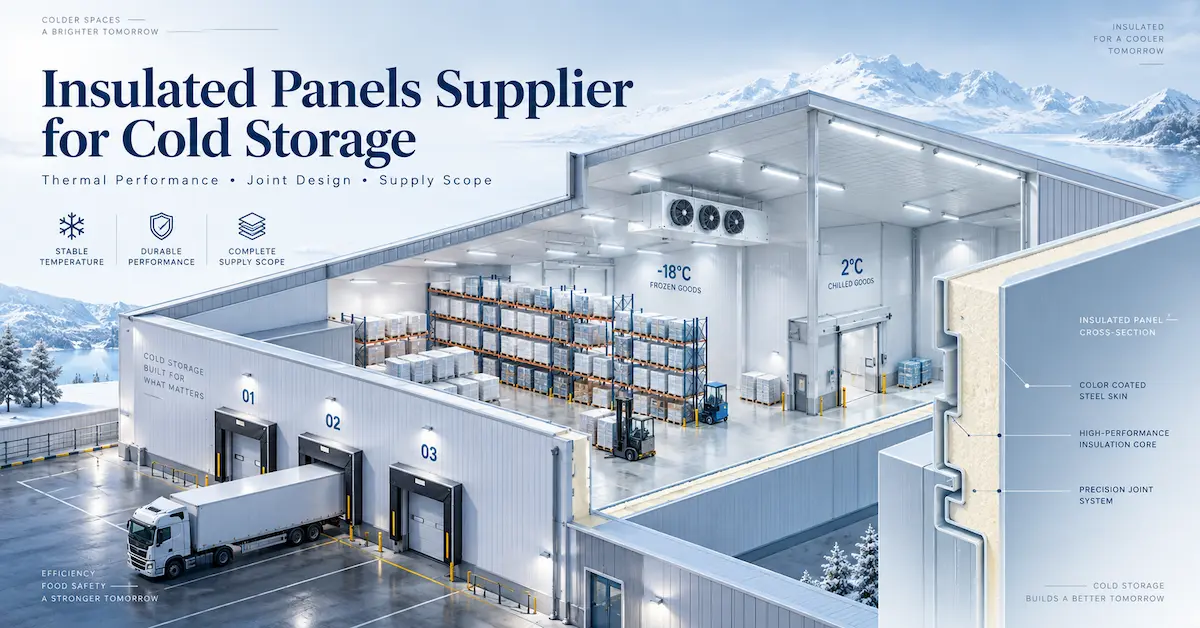
These applications require moisture control and thermal continuity as well as corrosion resistance.
Wall and Ceiling Solution
PVC+PU+PVC composite panels can combine:
- Smooth PVC faces
- Rigid PU insulation
- Wall or ceiling enclosure
- Interlocking installation
- Moisture resistance
Project Details
The specification should cover:
- Operating temperatures
- Required U-value
- Cleaning chemicals
- Washdown pressure
- Floor-to-wall details
- Door interfaces
- Refrigeration penetrations
- Ceiling continuity
- Condensation control
- Hygiene documentation
A smooth PVC surface should not be described as food grade unless the exact product has the required evidence.
Buyers can use the moisture resistant wall panels guide to review joints, condensation and washdown requirements in more detail.
Warehouses and General Industrial Buildings
A non-conditioned warehouse and a temperature-controlled warehouse should not use the same default specification.
Non-Conditioned Warehouse
Primary considerations may include:
- Weather protection
- Corrosion resistance
- Installation efficiency
- Impact
- Maintenance
- Total material cost
Temperature-Controlled Warehouse
Additional requirements include:
- Insulated walls
- Insulated ceilings
- Joint continuity
- Door detailing
- Thermal-bridge control
- Air-leakage management
The warehouse insulated panel guide helps determine when insulation adds operational value and when it may be unnecessary.
Technical Documentation, Certification and Quality Control
Separate Quality Management From Product Performance
ISO 9001 concerns quality-management systems. It can support confidence that an organization manages documented processes, but it does not prove the chemical resistance, load capacity, UV life, fire classification or thermal value of an individual panel.
Because ISO 9001 has been revised, buyers should also verify the edition, certificate validity and transition status with the certification body rather than relying only on an undated brochure logo. ISO
Check CE and Standard Scope
HONCH’s current About page states that the company was founded in 2008 and provides anti-corrosion and insulation solutions for roofs, walls and ceilings.
The page displays CE conformity information specifically for an Insulated Sandwich Panel, with:
- Material: PVC
- Thickness: 1–50 mm
- Referenced standard: EN 14509:2013
- Assessment system: System 4
This scope should not automatically be extended to every T920, T930, T1130 or T910 product. The ordered construction must be checked against the document. HONCH
Required Pre-Order File
A technical purchasing file should include:
- Approved product model
- Material-layer description
- Section or profile drawing
- Full and effective width
- Thickness
- Length schedule
- Color reference
- Joint details
- Accessory list
- Fastener specification
- Packaging requirement
- Applicable test reports
- Applicable certificate copies
- Inspection criteria
- Installation guidance
Quality-Control Checklist
| Inspection Item | Recommended Verification |
|---|---|
| Product identity | Model and batch linked to the purchase order |
| Material construction | Matches the approved specification |
| Thickness | Checked against agreed tolerance |
| Width | Full and effective widths confirmed |
| Length | Matches approved cut list |
| Profile geometry | Matches drawing and sample |
| Surface | No unacceptable damage or contamination |
| Color | Matches approved reference |
| Joint | Representative panels fit correctly |
| Core | Continuous and consistent where applicable |
| Accessories | Correct profile, quantity and color |
| Packaging | Protects faces, edges and corners |
| Labels | Identify building, zone or installation stage |
For projects requiring several product families, review the full HONCH product range before finalizing the inspection and packing plan.
Lifecycle Cost and Commercial Comparison
The lowest panel price does not always create the lowest project cost.
A more useful formula is:
Lifecycle cost = panels + accessories + freight + installation + waste + maintenance + operational disruption + replacement
Cost Elements Commonly Missed
Buyers should include:
- Effective coverage
- Custom-length cost
- Ridge components
- Corners
- Fasteners
- Washers
- Sealants
- Special packaging
- Site unloading
- Cutting waste
- Installation labor
- Inspection access
- Production shutdown during replacement
Custom Length as a Cost Tool
Custom length can reduce:
- End laps
- Site cutting
- Offcuts
- Installation time
Longer sheets may also increase:
- Transport difficulty
- Lifting requirements
- Thermal movement
- Damage risk
The correct length is a project optimization decision, not simply the longest length a manufacturer can produce.
Complete Building-Envelope Coordination
Projects that purchase roofing, walls, ceilings and accessories separately may encounter dimensional or interface conflicts.
HONCH’s roof and wall panel supplier guide explains how separate panel functions can still be coordinated within one building-envelope specification.
Order-Ready Anti Corrosion Panel RFQ
A detailed RFQ allows the supplier to recommend a defined product rather than issue a generic price.
| RFQ Field | Information to Provide |
|---|---|
| Project type | Chemical plant, farm, warehouse, cold room or coastal factory |
| Project location | Country, climate and distance from coast |
| Installation position | Roof, exterior wall, interior wall or ceiling |
| Drawings | Dimensions, slope, supports, openings and transitions |
| Corrosive medium | Chemical, ammonia, salt, detergent or industrial exhaust |
| Concentration | Working concentration or “to be confirmed” |
| Contact method | Vapor, mist, splash, washdown, condensation or liquid |
| Temperature | Minimum, normal and maximum |
| Humidity | Typical and maximum |
| UV exposure | Interior, shaded exterior or full exterior |
| Cleaning | Chemical, pressure, temperature and frequency |
| Insulation | Required thermal target or operating temperatures |
| Structural data | Support spacing and applicable loads |
| Product model | T920, T930, T1130, T910 or composite panel |
| Dimensions | Thickness, full width, effective width and length |
| Accessories | Ridges, ends, corners, trims, fasteners and seals |
| Testing | Chemical, UV, structural, thermal or fire requirement |
| Certification | Exact document required by the project |
| Packaging | Standard, private-label or zone-separated |
| Quantity | Total and phased quantities |
| Destination | Port or final site |
| Schedule | Approval, production, dispatch and delivery milestones |
Conditions Requiring Additional Engineering Review
A standard product recommendation should not be finalized without additional review when the project includes:
- Strong oxidizing chemicals
- Concentrated organic solvents
- Continuous liquid immersion
- High process temperatures
- Unidentified chemical mixtures
- Mandatory fire-performance classifications
- Unusually large structural spans
- Walkable roof requirements
- Equipment suspended from the panel
- Pharmaceutical or specialist cleanroom regulations
- Severe impact or abrasion
- Unverified support geometry
In these cases, the appropriate outcome may be:
- Additional product testing
- A modified fixing or support system
- A different panel model
- A different material family
- A specialist-engineer review
- Rejection of the proposed product for that application
A professional selection process must be able to identify both suitable and unsuitable uses.
Frequently Asked Questions About Choosing Anti Corrosion Panels
What is the first step in choosing anti corrosion panels?
Identify the actual corrosive medium, concentration, temperature, contact form and installation position. Material selection should follow the exposure definition rather than begin with a product name.
Are anti-corrosion roofing panels and insulated wall panels interchangeable?
No. Roofing panels are profiled for external weather, drainage, support and overlap.Insulated wall panels combine protective faces with an insulation core and use different joints and installation details.
Which HONCH roofing model has the widest published effective coverage?
T1130 has a published effective width of 1050 mm. T920 has a published effective width of 840 mm. T930’s exact effective width should be confirmed through its current profile drawing.
Does wider effective coverage automatically mean a lower total cost?
No. Wider coverage can reduce sheet runs, but total cost also depends on profile strength, support spacing, wind, transport, handling, accessories and installation labor.
What is the main technical difference between T920 and T930?
T920 publishes a defined 920 mm full width, 840 mm effective width and 26 mm wave height. T930 places greater published emphasis on an ASA exterior weathering layer, rigidity, impact resistance and customization.
What is the difference between T910 and the PU insulation ceiling panel?
T910 is a single PVC ceiling panel. The PU insulation ceiling panel has PVC faces and a rigid PU insulation core. They should not be treated as thermally equivalent products.
Can PVC or UPVC resist every acid and alkali?
No. Compatibility depends on the exact chemical, concentration, temperature, duration, stress and contact method. A general anti-corrosion statement is not universal chemical approval.
What test can be used to evaluate plastics against chemicals?
ASTM D543 is one relevant practice for evaluating the resistance of plastics to chemical reagents. The test programme must define reagent, concentration, temperature, duration, stress and measured properties.
How should outdoor weather resistance be checked?
Review the material’s UV and moisture exposure test method, cycle, lamp type, temperature, duration and measured property changes. ASTM G154 is one relevant accelerated-weathering practice for non-metallic materials.
Does ISO 9001 prove that a panel is corrosion resistant?
No. ISO 9001 concerns an organization’s quality-management system. Product corrosion, chemical, thermal, UV, structural and fire performance require product-specific evidence.
Does HONCH’s displayed CE certificate apply to every roofing sheet?
The current About page identifies the displayed document specifically as relating to an Insulated Sandwich Panel. Its scope should not automatically be applied to every roofing or ceiling model.
What should be included with an anti-corrosion roof order?
The order may require roofing sheets, ridge caps, ridge-end caps, corners, fasteners, washers, seals, closures and penetration components. The exact bill of materials should follow the roof drawing.
How should panel quotations be compared?
Normalize the product model, material construction, effective coverage, thickness, length, accessories, packaging, documentation, delivery terms and quantity basis before comparing price.
What information is needed for an accurate recommendation?
Provide drawings, building location, installation position, corrosive medium, concentration, temperature, humidity, cleaning conditions, support spacing, insulation target, quantity, destination and required documents.
Conclusion
Knowing how to choose anti corrosion panels requires matching the corrosive environment with the correct roofing, wall or ceiling construction, then verifying profiles, joints, fasteners, thermal requirements and product-specific evidence. T920, T930, T1130, T910 and PVC+PU+PVC panels solve different building functions and should be specified accordingly.
For technical model selection or a project quotation, submit your drawings, exposure conditions, quantities and document requirements through the HONCH contact page.