Corrosion Resistant Building Materials for Factories, Farms & Coastal Projects: A Buyer’s Specification Guide
Corrosion resistant building materials are selected for one reason: the building must continue to perform when moisture, salts, chemicals, condensation, cleaning agents, industrial vapors, or other environmental stresses would otherwise accelerate material deterioration.
For industrial, agricultural, coastal, and humid projects, that decision should not be reduced to choosing a panel advertised as “anti-corrosion.” The more reliable approach is to define the exposure, separate roof, wall, and ceiling functions, identify the material construction, review interfaces, and then compare suppliers against the same technical and commercial scope.
Review the current HONCH roofing range and compare the product categories according to your building function and exposure conditions.
Explore HONCH Roofing Materials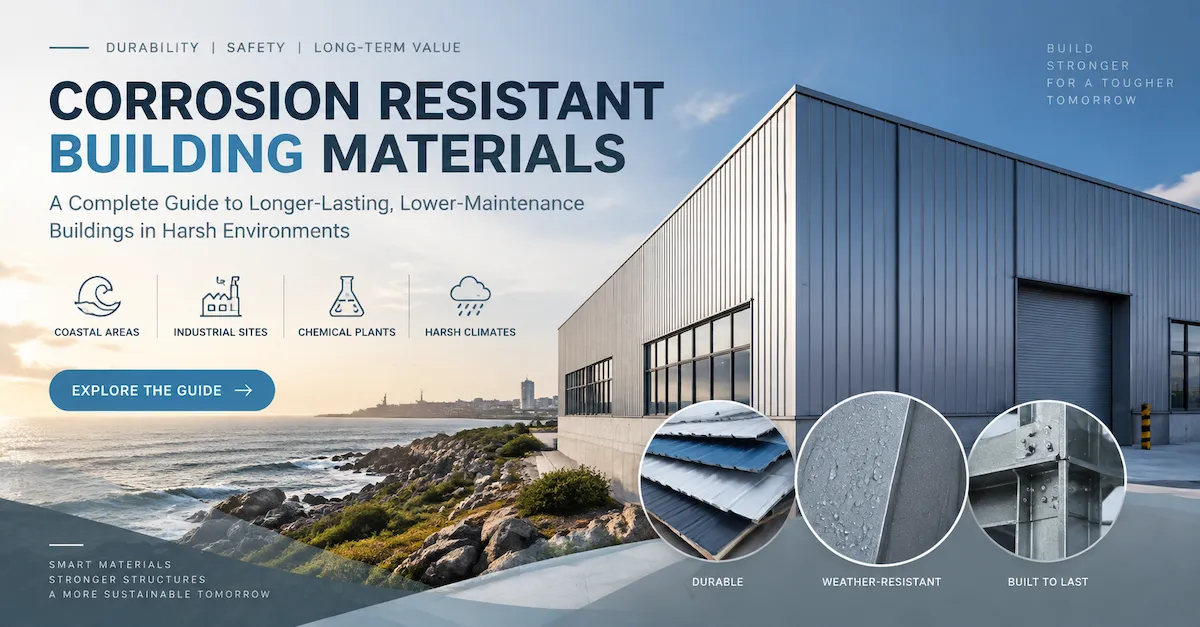
What Are Corrosion Resistant Building Materials?
Corrosion resistant building materials are construction products selected to maintain their required function when exposed to an environment that can cause corrosion, chemical attack, moisture-related deterioration, or other forms of material degradation.
In traditional construction, the word “corrosion” is often associated with metals and rust. For procurement, however, the broader question is how each material and each connection behaves under the actual exposure.
A metal roof may be affected by atmospheric moisture, salts, pollutants, or chemical contaminants. A polymer-based roof does not rust in the same way, but it still has to be assessed for UV exposure, temperature, chemical compatibility, mechanical requirements, joints, fasteners, and installation conditions.
An insulated wall panel introduces another layer of questions because the buyer is evaluating surface layers, insulation core, joints, openings, and supporting interfaces at the same time.
This is why a useful definition is functional rather than purely chemical: a corrosion resistant building material is one whose material construction and complete installed system are appropriate for the identified environmental exposure and intended building function.
For procurement teams, that definition creates a practical rule: never approve a material based only on the phrase “corrosion resistant.” Ask what it is resistant to, under what conditions, for which component, and based on what product-specific evidence.
Why “Corrosion Resistant” Is Not a Complete Specification
The phrase corrosion resistant is useful as a starting point, but it is not a complete engineering specification. A supplier may use the phrase to describe a polymer surface, a coating, a composite panel, or a particular product configuration. These are not equivalent.
The first step is to build an exposure map. Divide the building into roof, external wall, internal wall, ceiling, partition, wet area, utility area, and other relevant zones. For each zone, record the main environmental stresses.
This can include:
- Rain and outdoor weather
- Humidity and condensation
- Coastal salt exposure
- Chemical vapor or mist
- Liquid splash or direct chemical contact
- Cleaning water and detergents
- Sunlight and UV exposure
- Temperature changes
- Dust and industrial pollutants
- Maintenance and inspection conditions
Chemical exposure deserves particular attention. “Acid resistant” or “alkali resistant” should not be treated as universal compatibility statements. The relevant chemical, concentration, temperature, contact method, contact duration, and mechanical stress can change the evaluation.
A short splash is not the same condition as continuous immersion. Vapor exposure is not identical to direct liquid contact. A cleaning process performed once a week is different from a surface that remains in contact with a chemical environment throughout production.
This principle is reflected in ASTM D543, which provides practices for evaluating plastics against chemical reagents and notes that the relevance of a test depends on how closely the test conditions represent the intended end use. For special corrosive applications, the evaluation should consider the particular reagent, concentration, contact duration, temperature, stress, and other application factors.
For steel structures, ISO 12944-2:2017 provides a framework for classifying environments and their corrosivity. Its scope is important: it addresses steel structures and protective paint systems. It should not be presented as a certification for polymer roofing or wall panels.
Its practical value for procurement is the discipline of defining the environment before choosing protection.
Procurement rule: Replace “Is this material corrosion resistant?” with “What environmental exposure must this material and its complete installed assembly handle, and what product-specific evidence supports that assessment?”
Where Corrosion Risk Comes From in Building Projects
Moisture and Humidity
Water is rarely the only problem. Repeated wetting and drying, condensation, trapped moisture, and poorly managed joints can create conditions that accelerate deterioration.
In roof and wall systems, drainage and detailing matter because water can remain around interfaces even when the main panel surface is performing well.
Condensation can be especially important in buildings with large temperature differences between indoor and outdoor conditions. Livestock buildings, processing spaces, warehouses, and other enclosed facilities may have internal moisture loads that differ significantly from the outdoor environment.
Buyers should therefore consider ventilation, thermal conditions, ceiling construction, and joint details together with the panel material.
Coastal Salt Exposure
Coastal buildings face chloride-containing marine atmospheres that can be challenging for exposed metal components. The roof panel itself is only one part of the system.
Fasteners, flashings, trims, brackets, and other metal interfaces may have different resistance characteristics from the main panel.
A practical coastal specification should therefore identify the location, exposure level, panel material, fastener construction, accessory scope, and maintenance approach.
Simply specifying “coastal grade” without defining the complete system can leave important assumptions unresolved.
Chemical and Industrial Exposure
Factories can contain different exposure zones. A dry warehouse, chemical-processing area, metalworking workshop, washing area, and production room may all experience different combinations of humidity, vapors, cleaning agents, dust, and temperature.
This is why a building material supplier should not infer material compatibility from the word “factory.” The buyer should provide the actual substances and conditions where possible.
For chemical environments, a useful technical request includes:
- Chemical name
- Approximate concentration
- Normal operating temperature
- Vapor, mist, splash, or direct contact
- Exposure duration
- Cleaning frequency
- Mechanical stress or loading conditions
Agricultural and Livestock Environments
Livestock buildings can combine humidity, condensation, cleaning, biological residues, and airborne substances such as ammonia. This can create a different material environment from a conventional warehouse.
For these projects, buyers should evaluate roofing, wall partitions, ceilings, ventilation interfaces, cleaning practices, and fasteners as a coordinated system.
A material that is suitable for one part of the building may not automatically be the correct choice for another.
Cleaning and Wash-Down Exposure
Food, agricultural, and industrial facilities may use regular cleaning procedures. A panel can be exposed to water, detergents, disinfectants, or other cleaning agents depending on the facility.
The procurement specification should describe the cleaning method rather than simply stating “easy to clean.”
UV and Outdoor Weathering
External building materials must also deal with sunlight, temperature cycling, rainfall, and other weather effects. Corrosion resistance alone does not describe outdoor durability.
A roofing product may need to address several performance requirements at the same time, including weather exposure, profile, drainage, fixing, material stability, and long-term maintenance.
The Building Envelope Should Be Evaluated as a System
One of the most common procurement mistakes is to evaluate the large panel surface while giving little attention to interfaces.
In real buildings, roof and wall systems contain joints, fasteners, sealants, trims, flashing, penetrations, supports, doors, windows, ducts, pipes, and other connections.
These interfaces can create different exposure conditions.
A corrosion-resistant polymer panel does not automatically make a metal fastener corrosion resistant. A resistant wall surface does not automatically eliminate risk at a penetration. A well-designed roof panel cannot compensate for an unsuitable support arrangement.
For this reason, the technical review should cover at least five layers:
- Main material
- Panel or tile construction
- Joints and overlaps
- Accessories and fasteners
- Supporting structure and installation
This system view also improves quotation comparison. If Supplier A includes compatible trims and Supplier B quotes only the panel, the two prices are not directly comparable.
Key buying insight: The visible panel usually represents only one part of the installed building envelope. A useful RFQ must make the interfaces and accessories visible before the buyer compares price.
How to Select Corrosion Resistant Building Materials by Building Function
Industrial Factories
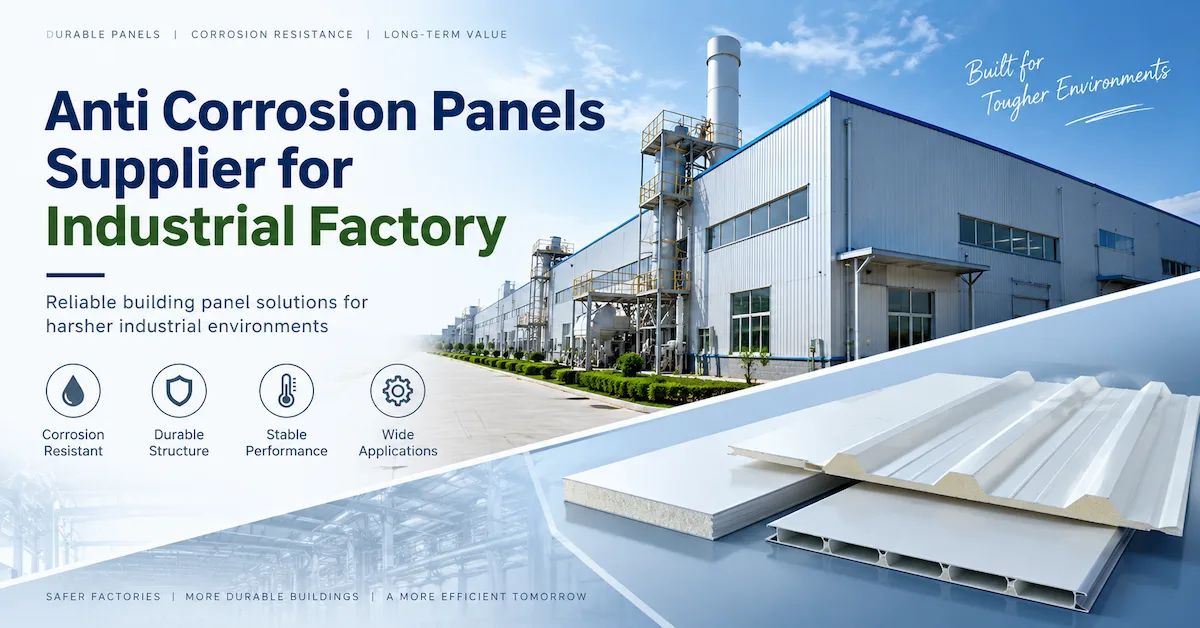
Industrial factories often require a combination of external roofing, wall systems, internal partitions, and ceilings. The right combination depends on the process and environment.
For a general industrial roof, buyers should review:
- Outdoor weather exposure
- Roof profile
- Effective coverage
- Thickness
- Supporting structure
- Fixing method
- Drainage
- Overlap
- Accessories
- Chemical exposure
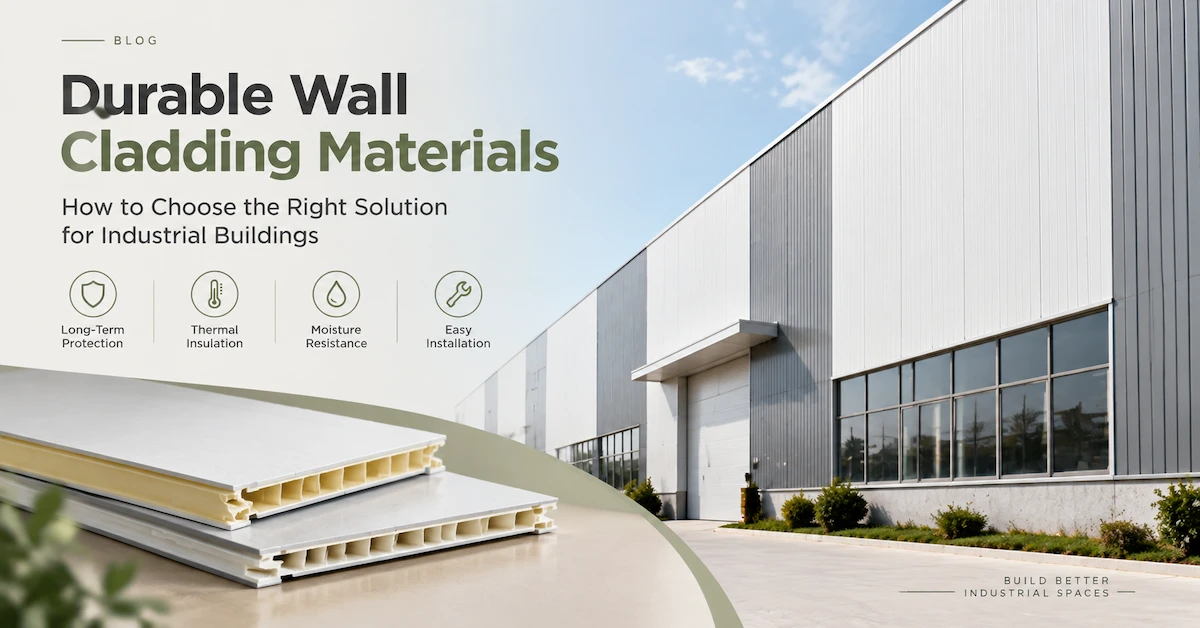
For industrial walls, the focus may shift toward enclosure, moisture management, thermal insulation, cleaning conditions, openings, and joint continuity.
Chemical Plants
Chemical plants require a higher level of environmental definition. Before selecting corrosion resistant building materials, the project team should document the chemicals involved, concentration, operating temperature, whether exposure is vapor, mist, splash or direct contact, and how frequently cleaning occurs.
Do not assume that a material described as corrosion resistant is compatible with every chemical. For demanding applications, ask the supplier for product-specific technical information or test evidence relevant to the actual exposure.
This is one area where the difference between a marketing claim and a procurement specification becomes particularly important.
Livestock Buildings
Livestock buildings may benefit from materials selected around moisture, cleaning, ventilation, and airborne environmental exposure. Roof, wall, and ceiling materials should be considered separately because their functions are different.
An external roof has to handle rain, sunlight, drainage, fixing, and structural support. An internal ceiling may have a stronger focus on insulation, cleanability, moisture, and connections. A wall partition may need to separate zones and accommodate doors, equipment, and ventilation.
Coastal Buildings
For coastal construction, the procurement team should treat the building as a combined weather and corrosion environment. Exposed metal components deserve particular attention because salt and moisture can accelerate corrosion.
Polymer-based roofing can be attractive where the material construction is appropriate, but the full assembly still needs review. Fasteners, trims, flashings, sealants, and supports should be included in the technical discussion.
Warehouses and Agricultural Buildings
Warehouses usually have fewer chemical stresses than chemical-processing buildings, but they can still experience humidity, condensation, dust, outdoor weather, and temperature cycling.
Agricultural storage buildings can add moisture and cleaning requirements. The right material therefore depends on the operating environment rather than the word “warehouse” alone.
Light Buildings and Civilian Applications
Light buildings and civilian projects may place more emphasis on weather protection, appearance, installation, maintenance, and overall project coordination.
HONCH states that its solutions cover light buildings as well as factories, farms, roofs, walls, and ceilings. This makes building function an appropriate starting point for product selection rather than simply choosing a material name.
Which Material Families Should Buyers Compare?
Metal Roofing and Wall Materials
Metal is widely used in construction and offers familiar structural and installation practices. However, exposed metal systems require an environmental and protective strategy.
Coatings, substrate condition, edges, fasteners, and damaged areas can all influence corrosion behavior.
For a metal system, the buyer should ask:
- What metal substrate is being supplied?
- What protective coating or treatment is used?
- What environment was the system designed for?
- What happens at cut edges and penetrations?
- What fasteners and accessories are included?
- What maintenance is expected?
Coated metal should not be treated as automatically equivalent to an inherently corrosion-resistant non-metallic material. Its performance depends on the full protective system and the actual environment.
Polymer-Based Roofing Materials
Polymer-based roofing is relevant when buyers want to reduce exposure to rust-related deterioration of the roof sheet itself. For B2B procurement, however, the phrase corrosion resistant roofing should still be connected to profile, thickness, support, fixing, exposure, and accessory requirements.
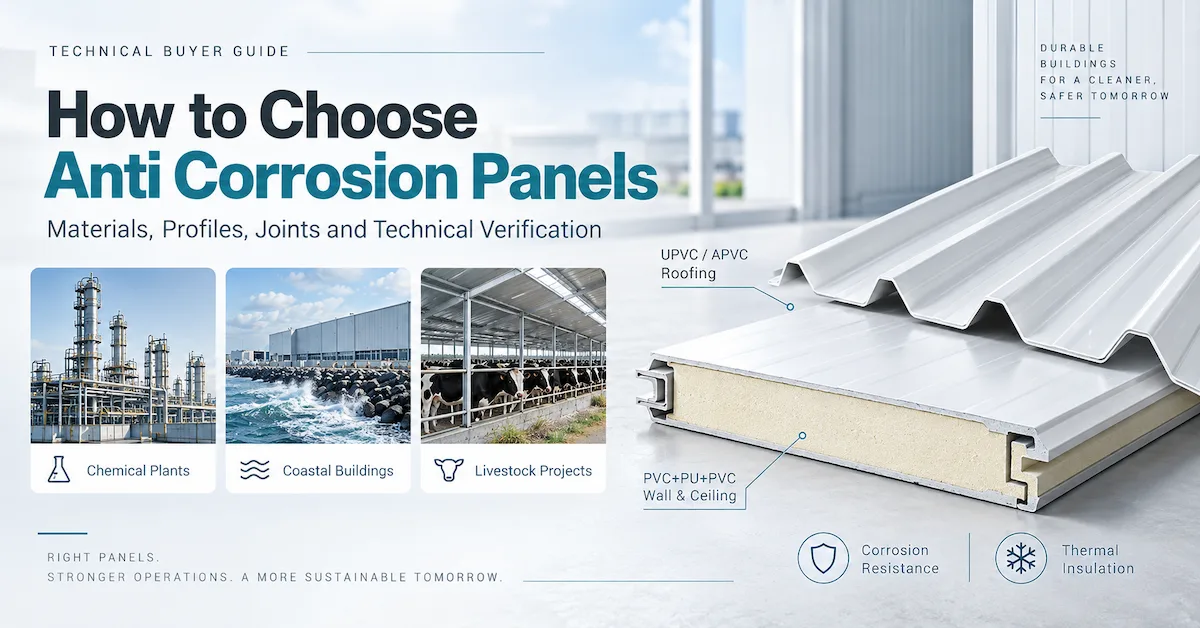
HONCH’s T920 UPVC/APVC roofing sheet is one example. The published product information lists a full width of 920 mm and an effective coverage width of 840 mm.
HONCH also describes the T920 as a roof panel designed for resistance to corrosion, UV aging, and harsh weather conditions, and lists applications including factories, livestock farms, warehouses, chemical plants, and light-duty construction projects.
For buyers, the important point is not to treat the model name as the entire specification. The T920 still needs to be evaluated against the actual building, support arrangement, exposure, fixing method, thickness, and accessory requirements.
If your project requires corrosion-resistant industrial roofing, review the published T920 construction and coverage information before preparing your RFQ.
View T920 UPVC/APVC Roofing SheetInsulated Wall Panels
Insulated wall panels serve a different function from external roof sheets. HONCH describes its PU insulation wall panel as a PVC+PU+PVC composite construction.
For a buyer, the important questions include panel thickness, dimensions, joint design, openings, support arrangement, cleaning conditions, and insulation requirements.
Where the wall is exposed to chemicals or aggressive cleaning, chemical compatibility should be evaluated separately from insulation performance.
Insulated Ceiling Panels
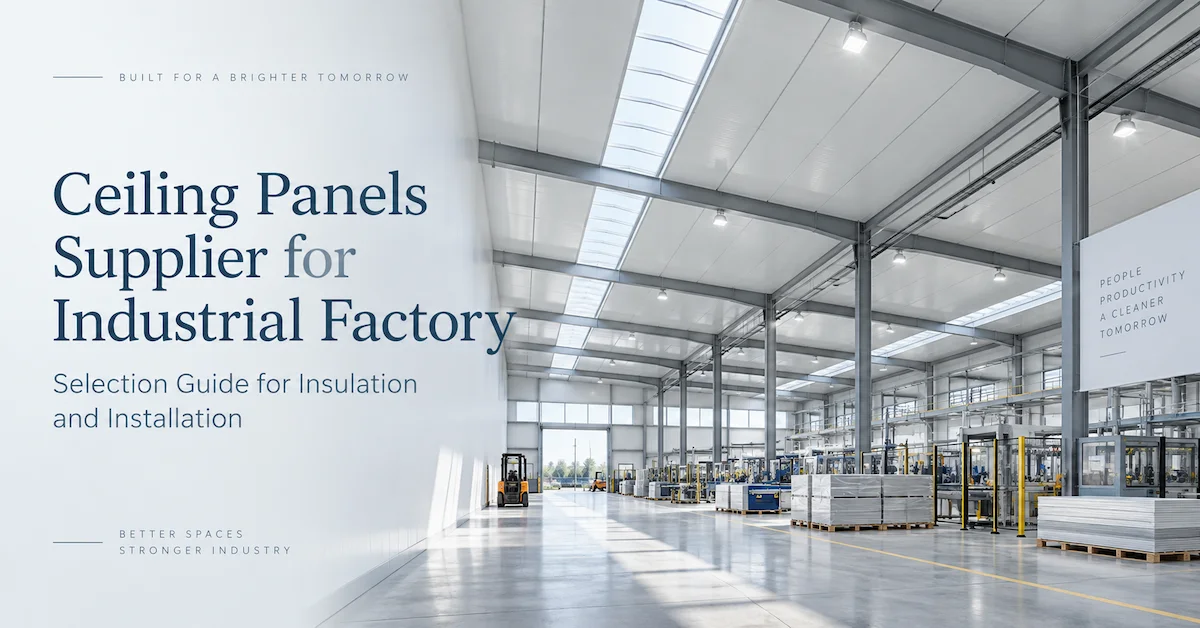
Ceiling systems also have their own role. HONCH’s industrial anti-corrosion content describes its PU insulation ceiling panel as a PVC+PU+PVC composite structure for ceiling applications.
The ceiling specification should consider support, joints, penetrations, perimeter details, cleaning conditions, and the required thermal or enclosure function.
A ceiling panel should not automatically be treated as an external roof because the building loads and exposure conditions are different.
Other Roofing and Building Material Families
HONCH’s current roofing product page lists several broader categories, including livestock-specific high-weather-resistant hollow insulation tiles, FSP livestock-specific roof panels, insulation sandwich tiles, PVC livestock-specific panels, industrial ASA composite tiles, plastic steel tiles, anti-corrosion and insulation ceiling panels, FRP transparent tiles, and civilian resin tiles.
These categories should not be treated as interchangeable. A buyer should first identify the building function and then compare the product constructions that are actually intended for that function.
| Material / System Family | Main Procurement Question | Key Evaluation Areas |
|---|---|---|
| Metal roofing or wall system | How is the metal protected for the actual environment? | Substrate, coating, edges, fasteners, exposure, maintenance |
| Polymer-based roofing | Is the roofing construction appropriate for the outdoor exposure? | Profile, effective coverage, thickness, support, fixing, UV, weather |
| Insulated wall panel | Does the composite construction meet the wall function? | Surface layers, core, thickness, joints, openings, insulation |
| Insulated ceiling panel | Does the system suit the internal ceiling environment? | Support, joints, penetrations, moisture, insulation, maintenance |
| Specialized agricultural system | Can the construction handle the operating environment? | Humidity, cleaning, ventilation, environmental exposure, interfaces |
A Practical Comparison Framework for Anti-Corrosion Building Materials
Instead of asking which material is “best,” score each candidate against the project conditions.
| Evaluation Factor | Key Buyer Question |
|---|---|
| Environmental exposure | What moisture, salt, chemical, UV, temperature, or cleaning exposure exists? |
| Material construction | What are the surface, core, substrate, or composite layers? |
| Application | Is the product for roof, wall, ceiling, partition, or another location? |
| Thickness | What thickness is available and what project requirement must it satisfy? |
| Dimensions | What are the full dimensions and, for profiled roofing, the effective coverage? |
| Joints | How are overlaps, joints, and connections formed? |
| Fasteners | Are fixing components compatible with the exposure? |
| Accessories | Are trims, flashing, closures, and other required parts included? |
| Support | What structural or installation interface is required? |
| Documentation | What product-specific specifications, reports, or certificates are available? |
| Customization | Can dimensions, color, packaging, or other project requirements be controlled? |
| Delivery | How will production and shipment be coordinated with the construction schedule? |
This framework prevents a common mistake: comparing materials only by price per square metre.
How Effective Coverage Can Change a Roofing Comparison
For profiled roofing, nominal width and usable coverage are not always the same. This matters when buyers compare quotations.
Suppose two suppliers quote a similar-looking roof sheet but use different definitions for width. One may present gross width, while the other calculates usable coverage after overlap. The apparent unit price may therefore be misleading.
The buyer should record:
- Full width
- Effective coverage width
- Sheet length
- Thickness
- Overlap arrangement
- Accessory requirements
- Quantity calculation method
HONCH’s T920 page provides a useful example of why this distinction matters: its listed full width is 920 mm while its effective coverage width is 840 mm.
The same principle applies to total project quantity. A lower nominal price does not necessarily produce a lower installed cost if the usable coverage, overlap, cutting loss, or accessory scope differs.
What Technical Documents Should Buyers Request?
A serious B2B sourcing process should move from marketing language to product-specific evidence.
Request, where applicable:
- Product specification
- Material construction
- Dimensions
- Thickness
- Profile drawing
- Effective coverage
- Installation information
- Joint details
- Available test reports
- Certificates
- Sample identification
- Inspection criteria
- Batch or order identification
- Packaging details
For a chemical environment, add:
- Chemical name
- Concentration
- Temperature
- Contact type
- Exposure duration
- Relevant test evidence
For an insulated panel, also ask:
- Core material
- Surface layers
- Panel thickness
- Joint construction
- Thermal information
- Fire-related documentation where required by the project
- Penetration and opening details
Certificate verification matters: A certificate is useful only when it applies to the product configuration being purchased. A report for one panel construction should not automatically be used as evidence for an unrelated roofing sheet.
How Standards Can Improve Procurement Decisions
Standards are useful when they help define a test or classification, but they should not be used as decorative words in a quotation.
ISO 12944-2:2017 is focused on the classification of environments and corrosivity for steel structures and protective paint systems. For buyers comparing steel-based building components, its environmental classification approach can help structure the discussion about exposure.
It does not certify a polymer panel, and it should not be presented as proof that a particular plastic roofing product has passed a particular corrosion test.
ASTM D543 provides practices for evaluating the resistance of plastics to chemical reagents. Its relevance is especially clear when the building material is polymer-based and chemical exposure is part of the application.
The standard emphasizes that test conditions should be related to the actual end-use conditions. This reinforces an important purchasing principle: the chemical name, concentration, temperature, contact type, duration, and stress conditions matter.
For insulated sandwich panels, HONCH’s About page states that its products comply with the EU Construction Products Regulation and are assessed against EN 14509:2013, and it specifically identifies a Certificate of Conformity for an Insulated Sandwich Panel. The published information identifies PVC, a stated thickness range of 1–50 mm, and Assessment System 4.
Buyers should still verify that the certificate scope matches the exact configuration being purchased.
The lesson is simple: standards and certificates should be connected to the actual product, construction, test method, and application.
How to Evaluate a Corrosion Resistant Building Materials Supplier
1. Start With Product Scope
Ask whether the supplier is quoting a roof sheet, wall panel, ceiling panel, accessory package, or a combination.
Avoid using a single product description for several different building functions.
2. Review Product Evidence
Ask for the product specification, dimensions, material structure, installation information, and relevant documentation.
If a certificate is important, verify the product name, construction, thickness, test method, and scope.
3. Check Interface Compatibility
A panel is not the complete system.
Confirm fasteners, trims, sealants, flashing, closures, joints, and penetration details.
4. Evaluate Customization Carefully
Customization may involve length, color, packaging, labels, or other project requirements.
If a change affects material structure, thickness, or profile, the technical documentation may need to be reviewed again.
5. Clarify Commercial Scope
Ask what is included in the quotation.
Compare panel area, effective coverage, accessories, packaging, documentation, shipping basis, and any other project-specific requirements.
6. Check Production and Delivery Planning
Do not rely only on a generic lead-time statement. Final production and shipment should be confirmed against the actual product type, dimensions, quantity, and order requirements.
7. Consider Communication Quality
For technical construction products, the quality of supplier communication is itself a procurement signal.
A supplier that asks about installation position, exposure, dimensions, joints, accessories, and documentation is addressing project risk rather than only selling a unit price.
Learn more about HONCH, its anti-corrosion and insulation focus, and its product and export background before discussing your project requirements.
Learn About HONCH Discuss Your ProjectHONCH as a Building Materials Partner
ZHEJIANG HONCH TECHNOLOGY CO., LTD states that it was founded in Jinhua in 2008 and specializes in anti-corrosion and insulation solutions for light buildings, factories, farms, roofs, walls, and ceilings.
The company also states that it has self-operated import and export rights and sells products domestically and internationally.
Its public product structure covers several building-envelope needs. The roofing range includes industrial and livestock-related products, while the company’s industrial content also describes PVC+PU+PVC insulation wall and ceiling panels.
This allows buyers to approach a project by building function rather than forcing every area into the same material category.
HONCH also states that its production line uses advanced technology and presents process-related performance categories including anti-corrosion, fire resistance, waterproofing, heat insulation and preservation, soundproofing, impact resistance, load-carrying resistance, and weather resistance.
These should be interpreted as the company’s published capability descriptions; product-specific requirements and evidence should still be confirmed for each project.
The company lists ISO9001 and EU CE certifications on its About page. For CE-related procurement, the same page specifically identifies an Insulated Sandwich Panel Certificate of Conformity under the EU Construction Products Regulation and EN 14509:2013.
Buyers should therefore verify certification scope at the product level rather than assuming every building material in the portfolio has the same certification.
How to Prepare an RFQ for Corrosion Resistant Building Materials
A strong RFQ reduces the number of assumptions between buyer and supplier.
Project Information
- Country and project location
- Building type
- New construction or renovation
- Building area
- Roof area
- Wall area
- Ceiling area
- Installation position
Environmental Information
- Humidity
- Rainfall or outdoor exposure
- Coastal or marine influence
- Chemicals present
- Concentration where known
- Temperature
- Cleaning method
- Condensation risk
- UV exposure
Technical Information
- Required material family
- Product application
- Thickness
- Dimensions
- Effective coverage
- Profile
- Joint type
- Support spacing or interface information
- Openings and penetrations
- Accessories
- Insulation requirements
Commercial Information
- Estimated quantity
- Packaging requirement
- Delivery destination
- Target construction schedule
- Required documentation
- Customization requirements
- Private-label requirements if applicable
When these details are supplied together, a supplier can respond with a more comparable proposal.
It also reduces the risk that an attractive quotation hides unresolved technical assumptions.
| RFQ Section | Information to Provide | Why It Matters |
|---|---|---|
| Building | Type, location, roof/wall/ceiling areas | Defines the basic application and product function |
| Environment | Humidity, salt, chemicals, temperature, UV | Defines the exposure that the material must handle |
| Roofing | Profile, thickness, dimensions, effective coverage | Allows meaningful product and quantity comparison |
| Wall / Ceiling | Construction, thickness, insulation, joints | Clarifies enclosure and thermal requirements |
| Interfaces | Fasteners, trims, flashing, openings | Reduces system-level compatibility risks |
| Documentation | Specifications, reports, certificates | Supports technical approval and project records |
| Commercial | Quantity, packaging, destination, schedule | Creates a realistic supply proposal |
Common Procurement Mistakes to Avoid
Choosing by Price per Square Metre
The lowest unit price may not be the lowest project cost.
Coverage, overlap, accessories, installation, packaging, shipping, maintenance, and replacement risk all matter.
Treating Every “Anti-Corrosion” Claim as Equivalent
A product label does not define exposure conditions or test scope.
Ask for the actual material construction and relevant evidence.
Using One Material Throughout the Building
Roof, wall, and ceiling systems have different functions.
A universal-material strategy may create unnecessary compromises.
Ignoring Fasteners and Accessories
A resistant panel combined with unsuitable interfaces can still create maintenance problems.
Comparing Non-Equivalent Quotations
Normalize material, thickness, dimensions, effective coverage, accessories, packaging, documentation, and delivery terms before comparing prices.
Assuming a Certificate Covers the Entire Product Range
Certificates and reports have scope. Match the document to the exact product configuration.
Requesting a Quotation Without Exposure Information
A supplier cannot responsibly assess chemical compatibility from a building name alone.
Writing the Specification Too Late
Roof penetrations, doors, ducts, ventilation, and equipment interfaces should be considered before final production quantities and cutting plans.
A Buyer’s Decision Tree
If the project has significant corrosion exposure, start by defining the environment.
If the primary concern is an external roof: compare roofing products based on exposure, profile, effective coverage, thickness, support, fixing, drainage, and accessories.
If the primary concern is an insulated wall: evaluate panel construction, thickness, insulation requirements, joints, openings, cleaning conditions, and environmental exposure.
If the primary concern is an insulated ceiling: focus on support, joint continuity, penetrations, thermal requirements, and internal operating conditions.
If the project is coastal: review the complete assembly and especially exposed metal interfaces.
If the project is agricultural or livestock-related: include humidity, condensation, cleaning, ventilation, and airborne environmental exposure in the specification.
If the project involves chemicals: provide the chemical identity, concentration, temperature, contact method, and duration before asking the supplier to confirm compatibility.
If the supplier cannot explain what is included in the quotation: request a line-by-line scope before comparing price.
This decision tree is more reliable than asking which corrosion resistant building materials are “best” in the abstract.
Send the building type, installation position, exposure conditions, dimensions, estimated quantities, and documentation requirements so the product scope can be evaluated more accurately.
Request a Project DiscussionFAQ
What are corrosion resistant building materials?
They are construction materials selected and specified to maintain their required function under identified environmental conditions that could otherwise cause corrosion or degradation. The correct material depends on exposure, building function, material construction, interfaces, and available evidence.
Which corrosion resistant building materials are suitable for industrial factories?
There is no universal answer. Industrial projects may use different roofing, wall, ceiling, and partition materials depending on humidity, chemicals, temperature, cleaning, outdoor exposure, and insulation requirements. The material should be selected by zone and function.
Are UPVC roofing sheets corrosion resistant?
UPVC does not corrode in the same way as conventional steel, but the complete roofing system still requires evaluation. HONCH describes its T920 UPVC/APVC roofing sheet as designed for resistance to corrosion, UV aging, and harsh weather conditions and lists applications including factories, livestock farms, warehouses, chemical plants, and light-duty construction.
Are corrosion resistant building materials suitable for coastal buildings?
They can be, but coastal exposure should be treated as a complete-system condition. Panel material, fasteners, trims, flashing, joints, sealants, supports, and maintenance should all be reviewed.
Does corrosion resistance mean a material is resistant to every chemical?
No. Chemical compatibility depends on the specific reagent, concentration, temperature, contact method, duration, stress, and other conditions. Buyers should request product-specific evidence for demanding chemical applications.
Should the roof, wall, and ceiling use the same material?
Not necessarily. These components perform different functions and may face different exposures. A project can reasonably use one construction for the external roof, another for insulated walls, and another for the internal ceiling.
What information should I send a supplier for a corrosion-resistant material quotation?
Provide the building type, location, installation position, dimensions, quantities, environmental exposure, chemical information where relevant, temperature, cleaning method, insulation needs, required accessories, delivery destination, schedule, and documentation requirements.
How should I compare two corrosion resistant building materials suppliers?
First normalize the product construction and application. Then compare dimensions, thickness, effective coverage, joints, accessories, documentation, packaging, delivery terms, customization scope, and technical support. Only after the scope is comparable should unit price become a major comparison factor.
What certifications should I ask for?
Ask for product-specific certificates and test reports relevant to the project. Verify the exact product configuration, thickness, construction, standard or test method, and certificate scope. Do not assume that a certificate for one product automatically applies to an unrelated product.
Can HONCH help with corrosion resistant building material projects?
HONCH states that it specializes in anti-corrosion and insulation solutions for light buildings, factories, farms, roofs, walls, and ceilings. Its product range includes industrial and livestock-related roofing products and insulation wall and ceiling solutions. Buyers should provide project conditions so the appropriate product category and technical scope can be evaluated.
Conclusion
Corrosion resistant building materials should be selected by environment, building function, material construction, interfaces, evidence, and total project scope—not by a single “anti-corrosion” label or the lowest square-metre price.
For B2B buyers, the most reliable process is to map exposure zones, separate roof/wall/ceiling requirements, compare equivalent specifications, verify product-level documentation, and include fasteners and accessories in the review.
HONCH provides anti-corrosion and insulation building-material solutions for industrial, agricultural, livestock, light-building, roof, wall, and ceiling applications, with product-specific selection and documentation to be confirmed against each project.
For a roofing, wall, ceiling, livestock, agricultural, industrial, or other building-material project, provide the actual exposure and project requirements first. A more complete specification creates a more meaningful supplier comparison.
Contact HONCH for Your Project Visit HONCH