How Should Buyers Choose an Insulated Panels Supplier for Cold Storage?
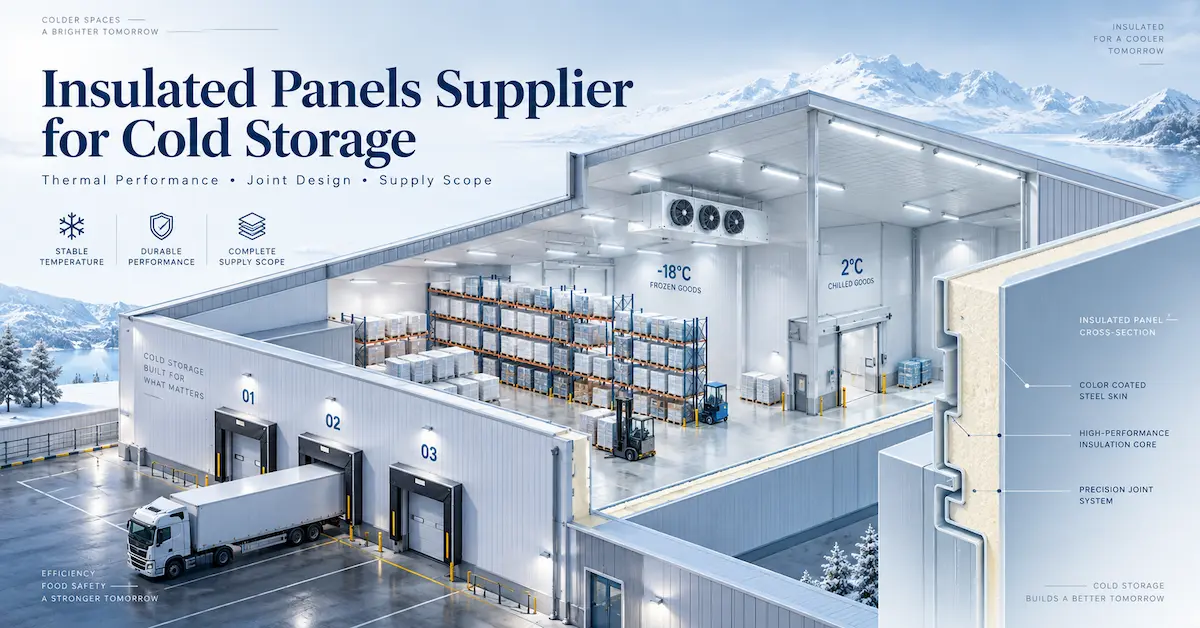
Choosing an insulated panels supplier for cold storage should begin with the operating temperature, room function, humidity conditions, building layout, and installation position rather than a generic request for a particular panel thickness. A chilled warehouse, frozen storage room, processing-area enclosure, temperature-controlled distribution center, and insulated room inside a larger warehouse can have very different requirements. HONCH offers PVC+PU+PVC insulation wall panels, insulated ceiling products, and other industrial building materials, but these products should be evaluated according to the actual cold-storage function rather than treated as a universal solution. A useful supplier proposal should identify the panel construction being offered, intended application, available thickness and dimensions, joint system, thermal information, accessories, customization options, documentation, packaging, and any project conditions that still require confirmation.
Define the Cold Storage Operating Conditions Before Selecting Panels
Cold storage panel selection is closely connected to the temperature and moisture conditions of the building. A room operating slightly below ambient temperature does not present the same requirements as a low-temperature frozen-storage enclosure, and a frequently opened distribution room is different from a stable storage chamber with limited traffic. Before requesting quotations, buyers should identify the intended internal temperature, surrounding ambient conditions, humidity where relevant, operating hours, door-opening frequency, cleaning procedure, room dimensions, and whether the project is a new build, expansion, or renovation. These details help suppliers and project designers determine which wall, ceiling, joint, and accessory requirements need to be evaluated rather than relying on a single thickness recommendation.
Separate Chilled, Frozen, and General Insulated Spaces
The phrase “cold storage” can describe several operating conditions. Chilled storage, frozen storage, insulated processing rooms, staging areas, and temperature-controlled warehouses may require different panel constructions or thicknesses. Instead of asking the supplier for one standard cold-room panel, divide the project into zones and identify the required condition for each area. Where the temperature requirement is demanding, the project designer should also consider doors, floor insulation, penetrations, ventilation, refrigeration equipment, and thermal bridges together with the wall and ceiling panels.
What Information Should Be Included in the Inquiry?
Provide the supplier with the target internal temperature, room dimensions, wall and ceiling areas, project country, outdoor climate where relevant, drawings, required panel positions, quantities, door and penetration locations, cleaning requirements, required technical documents, delivery destination, and installation schedule. If a parameter has not yet been finalized, mark it as requiring confirmation rather than replacing it with an assumption.
Understand the Difference Between Panel Construction and Thermal Performance
HONCH's PU insulation wall panel uses a PVC + PU foam + PVC composite construction and is described for insulated applications that include cold-room-related environments. The material structure is useful information, but the words PVC and PU alone do not establish the complete thermal performance of an installed cold room. The PVC surfaces and PU insulation core perform different functions, and the final enclosure also includes joints, corners, doors, penetrations, trims, seals, and interfaces with the floor or surrounding structure.
What Does the PU Core Contribute?
The PU core forms the insulation component of the composite panel. When comparing products, buyers should request thermal information for the proposed construction and confirm the corresponding panel or core thickness. A nominal thickness can be useful for comparing options within the same panel family, but it should not be treated as a complete cold-storage design calculation. The thermal requirement should come from the room operating conditions and project design rather than from a generic rule such as “thicker is always better.”
What Do the PVC Faces Contribute?
PVC surface layers provide the external faces of HONCH's composite insulation panel construction. For cold-storage procurement, buyers may need to consider surface cleaning, moisture exposure, appearance, maintenance, and the environmental conditions on each side of the panel. If cleaning chemicals are used, their type and concentration should be identified so the complete panel system can be assessed more accurately. A general moisture- or corrosion-resistant description should not be interpreted as compatibility with every cleaner or chemical.
Do Not Turn Material Names Into Unsupported Performance Claims
A panel containing PU should not automatically be described as meeting a particular thermal value, fire classification, service temperature, or energy-saving percentage unless the relevant data supports that claim. Likewise, PVC faces should not automatically be described as food-grade, antibacterial, or approved for every food-storage environment unless those specific requirements have been verified for the offered product.
What Should a Cold Storage Panel Specification Include?
An insulated panels supplier for cold storage should be able to turn a general inquiry into a clearly defined product specification. The following checklist helps buyers compare quotations on the same basis.
| Specification Item | Buyer Should Define | Supplier Should Confirm | Why It Matters |
|---|---|---|---|
| Room function | Chilled, frozen, insulated room or controlled warehouse | Proposed panel application | Different rooms can need different specifications |
| Internal temperature | Target operating temperature or range | Product configuration for evaluation | Supports thermal selection |
| Installation position | Wall, ceiling or partition | Product intended for that location | Prevents unsuitable substitution |
| Panel construction | Required insulation and surface function | Face material, core and panel construction | Allows like-for-like comparison |
| Thickness | Project requirement or thermal target | Available overall/core thickness | Thickness must correspond to actual construction |
| Dimensions | Room dimensions and cut schedule | Width, length and tolerances | Supports ordering and installation |
| Joint profile | Air and moisture-control requirement | Connection profile and treatment | Joints affect enclosure continuity |
| Thermal data | Project design requirement | Available data for proposed product | Supports engineering review |
| Openings | Doors, refrigeration pipes and services | Trim and interface requirements | Reduces uncontrolled site cutting |
| Accessories | Corners, trims, seals and closures | Included and excluded items | Prevents incomplete quotations |
| Fire requirement | Project-required classification | Applicable documentation where available | Avoids general fire claims |
| Cleaning environment | Cleaning method and chemical type | Product limitations or relevant information | Supports maintenance planning |
| Packaging | Installation sequence and storage plan | Packaging and identification method | Helps large projects stay organized |
| Delivery | Required project dates | Order-specific production and shipment schedule | Avoids generic lead-time assumptions |
Cold Storage Walls and Ceilings Should Be Evaluated as a Complete Enclosure
Cold-room performance does not depend only on the center of the panel. The joints between panels, corners, wall-to-ceiling connections, door openings, refrigeration penetrations, electrical services, drainage points, and interfaces with other construction elements can become critical parts of the enclosure. Buyers should therefore evaluate how panels connect and how the remaining details will be treated before finalizing the order.
Insulated Wall Panels
HONCH's PVC+PU+PVC insulation wall panel is positioned for insulated wall applications and supports customization in selected dimensions, colors, and packaging requirements. For a cold-storage project, the buyer should confirm the offered thickness, panel dimensions, connection profile, edge construction, installation method, thermal information, and compatibility with the intended room conditions. Door openings, corners, and service penetrations should be included in the layout before the final cut list is approved.
Insulated Ceiling Panels
HONCH also provides a PVC+PU+PVC insulation ceiling panel with a rigid PU insulation core and a tongue-and-groove connection described on the product page. Where this construction is being evaluated for an insulated room or ceiling application, buyers should confirm the proposed support method, panel thickness, perimeter connections, penetrations, and applicable technical data. A ceiling panel should not automatically be assumed to be walkable, load-bearing, or suitable for hanging equipment unless those requirements are specifically addressed.
Wall and Ceiling Panels Are Not Automatically Interchangeable
Similar materials do not make two products interchangeable. The installation position, connection design, supports, loads, and enclosure details can differ. Procurement documents should therefore identify whether each panel is intended for a wall, ceiling, partition, or another specific location.
Why Joint Design Matters in Cold Storage Projects
Cold storage buyers often spend significant time comparing insulation-core thickness while giving less attention to panel joints. However, joints are part of the continuous enclosure and should be considered when evaluating air movement, moisture migration, installation quality, and thermal continuity. HONCH describes interlocking or tongue-and-groove connections for its relevant insulation products, but the buyer should still request the profile and connection details for the exact product being offered.
Inspect Joined Samples, Not Only Flat Panel Pieces
A sample showing only the decorative face cannot demonstrate how two panels fit together. Where practical, ask for representative joined pieces so the purchasing and installation teams can inspect the connection profile, edge quality, surface alignment, and dimensional consistency.
Include Corners and Penetrations in the Review
Cold rooms may contain evaporator connections, refrigeration pipes, cables, sensors, drains, doors, and other penetrations. These interfaces should be planned before production so that site teams understand how insulation continuity and sealing will be maintained.
Ask Who Supplies the Additional Joint Materials
Confirm whether sealants, trims, corner profiles, closures, fixing components, or other accessories are included in the panel quotation. A competitive panel price may not represent a competitive complete enclosure if major accessories are excluded.
How Should Buyers Evaluate Condensation and Moisture Risk?
Insulated panels contribute to the thermal envelope, but they should not be marketed as an automatic guarantee against condensation. Moisture behavior depends on temperature differences, indoor and outdoor humidity, air leakage, joint continuity, thermal bridges, ventilation, and the overall building construction. In cold-storage applications, the temperature difference between the conditioned room and surrounding environment can make enclosure detailing particularly important.
Do Not Evaluate the Wall in Isolation
The wall panel may have adequate insulation while uncontrolled leakage occurs around doors, ceiling transitions, floor connections, penetrations, or other interfaces. Buyers should therefore review the complete enclosure with the responsible designer or contractor rather than expecting panel thickness alone to solve moisture-related problems.
Ask for the Information Needed by the Project Designer
The panel supplier can provide product construction and available technical information. The project designer can then use that information with the room temperature, ambient conditions, refrigeration design, floor construction, door specification, and operating pattern to evaluate the complete cold-storage envelope.
How Do HONCH Panel Options Fit Into Cold Storage and Industrial Buildings?
Not every part of a cold-storage facility performs the same function. A temperature-controlled enclosure may require insulated wall and ceiling panels, while the outer industrial building can have a separate roof system. HONCH's wider industrial product range includes industrial roofing products in addition to the PVC+PU+PVC insulation panels.
| HONCH Product Type | Published Product Role | Application to Evaluate | Main Procurement Check |
|---|---|---|---|
| PVC+PU+PVC insulation wall panel | Composite insulated wall panel | Cold-room wall, insulated wall or internal partition | Thermal data, thickness, joints and openings |
| PVC+PU+PVC insulation ceiling panel | Composite insulated ceiling product | Insulated ceiling or enclosed temperature-controlled area | Support, joints, perimeter and thermal requirements |
| T920 UPVC/APVC roofing sheet | Industrial roofing product | External roof of warehouse or industrial building | Effective coverage, thickness, fixing and support |
| T930 UPVC/APVC roofing sheet | Industrial roofing product | External industrial roofing application | Profile, weather exposure, support and roof design |
Do Not Confuse the External Roof With the Cold-Room Enclosure
HONCH's T920 UPVC/APVC roofing sheet is an industrial roofing product, while the PVC+PU+PVC wall and ceiling panels are composite insulation products. A cold-storage facility may require both categories, but they should not be described as technically equivalent. The external roof deals with weather exposure and roof construction, while an internal cold-room enclosure addresses thermal separation and room-specific detailing.
How Should Buyers Compare Cold Storage Panel Costs?
Price per square metre is useful only when the quotations being compared describe the same product construction and supply scope. One supplier may quote panels only, another may include trims and packaging, and a third may calculate area using a different dimensional basis. Before selecting the lowest price, normalize the technical and commercial assumptions.
Compare the Same Panel Construction
Make sure suppliers are quoting comparable facing materials, insulation-core construction, thickness, dimensions, joint type, color, and other required product characteristics. A lower price for a different construction does not represent a direct comparison.
Separate Material Price From Complete Project Supply
Ask suppliers to identify the cost or scope of panels, trims, corners, closures, joint materials where applicable, packaging, transport, technical documentation, and other agreed items. This makes it easier to understand the actual procurement cost rather than only the headline panel price.
Consider Installation and Rework Risk
A quotation that leaves important dimensions, openings, accessories, or packaging unresolved can create additional site work. This does not mean the highest-priced supplier is automatically the best choice; it means commercial evaluation should consider whether each quotation represents the same complete requirement.
What Quality and Documentation Should Buyers Request?
The quality framework used for this article emphasizes factual accuracy, traceable information, and avoiding unsupported claims. Applied to cold storage procurement, buyers should ask how the ordered configuration is identified and inspected rather than relying on statements such as “premium quality” or “international standard.”
Create an Approved Product Reference
The order specification can record panel construction, thickness, dimensions, color, connection details, packaging, and other agreed requirements. A representative approved sample can also be linked to the order so that surface appearance, cross-section, edge condition, and connection profile have a clear reference.
Check Documents Against the Exact Product
If thermal, fire, or other performance documents are required, verify which product construction they apply to. Check material description, configuration, relevant thickness, test method, and stated scope before using a document as evidence for the project.
Do Not Extend One Document Across an Entire Product Range
A report for one wall or sandwich-panel configuration should not automatically be assumed to cover every insulation panel, roofing sheet, or customized construction offered by the manufacturer. Product-level verification is especially important when a project changes materials or thicknesses.
How Should OEM and Customized Cold Storage Panels Be Managed?
HONCH's insulation wall panel information describes customization possibilities for dimensions, colors, and packaging, which can be relevant to cold-room contractors, distributors, and international project buyers. Customization can simplify installation and procurement when it is controlled through clear drawings and specifications.
Project-Specific Lengths and Dimensions
Providing accurate room drawings allows panel lengths and quantities to be discussed before production. Where several rooms or phases are involved, panel identification and packaging can also be coordinated with the construction sequence.
Packaging and Private-Label Requirements
Distributors may require branded packaging or repeatable product identification. These details should be approved together with the product specification so that subsequent orders can reference the same configuration.
Customization Should Not Override Technical Verification
Changing panel thickness, materials, joints, or other significant construction details may affect the information or documentation applicable to the product. Buyers should confirm each important change rather than assuming that all custom configurations have identical performance.
How Should Production, Packaging, and Delivery Be Planned?
Cold-storage projects can involve large quantities of panels with multiple lengths and room allocations. Packaging and identification can therefore influence site efficiency. Before production, contractors should approve the specification, quantities, dimensions, and final cut list.
Organize Deliveries by Installation Sequence
For multi-room projects, consider separating packages by cold room, building zone, elevation, or installation stage. Clear labeling can reduce unnecessary handling and help installers locate the correct panels.
Confirm Lead Time Against the Actual Specification
Do not rely on a generic production-time statement. The final schedule depends on the approved configuration, quantities, customization, packaging, inspection requirements, and shipping destination. Confirm sample approval, production, dispatch, and transport as separate stages.
What Should You Send an Insulated Panels Supplier for Cold Storage Quotation?
A useful quotation request should include the project country, cold-room purpose, internal temperature, room dimensions, wall and ceiling areas, drawings, door openings, refrigeration penetrations, required panel locations, thickness or thermal requirement if already specified, quantities, surface or color requirements, cleaning conditions, required documents, packaging method, shipping destination, and target installation sequence. Buyers can first review HONCH's insulated wall panel, insulated ceiling panel, and wider product range, then send project drawings and procurement requirements through the HONCH contact page. A detailed inquiry allows the supplier to identify what can be confirmed from standard product information and what still requires project-specific evaluation.
Frequently Asked Questions
What should I look for in an insulated panels supplier for cold storage?
Look for a supplier that can clearly define panel construction, thickness and dimensions, distinguish wall and ceiling applications, explain available joint systems and customization options, identify applicable technical documentation, and prepare a quotation with clear accessories, packaging, and exclusions. The proposal should respond to the actual operating temperature and room conditions rather than only provide a standard panel price.
Are PVC+PU+PVC panels suitable for cold storage?
HONCH positions its PVC+PU+PVC insulation wall product for insulated applications including cold-room-related use. Suitability for a specific project still depends on temperature, panel construction, thickness, joints, installation details, cleaning requirements, and the technical requirements established for that cold-storage facility.
How do I choose the correct cold storage panel thickness?
Start from the required operating temperature and thermal design rather than selecting a generic thickness. Ask the supplier for available data for the proposed panel construction and let the responsible project designer consider the walls, ceiling, floor, doors, penetrations, and refrigeration conditions together.
Can the same insulated panel be used for walls and ceilings?
Do not assume so. HONCH lists separate insulation wall and ceiling products. Even where materials are similar, connection details, support methods, openings, and installation requirements can differ. Specify the intended location of each panel in the purchase documents.
Can insulated panels prevent condensation?
Insulated panels contribute to thermal separation, but condensation depends on temperature, humidity, air leakage, thermal bridges, joint continuity, and the complete room design. It should not be treated as a performance guarantee based only on panel thickness.
Are HONCH industrial roofing sheets cold-storage sandwich panels?
No. HONCH's industrial UPVC/APVC roofing sheets and PVC+PU+PVC insulation panels belong to different product categories. A cold-storage building may use an external industrial roof together with an internal insulated enclosure, but they should not be treated as the same construction.
What should be checked on a cold-room panel sample?
Check the panel surfaces, cross-section, overall and core thickness, edge condition, connection profile, dimensions, and how representative panels join together. If trims or accessories are part of the order, confirm their interface with the panel as well.
What technical documents should a cold-storage buyer request?
Request the documents required by the project and confirm that they correspond to the proposed product construction. Thermal data, fire documentation, dimensional information, installation details, and other performance information should be checked against the actual panel being ordered.
Can HONCH customize cold-storage insulation panels?
HONCH's insulation wall and ceiling product information describes selected customization options. Buyers should submit the required dimensions, thickness, quantities, color, packaging, and drawings for confirmation. Exact feasibility and commercial conditions should be established for the specific order.
How do I request a cold storage panel quotation from HONCH?
Provide room drawings, target temperatures, panel locations, dimensions, quantities, door and penetration information, required technical documents, packaging requirements, project destination, and delivery schedule through the HONCH contact page. This gives HONCH a clearer basis for discussing the appropriate product configuration and supply scope.
Conclusion
Selecting an insulated panels supplier for cold storage should be treated as a technical and commercial specification process rather than a simple comparison of panel thickness and price. Buyers should define the operating temperature and room function first, then evaluate the proposed panel construction, thermal information, wall and ceiling roles, joint system, doors and penetrations, moisture conditions, accessories, documentation, customization, packaging, and delivery requirements. HONCH's PVC+PU+PVC insulation wall panels and insulation ceiling panels can be evaluated for different insulated building applications, while industrial roofing products should remain a separate part of the building-envelope decision. For a cold room, temperature-controlled warehouse, or insulated storage project, contact HONCH with your drawings, operating conditions, dimensions, quantities, and documentation requirements to discuss an appropriate product and supply scope.