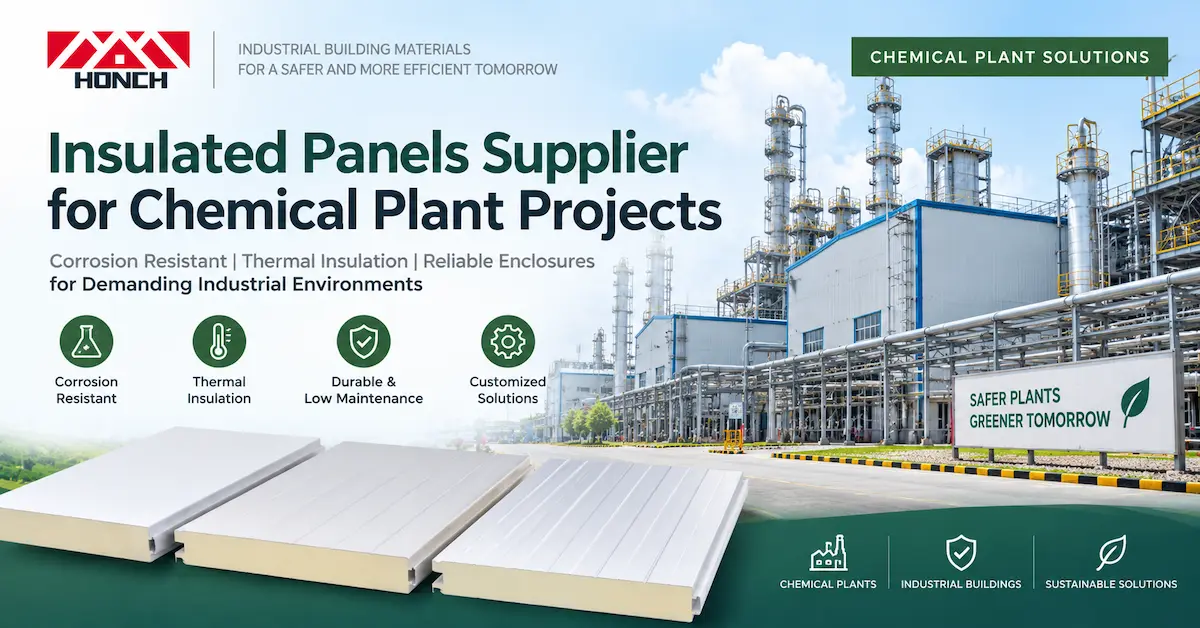
How Should Buyers Select an Insulated Panels Supplier for Chemical Plant Projects?
Selecting an insulated panels supplier for chemical plant construction should start with the operating environment rather than a catalogue thickness or a price per square metre. A chemical facility may include production workshops, warehouses, utility buildings, control rooms, maintenance areas, corridors and external building envelopes, and these zones can have very different requirements for thermal insulation, moisture resistance, chemical exposure, cleaning and weather protection. Buyers should therefore define where the panel will be installed, what substances may contact it, whether it is an internal ceiling, wall or external roof, and what technical documents are required before comparing suppliers. HONCH provides industrial building materials as well as insulation ceiling and wall panel products, allowing procurement teams to evaluate different building functions separately rather than treating every surface as the same panel application.
Chemical Plant Projects Need an Exposure-Based Specification
Chemical plant purchasing becomes risky when requirements are reduced to broad phrases such as “anti-corrosion panel” or “chemical-resistant insulated board.” Corrosion conditions can differ significantly depending on whether a material is exposed to vapor, condensation, cleaning water, chemical mist, splash, dust or outdoor weather. The buyer should identify the actual installation zone and describe the exposure as clearly as possible so that the proposed material can be evaluated against real operating conditions. The supplier should then explain which product construction is being offered, what supporting information is available and which conditions require additional engineering confirmation.
What Information Should the Buyer Provide?
A practical inquiry should include the chemical or process environment, approximate temperature range, humidity or condensation conditions where relevant, cleaning chemicals and cleaning frequency, installation position, required dimensions, building drawings, openings and penetrations, expected quantities, destination and required documentation.If the exact chemical concentration or operating condition is not yet known, it is better to identify that information as “to be confirmed” than to assume that one generic corrosion-resistant material will suit every zone.
Corrosion Resistance and Thermal Insulation Should Be Evaluated Separately
An insulated panel combines several functions, but each function should still be evaluated independently. A protective face may be intended to provide a cleanable and corrosion-resistant surface, while the insulation core addresses thermal performance. These are different technical questions. A material that performs well as a surface under one environment does not automatically establish the thermal performance of the full panel, and a panel with an insulation core does not automatically establish compatibility with every chemical used in a plant.
What the Panel Surface Needs to Do
For internal walls and ceilings, buyers should consider whether the surface will experience moisture, cleaning water, airborne contaminants or direct chemical contact. HONCH's PVC+PU+PVC insulation ceiling panel and PVC+PU+PVC insulation wall panel use PVC surface layers with a PU insulation core. This published construction provides a useful starting point for project evaluation, but it should not be interpreted as proof that the panel is resistant to every acid, alkali, solvent or oxidizing substance. Buyers should submit the relevant exposure conditions and request product-specific information before confirming suitability.
What the Insulation Core Needs to Do
The PU core provides the insulation component of these composite products, but purchasing decisions should not be made from nominal thickness alone. The project team should define its thermal objective and request the available thermal information for the proposed panel construction. Indoor temperature, outdoor climate, ventilation, wall or ceiling position, joints and penetrations can all affect the performance of the completed enclosure, so product data should be used together with the building design rather than converted into a universal performance guarantee.
Do Not Turn Material Names Into Performance Claims
Terms such as PVC, PU, UPVC or APVC describe materials or product constructions, but they do not by themselves prove a specific corrosion life, thermal value, fire classification, structural capacity or service life. A strong procurement specification links every important performance requirement to the exact proposed product and the supporting document available for that product.
What Should an Insulated Panels Supplier Document Before You Order?
An insulated panels supplier for chemical plant projects should be able to convert a general inquiry into a defined product and supply specification. Buyers should know what is being supplied, where it is intended to be installed and which technical requirements remain subject to project confirmation. This is especially important when several suppliers are being compared, because two quotations using the same general description may include different materials, dimensions, accessories or documentation.
| Specification Item | Buyer Should Define | Supplier Should Confirm | Procurement Purpose |
|---|---|---|---|
| Installation position | Ceiling, internal wall, external wall, roof or partition | Intended product application | Prevents incorrect substitution |
| Exposure condition | Chemical, humidity, cleaning,weather and temperature | Applicable product information and limitations | Supports material assessment |
| Panel construction | Required insulation and surface function | Face material, core and construction | Enables like-for-like comparison |
| Thickness | Project requirement or target performance | Panel and core thickness options | Avoids comparing thickness alone |
| Dimensions | Building layout and cut requirements | Width, length,tolerances and usable dimensions | Supports quantity planning |
| Joint system | Sealing and cleaning requirements | Connection profile and related details | Reduces weak points between panels |
| Openings | Pipes, ducts,doors and penetrations | Trims and interface requirements | Improves project coordination |
| Fixings | Supporting structure and exposure | Compatible fixing approach and accessory scope | Fixings may face separate corrosion risk |
| Thermal documentation | Required thermal target | Available data for proposed construction | Supports insulation assessment |
| Fire documentation | Required classification or project standard | Applicable report where available | Prevents unsupported fire claims |
| Packaging | Construction sequence and site storage | Packaging and identification method | Supports phased delivery |
| Inspection | Acceptance criteria | Inspection scope and records | Improves delivery control |
Match the Product Type to the Correct Chemical Plant Building Zone
One of the most important sourcing decisions is determining whether the project actually needs an insulated ceiling panel, insulated wall panel or external industrial roofing material. HONCH's current product structure includes all of these broader functions, but they should not be treated as interchangeable products.
PVC+PU+PVC Insulation Ceiling Panels
HONCH's PU insulation ceiling panel combines PVC faces and a rigid PU insulation core and is positioned as a ceiling product. For a chemical plant, a buyer might evaluate this type of construction for an internal ceiling where insulation and a protective surface are required. Before ordering, the project team should confirm the actual panel thickness, connection profile, installation arrangement, thermal documentation and suitability for the expected cleaning or environmental conditions.
PVC+PU+PVC Insulation Wall Panels
The PU insulation wall panel uses a similar broad PVC+PU+PVC construction for wall applications. A wall panel specification should identify whether the material is being used as an internal partition, an enclosure wall or another building element, because openings, corners, doors, support conditions and exposure can change the requirements. The quotation should also specify what accessories or trims are included rather than leaving these details to site installation.
Industrial UPVC/APVC Roofing Sheets
For weather-facing industrial roofing, HONCH also provides products such as the T930 UPVC/APVC roofing sheet and T1130 UPVC/APVC roofing sheet. These belong to an industrial roofing application rather than the same composite insulation panel category as the PVC+PU+PVC ceiling and wall products. A chemical plant project may therefore need several different material types: one for external roofing, another for insulated internal ceilings and another for walls.
Why These Products Should Not Be Treated as Interchangeable
A roof covering must address weather exposure, drainage, support and fixing requirements, while an internal insulated ceiling or wall panel has a different installation role. Similar material terminology does not prove equivalent structural, thermal or installation performance. Buyers should first define the building function and then evaluate the corresponding HONCH industrial product category.
How to Evaluate Chemical Resistance More Carefully
Chemical compatibility should be evaluated against the real exposure rather than a generic “chemical plant” description. Even within the same facility, a warehouse, utility room, washing area and process workshop may require different material considerations. A buyer should record the chemical name where known, approximate concentration, temperature, exposure form and frequency of contact so that the proposed panel can be evaluated more accurately.
The Flat Panel Surface Is Only One Part of the System
A panel may have a suitable face material while joints, edges, fasteners or sealants become the weaker point in an aggressive environment. Procurement teams should therefore inspect the complete assembly rather than approving only a flat sample. This is particularly important around wall-to-ceiling transitions, corners, pipe penetrations, cable routes, ventilation openings and doors.
Questions to Ask Before Approving the Material
Ask whether the available compatibility information relates to the exact surface material being quoted; whether exposed edges require special treatment; whether joint materials and sealants are supplied or specified separately; what fixing materials are expected; and whether any chemical or temperature limitations need to be included in the project specification. These questions are more useful than asking only whether the panel is “corrosion resistant.”
How Should Thermal and Condensation Requirements Be Checked?
Thermal insulation can be important in chemical plants for temperature control, personnel working conditions, storage areas or separation between conditioned and unconditioned spaces. However, the insulation requirement should come from the project conditions rather than from a generic recommendation by thickness.
Ask for Data for the Proposed Construction
If thermal performance is a purchasing criterion, request the available data for the exact panel construction being offered.Confirm whether the stated value relates to the complete panel, the insulation core or another test configuration. The quotation should identify the proposed thickness so that different suppliers can be compared on the same basis.
Condensation Is a Building-System Question
An insulated panel can contribute to thermal control, but it should not automatically be marketed as a guarantee that condensation will disappear. Indoor humidity, ventilation, outdoor temperature, insulation continuity, thermal bridges and joints all influence condensation risk. The responsible project designer should evaluate these conditions together.
Do Not Use Thickness as the Only Selection Rule
A thicker panel may provide more insulation within a specific product family, but thickness alone does not determine overall building performance. Buyers should establish the required outcome first and then ask the insulated panels supplier for chemical plant applications to provide a suitable product option and the supporting technical information available for it.
Fire and Safety Documentation Need Product-Level Verification
Chemical plants often have project-specific safety requirements, making unsupported fire claims especially risky. Terms such as “fireproof,” “flame resistant” or “safe for chemical plants” should not be accepted without understanding what product construction and test method they refer to.
Match the Report to the Ordered Panel
If the project requires a fire classification or another performance document, compare the report with the exact product being purchased. Check the product description, facing material, insulation core, thickness or configuration, test method and stated scope. A document for one product construction should not automatically be extended to every wall, ceiling or roofing product offered by the same manufacturer.
Supplier Documentation Does Not Replace Project Engineering
A supplier can provide product information and available reports, while the project designer or responsible engineer determines whether those documents satisfy the requirements of the specific facility.This separation helps buyers avoid turning a general product certificate into a broader project approval than it actually represents.
Inspect Joints, Edges and Samples Before Final Approval
Sample approval is more valuable when the sample represents the construction being purchased rather than only the color. Ask for a sample or mock-up that shows the panel face, insulation core, edge and connection profile where practical.
What Should Be Checked on a Panel Sample?
Check the surface finish, thickness, cross-section, joint shape, edge condition and dimensional consistency. Where two panels connect, assemble representative pieces and inspect how the joint closes. If trims, seals or accessories are part of the supply, confirm how they interface with the panel.
Keep an Approved Reference for Delivery Inspection
An approved sample should be linked to a written specification or order reference. This gives the buyer a more useful basis for checking delivered material and helps prevent approval from being reduced to a verbal agreement about appearance.
How to Compare HONCH Product Roles for a Chemical Plant
The following comparison focuses on product role rather than declaring one product technically superior. Actual suitability depends on the project requirements and confirmed product data.
| Product Type | Published Role | Chemical Plant Application to Evaluate | Main Checks Before Ordering |
|---|---|---|---|
| PVC+PU+PVC insulation ceiling panel | Composite insulated ceiling product | Internal insulated ceiling or lining | Exposure, thermal data, joints,fire requirement |
| PVC+PU+PVC insulation wall panel | Composite insulated wall product | Internal wall or insulated enclosure | Chemical environment, openings, fixing and documentation |
| T930 UPVC/APVC roofing sheet | Industrial roofing product | Weather-facing industrial roof | Roof design, exposure, fixing and support |
| T1130 UPVC/APVC roofing sheet | Industrial roofing product | Industrial roof requiring its specific profile | Dimensions, effective coverage,thickness and support |
A Single Chemical Plant May Require More Than One Product Family
Searching for an insulated panels supplier for chemical plant projects does not necessarily mean every building element should use an insulated sandwich construction. The roof, wall and ceiling may have different requirements. A better purchasing strategy is to create a material schedule by building zone and then select the appropriate product family for each function.
Compare Total Supply Scope Instead of Only Price per Square Metre
Price comparison becomes unreliable when suppliers calculate quantities differently or include different accessory and logistics packages. Before selecting a quotation, procurement teams should normalize the scope so that every supplier is responding to the same specification.
Confirm the Quantity Basis
Ask whether the quoted area represents gross manufactured area, shipped area, usable coverage or another quantity basis.This distinction is especially important for profiled roofing products, where nominal sheet width and effective coverage may not be the same.
Identify What the Price Includes
Confirm panel material, dimensions, accessories, trims, packaging, inspection requirements, technical documents, transport basis and any other agreed services. If installation is not included, this should be clear rather than assumed.
Lower Unit Price Does Not Automatically Mean Lower Project Cost
A lower material price may not be a better commercial result if the scope excludes necessary accessories, uses a different construction or creates additional site work. Conversely, a higher price does not automatically prove better quality. The comparison should focus on whether suppliers are quoting the same technical and commercial package.
How Should OEM and Custom Requirements Be Managed?
HONCH's insulation panel pages describe customization options for selected dimensions, colors, surfaces, connection-related requirements or packaging depending on the product.For industrial projects, customization should be controlled through an approved specification rather than informal messages.
Project-Specific Customization
Contractors may need panel lengths coordinated with drawings, identification by building area, project-specific packaging or different quantities for phased installation. These requirements should be submitted before production so the supplier can confirm feasibility and commercial implications.
Distributor and Private-Label Requirements
Distributors may need repeatable product specifications, packaging artwork or private-label identification. These requirements should be documented so later orders can reference the same approved construction rather than relying on a general product name.
Customization Does Not Mean Unlimited Specification Freedom
Any change to materials, dimensions, joints or performance-related construction should be confirmed by the supplier. If a technical report is important to the order, buyers should also confirm whether the changed configuration remains covered by the relevant documentation.
What Should a Chemical Plant Buyer Send Before Requesting a Quote?
A strong quotation request gives the supplier enough information to identify the correct product family and the remaining technical questions. Buyers should provide the project country and location, building function, installation area, roof/wall/ceiling position, approximate dimensions, quantities, drawings, operating environment, known chemical exposure, temperature and humidity conditions where relevant, cleaning method, required thermal or safety documents, packaging requirements, delivery destination and expected construction sequence. Mark mandatory requirements separately from items where the supplier is being asked to recommend an option. Buyers can first review HONCH's industrial materials and broader product range, then submit the project details through the HONCH contact page.
Frequently Asked Questions
What should I ask an insulated panels supplier for chemical plant projects before ordering?
Ask for the exact proposed product construction, intended application, dimensions, connection details, available technical documents, accessory scope, customization options, packaging basis and commercial exclusions. The supplier should respond to your actual plant environment rather than provide only a standard catalogue quotation.
Are PVC+PU+PVC panels suitable for every chemical environment?
No universal suitability should be assumed. Chemical compatibility depends on the actual substances, concentration, temperature, exposure form, contact frequency and cleaning conditions. Provide these details to the supplier and request information relevant to the proposed material.
Can I select an insulated panel only by thickness?
No. Thickness is only one parameter.Buyers should also consider panel construction, required thermal performance, installation position, joints, operating environment, project safety requirements and available documentation.
Are industrial roofing sheets the same as insulated wall panels?
No. HONCH's industrial roofing products and PVC+PU+PVC insulation wall products serve different building functions. Roofing sheets should not automatically be treated as insulated sandwich panels, and internal insulation panels should not automatically be specified as external roofing.
What parts of the panel system need corrosion evaluation?
Consider the panel face, exposed edges, joints, sealants, trims, fixings and penetrations. The flat surface may not represent the most demanding part of the installed system.
Can insulated panels prevent condensation completely?
They can contribute to the building's thermal envelope, but condensation depends on indoor humidity, outdoor temperature, ventilation, thermal bridges and connection details. It should be evaluated at building-system level rather than guaranteed from panel thickness alone.
How should fire-performance documents be checked?
Confirm that the document relates to the product construction being offered, including relevant materials and configuration. The project designer should determine whether that documentation satisfies the facility's requirements.
How should several supplier quotations be compared?
Use one common technical specification and quantity basis. Compare materials, dimensions, accessories, documentation, packaging, transport terms and exclusions alongside price so that different offers can be evaluated on a like-for-like basis.
Can HONCH provide customized industrial panel solutions?
HONCH's product pages describe customization possibilities for selected panel characteristics and packaging. Buyers should submit the required dimensions, quantities, drawings and customization details so feasibility, scope and commercial conditions can be confirmed for the actual order.
What information should I send HONCH for a chemical plant project?
Provide the building drawings, panel locations, dimensions, quantities, project destination, environmental conditions, known chemical exposure, thermal requirements, required technical documents, packaging needs and delivery sequence. These details can be submitted through the HONCH contact page for further product and quotation discussion.
Conclusion
Choosing an insulated panels supplier for chemical plant projects should be treated as a technical procurement decision rather than a simple comparison of thickness and price. Start by separating roof, wall and ceiling functions, then define chemical exposure, thermal requirements, cleaning conditions, joints, fixings, openings and documentation needs for each building zone.Evaluate PVC+PU+PVC insulation panels and industrial roofing products according to their actual roles instead of treating them as interchangeable materials, and compare quotations only after the technical scope, accessories, quantity basis and delivery conditions have been aligned. Buyers planning a new chemical plant building, renovation or industrial enclosure project can review HONCH's industrial products and contact HONCH with drawings, operating conditions and purchasing requirements to discuss an appropriate product and supply scope.