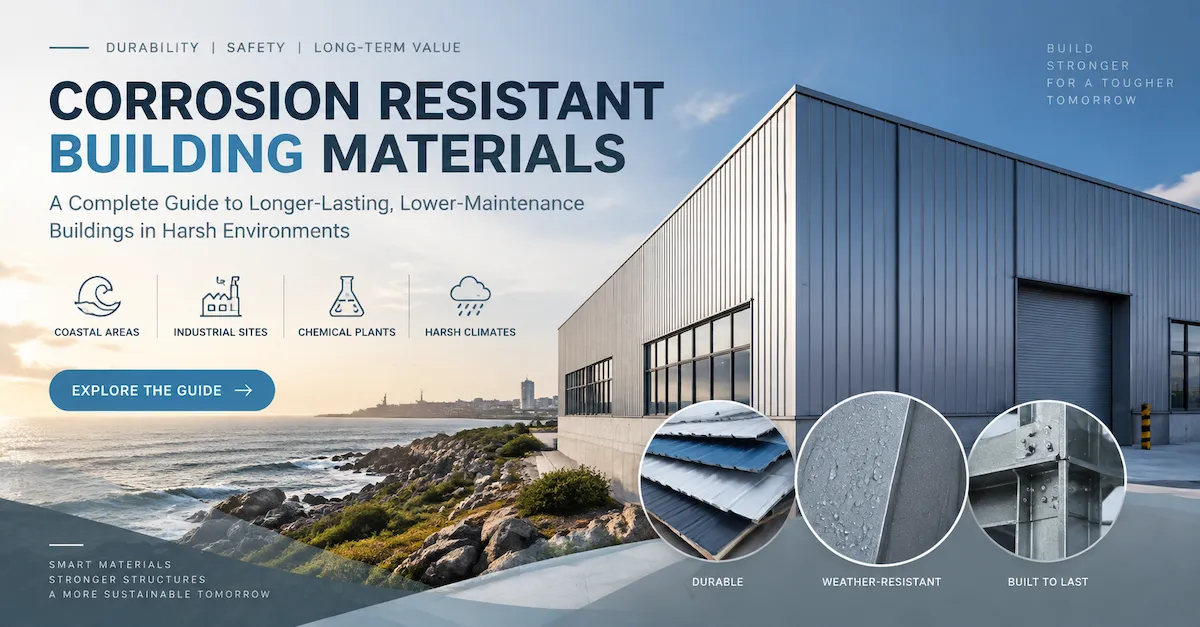
Direct answer for buyers: Anti-corrosion panels create value when they replace a material failure risk with a documented roof, wall or ceiling construction matched to the actual environment. The strongest purchasing case is not one broad durability promise; it is a set of measurable benefits tied to the selected product, such as PVC surfaces for corrosive conditions, a PU core where insulation is required, suitable joints and accessories, and a maintenance plan based on the operating environment.
HONCH supplies separate product families for UPVC/APVC roofing, PVC+PU+PVC insulated walls, PVC+PU+PVC insulated ceilings and the T910 PVC single ceiling panel. These products serve different building positions and should not be treated as interchangeable.
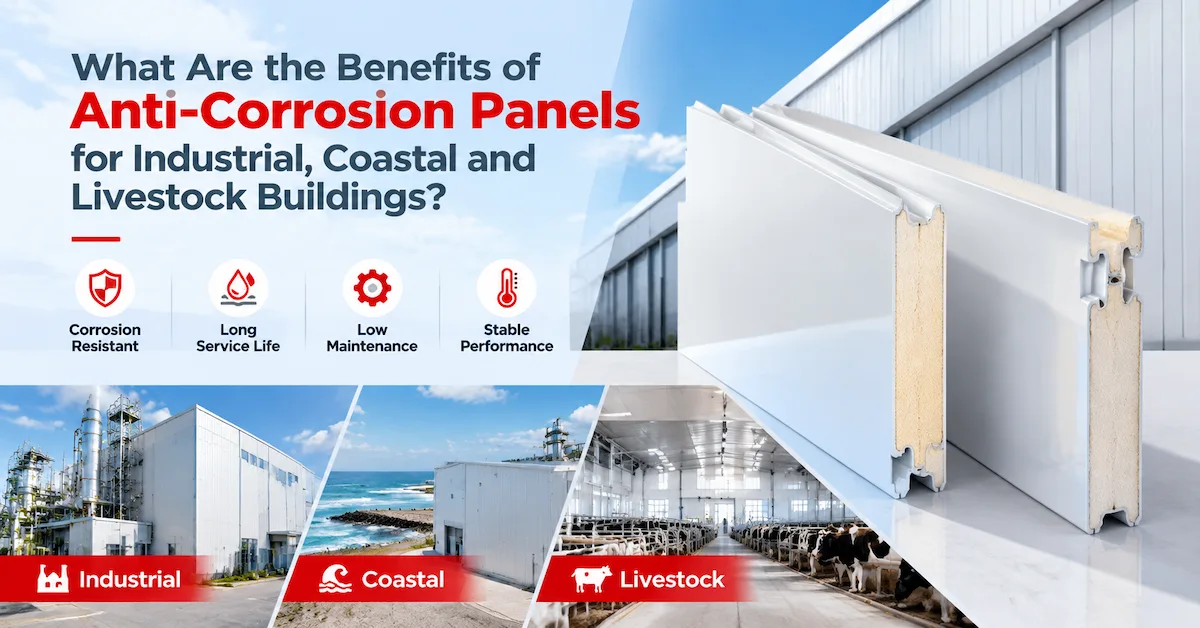
Anti-Corrosion Panel Benefits at a Glance
Buyers asking what are benefits of anti corrosion panels often need a quick business answer before a technical specification. The table below separates the potential benefit from the condition that makes it credible.
| Potential benefit | Practical buyer value | Condition to verify |
|---|---|---|
| Corrosion-risk control | Reduces dependence on exposed ferrous surfaces in humid, saline, livestock or process environments. | Material compatibility with the actual chemical, gas, salt, temperature and exposure route. |
| More predictable maintenance | Can reduce repeated treatment of rusting surfaces and make inspection priorities clearer. | Correct joints, fasteners, edges, cleaning procedure and documented maintenance intervals. |
| Moisture-conscious surfaces | Supports cleaning and use in high-humidity or washdown-sensitive spaces. | Complete wall, roof or ceiling details; a water-resistant panel alone does not make a watertight building. |
| Thermal control when insulated | A composite panel can combine protective PVC faces with a PU insulation layer. | Core specification, thickness, thermal data, joint continuity and building-design review. |
| Lower handling weight | Can simplify transport, cutting and installation planning compared with heavier assemblies. | Actual panel weight, length, lifting method, support spacing and fixing requirements. |
| System coordination | Related roof, wall, ceiling and accessory products can be discussed as one envelope package. | Position-specific products, compatible transitions and a complete supply-scope schedule. |
Benefit 1: Better Control of Corrosion Risk
The first benefit is also the most misunderstood. Iron-based materials can rust when moisture and reactive substances reach the substrate. PVC, UPVC and APVC do not contain the same exposed iron substrate, so they do not rust in the same way. This can make polymer-based panels useful where humidity, ammonia, salt-laden air or industrial gases create a recurring corrosion concern.
HONCH positions its PVC and UPVC/APVC products for demanding agricultural and industrial settings. The T910 ceiling panel is described for livestock houses and industrial buildings exposed to ammonia, moisture and chemical vapors. The PVC+PU+PVC wall and ceiling panels use PVC faces around a rigid PU core. The T920 roofing sheet is presented for factories, farms, warehouses, chemical plants and light buildings.
Why non-rusting is valuable but not the whole answer
A non-ferrous surface removes one familiar failure mechanism, but polymers can still age or lose performance through incompatible chemicals, high temperatures, ultraviolet exposure, thermal movement, impact, excessive stress or unsuitable cleaners. The correct benefit is therefore “better control of a defined corrosion risk,” not “indestructible in every environment.”
For procurement, convert the environment into a written exposure brief. Name the chemical or gas, concentration, temperature, contact time, frequency, ventilation and cleaning method. Ask whether the proposed material, seals, edges, fasteners and accessories have all been reviewed. This creates a defensible connection between the anti-corrosion benefit and the real site.
Where corrosion-risk control matters most
- Livestock houses with ammonia, hydrogen sulfide, humidity and disinfectant exposure.
- Coastal factories and warehouses affected by salt-laden air and wind-driven moisture.
- Chemical, paper, smelting or process buildings with defined vapors and cleaning regimes.
- Agricultural storage areas exposed to fertilizers, organic moisture or intermittent washing.
- Food-related or humid rooms where surface corrosion would complicate cleaning and inspection.
Benefit 2: More Predictable Maintenance and Lifecycle Planning
When a roof, wall or ceiling repeatedly corrodes, the cost is not limited to replacement material. The owner may also face access equipment, labor, production disruption, cleaning, temporary protection, disposal and damage to adjacent components. An anti-corrosion panel can support more predictable maintenance by reducing reliance on a surface that requires recurring rust treatment in the defined environment.
This does not justify a universal savings percentage. The financial benefit depends on the original material, exposure severity, panel price, installation method, inspection access, project life and cost of downtime. A responsible lifecycle comparison records these inputs rather than promising a fixed payback.
Compare lifecycle tasks, not only unit prices
Ask each bidder to separate material, accessories, packaging, freight and installation assumptions. Then compare expected inspection, cleaning, recoating, fastener replacement, seal maintenance and panel replacement tasks. A higher initial material price may be reasonable when it removes a known maintenance operation, but only if the proposed construction is compatible with the site and its own maintenance requirements are understood.
Maintenance remains necessary
Anti-corrosion panels still need inspection. Review impact damage, loose fixings, seal condition, cut edges, penetrations, accumulated deposits and changes in the building process. Washdown procedures should not force water or chemicals into joints. Outdoor sheets need inspection after severe weather, and internal agricultural panels need attention at lower-wall impact zones and equipment interfaces.
The practical engineering lesson is simple: the panel should make maintenance more controlled, not invisible. A documented inspection plan protects the benefit by identifying small defects before they affect the wider assembly.
Benefit 3: Moisture Resistance and Easier Cleaning
What are benefits of anti corrosion panels in humid interiors? One important advantage is the possibility of using a moisture-conscious, smooth surface instead of a material that readily absorbs water, flakes or exposes a corroding substrate. This is relevant to livestock buildings, agricultural rooms, food-processing areas, cold rooms and selected industrial spaces.
HONCH describes the PVC surfaces of its wall and ceiling products as waterproof or moisture-resistant and positions them for high-humidity and corrosive conditions. A smooth PVC face can be easier to inspect and clean, provided that the cleaning chemicals, temperature, pressure and contact time are compatible with the complete assembly.
Panel moisture resistance is not complete-building waterproofing
Water often enters through joints, corners, fasteners, openings and transitions rather than through the center of a panel. An individual sheet can resist moisture while a poorly detailed wall or roof still leaks. Buyers should therefore review wall-to-floor connections, roof-to-wall transitions, door and window openings, ridge details, penetrations and drainage.
Cleanability must be converted into operating conditions
“Easy to clean” is meaningful only when the cleaning procedure is defined. Provide detergent and disinfectant names, dilution, water temperature, pressure, contact time and frequency. Ask the supplier to identify restrictions and review exposed edges, seals and fixings. For hygiene-sensitive facilities, the project team should also review joint geometry, access and drying, because surface material alone does not establish a hygienic building.
Benefit 4: Thermal Insulation in Composite Panel Systems
Anti-corrosion performance and insulation are separate functions, but a composite construction can provide both. HONCH’s PU insulation wall and ceiling panels use a PVC outer skin, rigid PU core and PVC inner skin. The PVC faces address the exposed surfaces, while the PU core provides the insulation layer.
This can be valuable in livestock houses, cold rooms, industrial workshops and agricultural buildings where indoor temperature matters as well as corrosion. Combining surfaces and insulation in one panel can simplify the material schedule and reduce the number of separate layers that must be coordinated.
Insulation can support operating stability
In animal housing, indoor temperature interacts with ventilation, animal density and moisture. In a workshop, it can affect worker comfort or process conditions. In a cold room, thermal separation is central to the building’s purpose. An insulated anti-corrosion panel can contribute to these goals when the core, thickness and joints are designed for the required thermal performance.
A PU core does not prove every performance claim
The material name alone does not establish a U-value, fire classification, condensation result or structural span. Request thermal data and test documents for the proposed construction and thickness. Have the responsible designer assess joints, thermal bridges, doors, supports and penetrations. Fire requirements must be checked against the applicable report and local project rules; “insulated” is not the same as “fireproof.”


Benefit 5: Lower Weight and Practical Installation
PVC and PVC composite panels are presented as lightweight building materials. Lower weight can help with transport, unloading, lifting, cutting and installation, especially in renovation work or buildings with long panel runs. It may also reduce handling pressure on crews and make replacement pieces easier to manage.
The benefit should be verified with actual numbers. Ask for panel weight, dimensions, bundle weight, lifting points, storage requirements and support spacing for the offered configuration. A lightweight panel is not automatically suitable for every wind load, span, impact zone or suspended equipment condition. Structural decisions remain the responsibility of the project design and the approved installation details.
Custom lengths can reduce site cutting
HONCH publishes length customization for selected roofing and wall-panel products. A length schedule coordinated with the building can reduce site cutting, offcuts and unnecessary joints. It can also improve packaging by grouping material according to elevations or construction phases.
Long pieces create their own logistics questions. Confirm transport limits, container loading, unloading equipment, carrying access, thermal movement and installation sequence. The useful benefit is not “longer is always better”; it is that the manufacturer can align production length with a reviewed cut list and logistics plan.
Benefit 6: Better Fit for Livestock and Agricultural Buildings
Livestock facilities combine conditions that are difficult for ordinary finishes: humidity, ammonia, hydrogen sulfide, dust, washdown, disinfectants and seasonal temperature changes. Anti-corrosion panels are relevant because they can address exposed surfaces while composite products can add thermal insulation where the building plan requires it.
HONCH’s public livestock engineering case describes insulation ceiling work for large modern cattle, chicken and pig farms and names Muyuan Food Group, Wenshi Group and Chia Tai Group. It presents stable indoor conditions, improved breeding environments and cost control as project goals. This is useful evidence of agricultural project experience, but a new buyer should still request the product scope and records relevant to its own building.
Hygiene and animal management depend on details
For a pig or poultry building, inspect lower walls, wall-to-floor junctions, ceiling penetrations, fan openings, doors and service equipment. Cleaning water should drain rather than remain in concealed interfaces. Ventilation must control moisture because no panel can eliminate condensation independently of indoor humidity, temperature and air movement.
Separate single ceilings from insulated composites
The T910 PVC single ceiling panel and a PVC+PU+PVC insulation ceiling panel do not perform the same role. T910 primarily provides a PVC-based ceiling surface, while the composite product includes a rigid PU core. Buyers should choose between them based on the need for an exposed ceiling lining, thermal insulation or both, then verify supports and connection details.
Benefit 7: A Coordinated Roof, Wall and Ceiling Package
Corrosion problems often cross product boundaries. A suitable wall can still be compromised by roof leakage, an incompatible fastener, an unsealed opening or a poorly detailed ceiling transition. One benefit of working with a manufacturer that offers multiple building-envelope products is the ability to discuss interfaces within one technical and commercial package.
HONCH’s portfolio includes UPVC/APVC roofing sheets, PVC and PVC+PU+PVC ceiling products, a PVC+PU+PVC wall panel and roofing accessories. This does not mean every product automatically connects to every other product. It does allow the buyer to request a coordinated review of roof, wall, ceiling and accessory positions instead of purchasing isolated materials with unresolved transitions.
| Building position | HONCH product direction | Main benefit to evaluate | Important boundary |
|---|---|---|---|
| External roof | UPVC/APVC roofing sheets such as T920 | Corrosion-conscious weather protection with defined profiles and custom length options. | Verify slope, wind, drainage, overlap, support and accessories. |
| Internal ceiling | T910 PVC single ceiling panel | Moisture- and corrosion-conscious internal surface. | Do not assume equivalence to a PU-core insulated panel or external roof. |
| Insulated ceiling | PVC+PU+PVC insulation ceiling panel | Protective faces plus a rigid insulation core. | Verify thermal data, joints, support, fire documents and permitted use. |
| Insulated wall | PVC+PU+PVC insulation wall panel | Corrosion-conscious faces, insulation and interlocking installation concept. | Verify openings, impact zones, floor connection, support and chemical exposure. |
When the Claimed Benefits May Not Apply
A credible answer to what are benefits of anti corrosion panels must include the limitations. The material may be a poor choice when the operating temperature, solvent, oxidizer, direct immersion, fire requirement, structural load or impact condition exceeds the documented scope. It may also fail to deliver value when the joints, fasteners, edges or supports are incompatible with the environment.
Severe or undefined chemical exposure
If the buyer cannot identify the process chemical or if exposure includes strong solvents, oxidizers, immersion or high temperature, request project-specific material review. Laboratory testing may be needed. A pH value alone is not enough because chemicals with similar pH can interact differently with polymers, seals and fasteners.
External weather without verified UV and profile suitability
An internal wall or ceiling product should not be moved outdoors because it contains PVC. Outdoor roofing and wall cladding require weathering, drainage, wind and connection checks. Use a product published for the position and request evidence for the selected configuration.
Unresolved fire or structural requirements
Anti-corrosion is not a fire or structural classification. Check the panel against local project requirements and the applicable report. Do not suspend equipment, walk on a ceiling panel or increase support spacing without written engineering confirmation.
Poor ventilation and uncontrolled condensation
Insulated panels can contribute to thermal control, but they cannot independently correct excessive indoor humidity, uncontrolled air leakage or inadequate ventilation. Condensation analysis must include indoor conditions, climate, joints and thermal bridges.
How Buyers Should Verify the Benefits Before Ordering
Understanding what are benefits of anti corrosion panels is useful only if the promised value survives the purchase process. Before ordering, connect each claimed benefit to a document, sample, project condition or inspection point.
Product identity: exact product name, installation position, material layers, profile and approved sample.
Dimensions: overall thickness, face and core information, width, usable coverage, length, tolerance and weight.
Exposure: chemical or gas, concentration, temperature, contact time, humidity, UV, salt and cleaning procedure.
Interfaces: joint, fastener, seal, edge, corner, opening, ridge, floor and roof transition details.
Documents: technical data, applicable test reports, certificate scope, inspection criteria and installation guidance.
Commercial scope: MOQ, sample process, production schedule, packaging, labels, accessories, delivery basis and exclusions.
Use HONCH evidence within its stated scope
ZHEJIANG HONCH TECHNOLOGY CO., LTD was founded in Jinhua, China, in 2008 and states that it specializes in anti-corrosion and insulation solutions for light buildings, factories, farms, roofs, walls and ceilings. The company publishes ISO9001 and EU CE information, self-operated import and export rights, manufacturing and process images, international exhibition activity and OEM/ODM support.
The public CE information identifies an Insulated Sandwich Panel, PVC material, thickness 1–50 mm, assessment System 4 and EN 14509:2013. Buyers should check whether the offered product and construction fall within the relevant document. The certificate should not be generalized to every roofing sheet, ceiling panel or customized configuration.
Confirm MOQ, lead time and packaging against the final specification
HONCH’s public product pages describe customization and export support but do not establish one universal MOQ or fixed lead time for every product. Ask for commercial terms after confirming product, color, thickness, length, quantity, packaging and destination. Separate sample approval, production, dispatch and transit in the project schedule.
For packaging, request bundle dimensions, weight, protection, labels, loading arrangement and package separation by building or installation area. For a distributor, confirm branding and repeat-order controls. For a contractor, connect package labels to the approved cut list and installation sequence.
FAQ: Benefits of Anti-Corrosion Panels
What are benefits of anti corrosion panels for industrial buildings?
They can reduce exposure of rust-prone surfaces, support more predictable maintenance, provide moisture-conscious interior or exterior surfaces and, in composite constructions, add thermal insulation. The benefit depends on matching the panel and complete assembly to the factory’s chemicals, temperature, humidity, weather and structural requirements.
Do anti-corrosion panels resist every chemical?
No. Compatibility depends on the material formulation, chemical identity, concentration, temperature, contact time and exposure route. Provide the manufacturer with the site’s actual chemicals and cleaning procedure. Include seals, fasteners, edges and accessories in the review.
Are anti-corrosion panels waterproof?
Some products are described as waterproof or moisture-resistant, but a panel claim does not make the installed building watertight. Roof laps, wall joints, corners, openings, penetrations, fasteners and drainage determine whether the complete assembly controls water.
Can anti-corrosion panels reduce maintenance costs?
They may reduce maintenance associated with rusting or repeatedly coated surfaces in a compatible environment. Calculate the benefit using project-specific material, installation, inspection, cleaning, recoating, downtime and replacement costs. Avoid relying on an unsupported universal savings percentage.
Do anti-corrosion panels provide thermal insulation?
Not all of them. A single PVC ceiling panel and a PVC+PU+PVC composite have different structures. In the composite, the rigid PU core provides the insulation layer. Request thermal data for the ordered thickness and review joints and thermal bridges.
Are anti-corrosion panels maintenance-free?
No. Inspect joints, seals, fixings, impact damage, deposits, openings and edges. Follow a cleaning procedure compatible with the material. Maintenance may become more predictable, but it does not disappear.
Why are anti-corrosion panels useful in livestock buildings?
Livestock interiors can combine humidity, ammonia, hydrogen sulfide, disinfectants and washdown. A suitable PVC surface can address corrosive and moisture exposure, while a PVC+PU+PVC product can also add insulation. Ventilation, joints, cleaning and chemical compatibility remain essential.
Can wall or ceiling panels be used as external roofing?
Do not assume so. External roofing has requirements for slope, rain, overlap, drainage, UV, wind and ridge details. Select a product intended for roofing and verify the structural and installation requirements.
What should buyers include in an anti-corrosion panel RFQ?
Include the building position, drawings, dimensions, support layout, chemicals, cleaning method, temperature, humidity, UV or salt exposure, insulation target, required documents, quantity, destination, packaging and delivery sequence. Ask the supplier to state assumptions and exclusions.
Who manufactures HONCH anti-corrosion building panels?
ZHEJIANG HONCH TECHNOLOGY CO., LTD, founded in Jinhua in 2008, publishes anti-corrosion and insulation products for roofs, walls and ceilings. Its markets include livestock, industrial, agricultural and light-building projects in China and overseas. Review the HONCH company and certification information for entity and factory details.
Conclusion
What are benefits of anti corrosion panels? The most valuable benefits are better control of defined corrosion risks, more predictable maintenance, moisture-conscious and cleanable surfaces, lower handling weight, and the option to combine protective PVC faces with a rigid PU insulation core. In livestock, coastal, chemical, agricultural and humid buildings, these characteristics can improve the reliability and operating fit of roofs, walls and ceilings.
The benefit is credible only when the material and complete assembly match the actual exposure. Verify product position, material layers, joints, fasteners, support, chemicals, cleaning, weather, thermal data and document scope before ordering. HONCH can discuss UPVC/APVC roofing, PVC ceilings and PVC+PU+PVC wall and ceiling products against a project brief, with MOQ, lead time, packaging and customized specifications confirmed for the selected configuration.