The Short Answer: Which Roofing Material Lasts Longer?
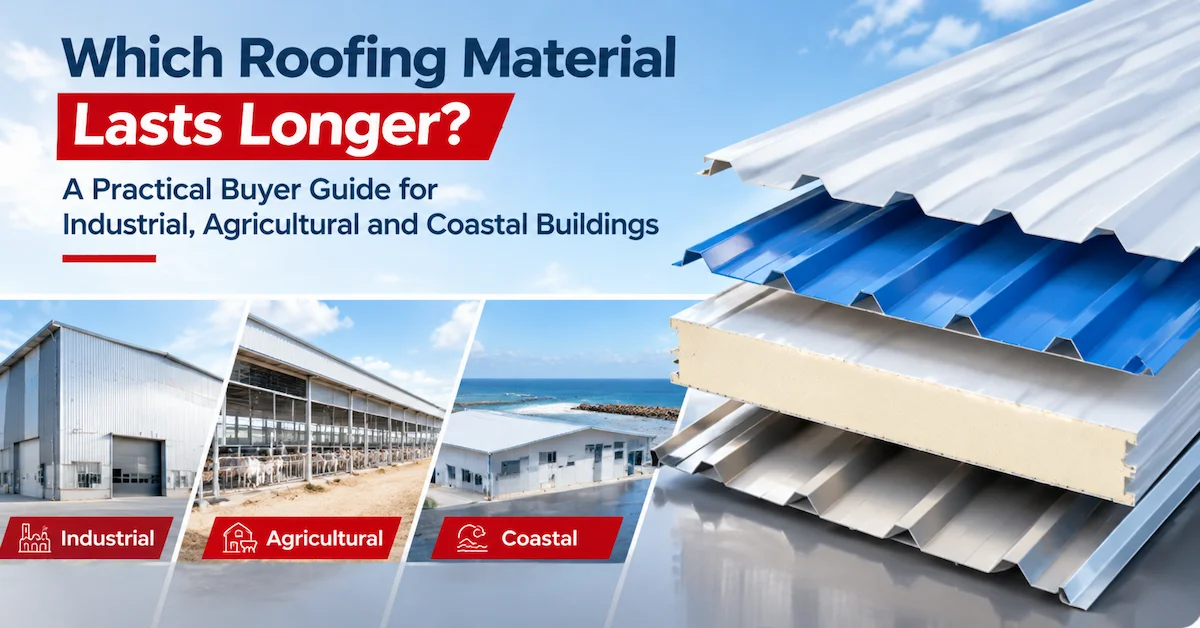
When buyers ask which roofing material lasts longer, the most accurate answer is: the material that matches the building's exposure, roof design, installation quality and maintenance plan. There is no universal winner between metal, UPVC, APVC, PVC and insulated roof panels. A coated metal roof can be a strong long-term choice in a dry environment with good detailing. UPVC or APVC roofing can be the more durable option where humidity, salt, ammonia, acid fumes or industrial exhaust make rust-related maintenance the dominant risk.
Roofing life is not controlled by the sheet alone. Water can enter at a ridge, overlap, fastener, penetration or wall-to-roof transition even when the main sheet is still sound. UV exposure can change a surface. Thermal movement can stress fixings. Poor support spacing can cause deformation. A roof that is technically durable in the factory can therefore have a short practical life if the system is specified or installed incorrectly.
Procurement answer: For dry, well-maintained buildings, properly specified metal roofing may last a long time. For humid, coastal, livestock, agricultural and chemically exposed buildings, UPVC or APVC roofing may deliver a longer maintenance-free service period because it does not rust like exposed steel. For temperature-controlled buildings, an insulated roof may offer the best lifecycle result because thermal performance and condensation control are part of the durability decision.
What “Lasts Longer” Should Mean in a Roofing Specification
“Long-lasting” is too vague to use as a purchasing requirement. A roof can remain visibly intact while leaking around fasteners, losing thermal performance through open joints or requiring frequent coating repairs. To make a fair comparison, define the performance endpoint that matters to the building owner.
| Durability question | What to measure or inspect | Why it affects the buying decision |
|---|---|---|
| Will the roof remain watertight? | Profile, slope, overlaps, ridge details, penetrations, fasteners and drainage. | A durable sheet cannot compensate for a weak waterproofing detail. |
| Will the surface resist the environment? | Metal coating or polymer formulation, UV exposure, salt, chemicals and humidity. | The dominant exposure determines whether rust, chalking, cracking or chemical attack controls maintenance. |
| Will indoor conditions remain acceptable? | Heat transfer, condensation, ventilation, insulation thickness and thermal bridges. | An uninsulated roof may remain waterproof but still create an expensive indoor climate problem. |
| Can the roof be maintained? | Access, replacement parts, compatible accessories, cleaning method and inspection records. | Repairability often determines practical lifecycle cost. |
| Will the roof retain its structural function? | Support spacing, wind, snow, impact, profile stiffness and fixing design. | Material durability does not equal structural suitability. |
This definition changes the conversation from “Which material has the biggest lifespan claim?” to “Which roof system is least likely to fail in this building?” That is the more useful question for a factory owner, livestock developer, contractor or distributor.
How the Main Roofing Materials Fail
Metal roofing: durable when the corrosion system stays intact
Metal roof panels are familiar because they offer established structural design practices, a wide range of profiles and strong availability in many markets. Their durability depends on the base metal, metallic coating, paint system, thickness, cut-edge treatment, fasteners, overlaps and exposure. A dry warehouse with controlled drainage may be a favorable environment. A humid farm or chemical workshop can create a much more demanding one.
The most important metal-roof risks are often local rather than uniform. Scratches, drilled holes, cut edges, incompatible screws, trapped moisture under laps and contact with dissimilar metals can create corrosion points. Once a coating is damaged, the repair may require cleaning, priming, repainting or replacing a detail. If the building is difficult to access, the cost of that maintenance can exceed the initial material price difference.
When metal may be the better fit
- The project has significant structural or long-span requirements that the selected metal system is designed to meet.
- The site has a moderate corrosion load and the coating, fastener and edge details are clearly specified.
- Local contractors, design codes and maintenance teams are already set up for the metal roof system.
- The buyer can inspect and repair coating damage before it becomes widespread.
UPVC and APVC roofing: less rust risk, but still a complete system
UPVC and APVC roof panels are often selected for factories, farms, warehouses, chemical-related buildings and other humid or corrosive environments. Their main durability advantage is that they do not rust like an exposed ferrous substrate. That can reduce the risk of rust around broad surface areas, especially where ammonia, salt or industrial exhaust makes painted steel maintenance-intensive.
Polymer roofing is not chemically invulnerable. The buyer should still check UV exposure, temperature range, chemical compatibility, impact risk, profile stiffness, support spacing and the performance of fasteners and accessories. A polymer sheet can age through weathering, discoloration, cracking, deformation or impact even when rust is not present. The right comparison is therefore “polymer roof system versus coated metal roof system under this exposure,” not “plastic versus metal in every situation.”
Where UPVC or APVC can have a lifecycle advantage
- Livestock buildings where ammonia, humidity and washdown create a corrosive atmosphere.
- Coastal or salt-exposed buildings where wet-dry cycles increase coating maintenance.
- Chemical or industrial buildings where the confirmed material compatibility is better suited to the exposure.
- Projects that value low weight, corrosion resistance and simpler handling.
PVC and ASA-surface roofing: surface protection must match the climate
PVC-based roofing can provide a smooth, water-resistant and corrosion-conscious roof surface. Some products use a weather-resistant or ASA surface layer to improve outdoor stability. The important procurement question is not whether the word “ASA” appears in a brochure. It is whether the exact surface construction, color, thickness and profile have been selected for the project's UV, temperature and chemical conditions.
For a roof in strong sunlight, compare surface weathering evidence, color stability, thermal movement and installation guidance. For a roof in a farm or chemical building, compare the surface with the cleaning method, airborne exposure and expected impact. A more weather-resistant face can improve service performance, but it cannot correct an inadequate roof slope or unsealed penetration.
Insulated roof panels: durability includes thermal and condensation control
An insulated roof system may use a metal or polymer face with an insulation core. Its service value comes from the complete assembly: face, core, joint, vapor control, flashing, fasteners and support. If the building requires temperature control, a roof that remains physically intact but causes persistent condensation may be a poor long-term choice.
Insulation also introduces additional details to check. Joints must remain aligned and sealed. Penetrations must preserve vapor control. Edges must be protected. The buyer should request thermal data for the final thickness and construction rather than infer performance from the word “insulated.” The same principle applies whether the face is metal, PVC or another material.
Material Comparison by Exposure
Climate and building use often reveal which roofing material lasts longer more clearly than a general material ranking. The table below is a screening tool. It does not replace the product specification or structural design.
| Project condition | Material family to investigate first | Why it may fit | Main verification before ordering |
|---|---|---|---|
| Dry general warehouse | Coated metal or polymer roof panels | Both can work when drainage, support and access are well controlled. | Wind, roof span, coating or polymer weathering, total maintenance scope. |
| Livestock or poultry building | UPVC/APVC or another confirmed corrosion-resistant system | Reduces dependence on exposed steel in ammonia and high-humidity conditions. | Ammonia, disinfectant, washdown, ventilation, impact and accessory compatibility. |
| Coastal building | UPVC/APVC or a metal system with a verified coastal coating package | Salt exposure makes coating, edge and fastener quality critical. | Salt exposure, wind-driven rain, UV, dissimilar metals and inspection access. |
| Chemical or industrial workshop | Material selected from confirmed chemical compatibility | The best material is the one that resists the actual vapor, splash and cleaning regime. | Chemical name, concentration, temperature, contact time, seals and trims. |
| Cold or temperature-controlled room | Insulated roof assembly with compatible vapor and joint details | Thermal continuity and condensation control become part of roof durability. | Thermal report, joint performance, penetrations, doors, flashing and drainage. |
| Light-duty renovation | Lightweight UPVC/APVC or compatible roof overlay system | Low weight and custom length may simplify handling and installation. | Existing structure, support condition, wind uplift, overlap and old-roof drainage. |
The Roof Details That Often Decide Service Life
Profile and effective coverage
A nominal width is not the same as the installed coverage. The overlap consumes part of the sheet, and the profile influences drainage, stiffness and fastener placement. Confirm full width, effective width, wave or rib geometry, overlap direction and the length available for the project. Long custom panels can reduce transverse joints, but they also require careful handling, support alignment and movement planning.
Slope and drainage
A roof material cannot perform its waterproofing function if water is allowed to pond or travel against the intended overlap. Check roof pitch, gutter design, valley details, penetrations and the local rainfall pattern. On a large roof, a small drainage mistake is repeated across a large area and becomes a recurring maintenance cost.
Fasteners and washers
Fasteners should be compatible with the roof material and exposure. Overtightening can deform a polymer sheet or damage a washer. Undertightening can allow movement and water entry. Metal roofs also require attention to coating damage around drilled points and contact between dissimilar materials. The supplier should provide or approve the fixing arrangement instead of leaving the installer to improvise.
Ridges, edges and penetrations
Ridge caps, end closures, flashings, skylights, fans, pipes and solar penetrations are common failure locations. A roof quote that covers only the sheet may look inexpensive but leave the most important details unresolved. Review the complete accessory list and the method for sealing each opening before comparing suppliers.
Support spacing and movement
Profile strength is meaningful only with the correct support spacing and loading assumptions. Wind, snow, maintenance traffic and temperature movement should be considered in the design. A roof panel that is durable against corrosion can still fail from excessive span, impact or movement. Ask for installation limits and do not use a roofing sheet as a structural deck unless the supplier and engineer confirm that function.
What HONCH Roofing Products Show About Material Selection
HONCH publishes several UPVC/APVC roofing profiles rather than treating every roof as the same product. The T920 UPVC/APVC roofing sheet page lists a 920 mm full width, 840 mm effective coverage width, 26 mm wave height and thickness options of 1.5, 2.0, 2.5 and 3.0 mm. It positions the profile for factories, livestock farms, warehouses, chemical plants and light-duty construction, with custom length.
The T930 profile is presented for industrial and agricultural buildings, with anti-corrosion, waterproof, insulation and impact-resistance claims. The T1130 profile is published with 1130 mm width and 1050 mm effective width, together with custom length, thickness and color options. These pages support a product-selection discussion, but they do not establish one universal lifespan for every project or configuration.
For procurement, the practical point is that a profile, width and thickness should be selected with the roof structure and environment. A wider profile may reduce the number of sheets or improve installation efficiency, while the required support spacing and fixing pattern still need confirmation. A thicker sheet may help with certain handling or mechanical requirements, but it does not make an unsuitable chemical or installation detail acceptable.
HONCH states that it supplies anti-corrosion and insulation building materials for factories, farms, roofs, walls and ceilings, and that the company was founded in Jinhua in 2008. Buyers can use the company information page to review the published manufacturing scope and certification information, then request documentation for the exact product and destination market.
How to Compare Total Roof Life Instead of Sheet Price
A roof with a lower purchase price can become more expensive if it requires frequent coating repairs, complicated accessories, early replacement or repeated downtime. A roof with a higher initial price can also be poor value if its material is over-specified for a simple dry building. Use a lifecycle comparison that includes the items below.
Initial material and accessory cost
Compare the sheet, effective coverage, ridge caps, flashings, fasteners, washers, sealants, edge trims and packaging. Do not compare a complete polymer roof system with a metal sheet price that excludes its coating, fasteners or accessories.
Installation cost and handling
Weight, custom length, cutting, overlap quantity and installation method affect labor. A lightweight roof may be easier to handle, but the installer still needs the right support and fixing procedure. Large custom sheets can reduce seams but may need better transport and lifting control.
Inspection and repair cost
Estimate how easily the roof can be inspected and what happens after a scratch, leak, storm event or chemical incident. Consider whether matching replacement sheets and accessories will still be available. A roof with a clear repair path is easier to manage than one that depends on improvised parts.
Energy and indoor-condition cost
For a livestock building, cold room or workshop, heat gain and condensation can affect operating cost and product quality. Include insulation, ventilation and drainage in the comparison. A roof that lasts physically but creates persistent overheating may still fail the building's business purpose.
Downtime and replacement risk
Roof work can interrupt production, storage or animal housing. A material with lower corrosion exposure may be worth considering when access is difficult or shutdown is expensive. This does not mean every project should select UPVC/APVC; it means the cost of failure should be part of the decision.
A Buyer’s Verification Checklist
Before ordering, ask each supplier to answer the same questions. The goal is not to collect the largest brochure. It is to make the proposed roof comparable and auditable.
Material: What is the exact face material, formulation, coating or surface layer? Is the product PVC, UPVC, APVC, ASA-surfaced, coated steel, galvanized steel or another construction?
Exposure: Has the supplier reviewed the site's humidity, salt, ammonia, chemical vapor, UV, temperature, rainfall, wind and cleaning conditions?
Geometry: What are the full width, effective coverage, profile height, thickness, custom length and minimum roof slope?
System: Which ridge caps, flashings, fasteners, washers, sealants and edge details are included or recommended?
Structure: What support spacing, wind load, snow load, impact limits and maintenance access assumptions apply?
Evidence: Can the supplier provide a sample, cross-section, technical sheet, test or certification document that matches the ordered configuration?
Supply: What are the MOQ, production lead time, packaging method, replacement availability and export terms for the final color, length and quantity?
For a project quotation, send the building type, roof area, roof drawing, slope, support spacing, location, exposure, preferred color, thickness, quantity and destination. This gives the manufacturer enough context to recommend a profile instead of returning a generic price list.
Application Decisions: Which Material Lasts Longer in Your Building?
For livestock farms and poultry houses
The main durability question is usually corrosion and cleaning, not just wind resistance. Ammonia, humidity, disinfectants and washdown can accelerate maintenance on exposed metal details. UPVC or APVC roofing should be compared with a metal system whose coating, edges and fasteners are specifically approved for the farm environment. Also review ventilation, condensation, animal contact, lower-wall protection and access for cleaning.
HONCH's roofing pages identify livestock and breeding facilities as applications for its UPVC/APVC profiles. The correct thickness, profile, support and accessories still depend on the project. Do not transfer a product-page claim into a structural or chemical guarantee without confirming the actual building conditions.
For factories and chemical workshops
Factories may have very different roof exposures even within the same site. A dry assembly area, an acid-mist process zone and a warehouse beside a process building should not automatically use the same roof. Identify the chemical route: vapor, splash, deposit, washdown or accidental spill. Then check the roof face, sealants, fasteners, flashings and drainage as a group.
For warehouses and logistics buildings
Roof leaks, heat buildup and maintenance access often matter more than chemical resistance. Metal may be suitable when the environment is dry and the coating package is controlled. UPVC/APVC can be a practical alternative where humidity, agricultural dust or coastal air increases rust risk. Compare effective coverage, installation speed, ridge details and the cost of keeping stored goods dry.
For coastal buildings
Salt-laden air reaches fasteners, cut edges, laps and drainage points. A metal roof can still work when the selected coating and connection system are appropriate, but the evidence should address coastal exposure. Polymer roofing may reduce rust-related risk, while UV, wind, impact and thermal movement still need attention. Maintenance access is especially important because salt deposits can hide local deterioration.
For renovation or flat-to-slope projects
Renovation adds an existing-structure constraint. Check the old roof, purlin spacing, drainage, added weight, fixing route and ventilation before selecting a new material. Lightweight UPVC/APVC panels can be attractive for some projects, but the installation must prevent trapped water and ensure that the new roof has a workable slope and accessory system.
FAQ: Roofing Material Service Life
Which roofing material lasts longer?
The material that lasts longer is the one that best matches the building's exposure and installation conditions. Coated metal can perform well in dry, well-maintained buildings. UPVC or APVC may be more durable in humid, livestock, coastal or corrosive environments because it avoids rust in the polymer surface. Insulated systems may provide better lifecycle value when condensation and temperature control are critical.
Do metal roof panels last longer than UPVC roofing sheets?
Not automatically. Metal durability depends on its base metal, coating, cut edges, fasteners and maintenance. UPVC roofing sheets avoid rust but still need suitable UV, impact, temperature and support performance. Compare the complete systems under the actual site exposure rather than using a general material ranking.
Are UPVC or APVC roofs suitable for industrial buildings?
They can be suitable for industrial buildings when the product, profile, thickness, support and chemical compatibility match the project. HONCH publishes UPVC/APVC roofing profiles for factories, warehouses, chemical-related buildings and other light-duty applications. Confirm the actual exposure and required structural performance before ordering.
Does a thicker roofing sheet always last longer?
No. Thickness may affect stiffness, handling and impact performance, but it does not solve poor drainage, incompatible chemicals, excessive span, open overlaps or damaged fasteners. Select thickness together with profile, support spacing, load, climate and installation method.
What makes a roof fail before the sheet wears out?
Common early failure points include ridge caps, overlaps, fasteners, washers, flashings, penetrations, cut edges, gutters and support movement. Poor slope and trapped moisture can also shorten roof life. This is why accessory and installation details should be included in the supplier comparison.
Is PVC roofing better than metal roofing in coastal areas?
PVC-based roofing can reduce rust-related maintenance in coastal areas, but coastal suitability still depends on UV stability, wind resistance, fasteners, drainage and impact. A metal roof with a verified coastal coating system may also be appropriate. Request evidence for the exact material and connection details instead of relying on a generic “coastal” label.
What roofing material is best for livestock buildings?
For livestock buildings, compare corrosion resistance, ammonia exposure, washdown, humidity, condensation, ventilation, impact and cleaning. UPVC/APVC roofing is often considered because the surface does not rust like exposed steel. The selected profile and accessories must still be checked for the farm's structural and operating conditions.
How should I request a roofing material sample?
Send the supplier the building use, location, roof slope, support spacing, preferred thickness, color, approximate area and exposure conditions. Ask for a sample or cross-section that represents the quoted construction, along with the technical sheet, accessory recommendation, MOQ, packaging and estimated production lead time.
Conclusion
There is no single roofing material that lasts longer in every building. The right answer depends on what is most likely to end the roof's useful service: rust, coating repair, UV aging, chemical attack, leakage, condensation, impact, structural movement or difficult maintenance. Metal can be a strong choice when its corrosion system and structural design fit the site. UPVC and APVC can offer a useful lifecycle advantage in humid, agricultural, coastal and corrosive environments. Insulated roofing can be the better choice when indoor temperature and condensation are central to the project.
To make a defensible decision, compare the complete roof system rather than the sheet price alone. Confirm the exact material, profile, thickness, effective coverage, slope, supports, fasteners, ridge details, exposure, maintenance and supply documents. HONCH can review these inputs and recommend a suitable UPVC/APVC or related roofing option for the project.