How a Sandwich Panel Manufacturer Controls Thermal Performance in Cold Storage Projects
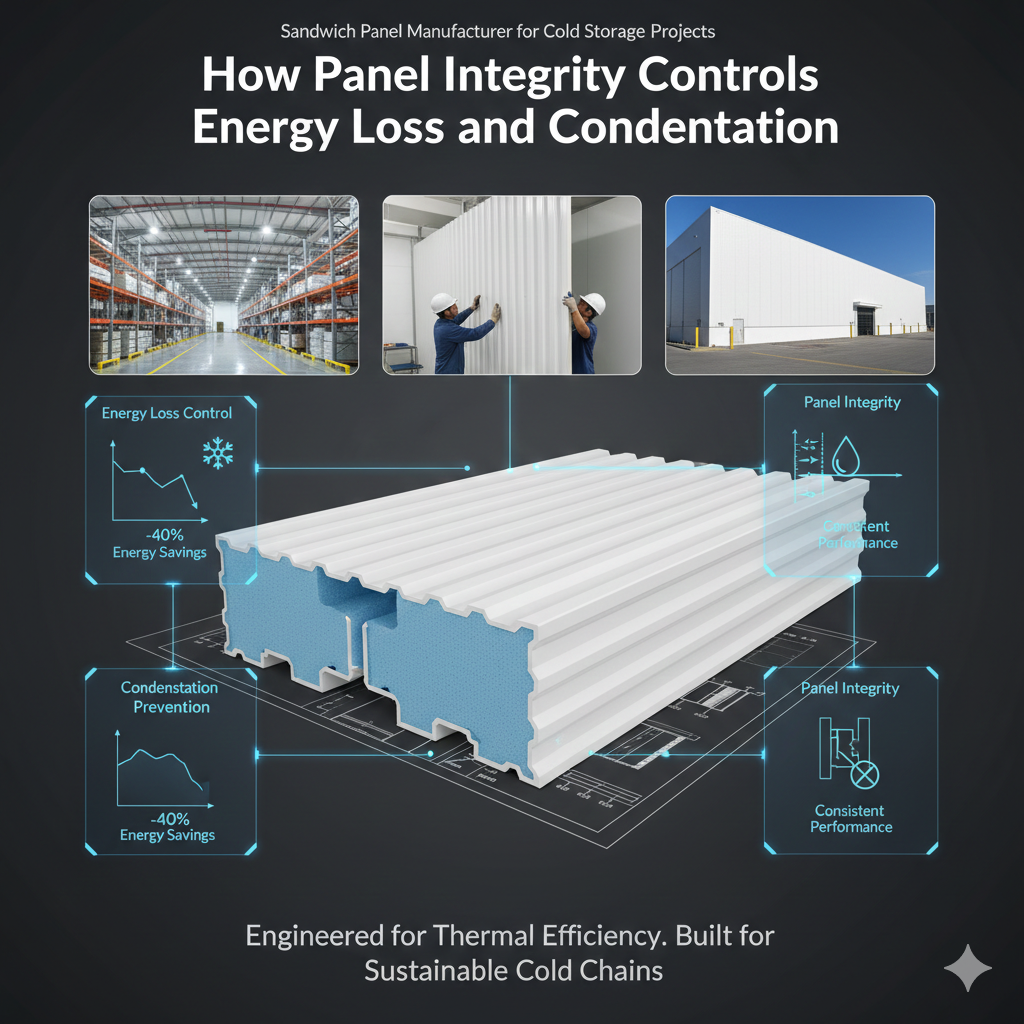
Cold storage buildings are unforgiving environments. Temperature differences between interior and exterior can exceed 30°C. Moisture migration is constant. Condensation risks never fully disappear. In such conditions, the panel system does not merely enclose space—it becomes the primary barrier against energy loss and structural deterioration.
A professional Sandwich Panel Manufacturer determines whether a cold storage facility operates efficiently for years—or struggles with frost buildup, joint leakage, and rising electricity bills.
Cold Storage Reality: Where Standard Panels Fail
In refrigerated warehouses and food processing facilities, typical failure points include:
-
Thermal bridging at panel joints
-
Condensation forming inside wall assemblies
-
Core shrinkage causing joint separation
-
Fastener cold spots leading to frost lines
These issues are rarely visible at installation. They emerge months later as ice accumulation, damp insulation, or increased compressor load.
The difference lies in how the Sandwich Panel Manufacturer controls panel density, bonding strength, and joint geometry.
Core Material: PIR vs PU in Refrigerated Environments
Cold storage facilities require panels with low thermal conductivity and stable dimensional performance.
| Core Type | Thermal Conductivity (W/m·K) | Dimensional Stability | Fire Performance | Cold Storage Suitability |
|---|---|---|---|---|
| EPS | 0.038–0.042 | Moderate | Low | Limited |
| PU | 0.022–0.026 | Good | Medium | Good |
| PIR | 0.020–0.023 | Excellent | Higher | Excellent |
In HONCH cold storage projects, PIR-core panels demonstrated up to 12–18% improved thermal resistance compared with standard PU systems under identical thickness conditions. This difference translates directly into reduced compressor runtime and lower energy cost over time.
A capable Sandwich Panel Manufacturer selects core formulation based on thermal gradient and humidity exposure, not just insulation thickness.
Joint Sealing: The Hidden Energy Variable
In cold storage systems, joints represent the most vulnerable point for vapor infiltration.
Engineered joint profiles are designed to:
-
Minimize air leakage pathways
-
Increase compression sealing pressure
-
Reduce metal-to-metal thermal bridging
HONCH’s cold room projects showed that optimized joint systems reduced measurable air leakage by approximately 20–30%, especially in large refrigerated distribution centers exceeding 5,000 m².
Without such precision, condensation forms inside panel joints—eventually weakening adhesion and insulation integrity.
Real Scenario: Food Processing Facility Application
In a regional food processing plant project supplied by HONCH, the building required:
-
Interior temperature maintained at 4°C
-
High washdown hygiene conditions
-
Continuous operation without shutdown
Adjustments made included:
-
Increased panel density to enhance structural rigidity
-
Anti-corrosion coated outer skins for washdown durability
-
Precision-cut panel lengths to reduce on-site modifications
After commissioning, thermal imaging showed stable wall surface temperature distribution with minimal cold bridging. Over the first operational year, the facility reported consistent interior temperature stability and no condensation-related maintenance interventions.
This demonstrates how a Sandwich Panel Manufacturer directly influences operational reliability—not just building enclosure.
Vapor Control and Structural Integrity
Cold storage panels must resist both internal moisture and external temperature stress.
A professional Sandwich Panel Manufacturer ensures:
-
Strong adhesive bonding between core and steel skins
-
Controlled core density to prevent shrinkage
-
Proper panel camber to reduce structural warping
Improper bonding or inconsistent density may result in micro-gaps that gradually allow moisture intrusion. Over time, this increases insulation degradation and reduces energy efficiency.
HONCH’s manufacturing process emphasizes uniform core injection and pressure-controlled lamination, improving long-term panel integrity under low-temperature conditions.
Installation Efficiency in Refrigerated Projects
Cold storage construction often operates under strict scheduling constraints. Delays increase pre-operation costs.
Optimized panel design can:
-
Reduce cutting and adjustment time
-
Improve alignment during assembly
-
Minimize sealing correction work
In practice, cold storage installations using HONCH panels reported 15–25% faster enclosure completion, particularly where panel lengths were pre-engineered to match structural spacing.
A knowledgeable Sandwich Panel Manufacturer anticipates installation complexity during production—not after problems arise on site.
Common Buyer Questions
Q: Is thicker insulation always better for cold storage?
A: Not necessarily. Core quality, density, and joint design can influence performance as much as thickness.
Q: Why is PIR often preferred over PU in refrigerated buildings?
A: PIR offers improved thermal resistance and better fire performance, making it suitable for controlled environments.
Q: Can sandwich panels prevent condensation entirely?
A: No system eliminates risk entirely, but engineered joints and proper vapor control significantly reduce condensation potential.
Final Guidance for Cold Storage Panel Selection
Cold storage construction demands precision. A Sandwich Panel Manufacturer that understands thermal behavior, vapor control, and structural stability can reduce long-term energy loss and maintenance risk.
HONCH supplies insulated sandwich panel systems tailored for refrigerated warehouses, food processing facilities, and controlled-environment buildings. With optimized joint design and stable core performance, these panels support reliable cold storage operations over time.
To explore cold storage panel systems and project experience, visit the HONCH homepage:
https://www.honchroof.com/
For technical consultation or project-specific panel customization, contact the team via Contact Us:
https://www.honchroof.com/contact-us