Ask any experienced farm owner what worries them most—it’s rarely just feed cost or market price.
It’s disease.
A single outbreak can spread faster than expected. One section of the building gets affected, then another. Within days, what seemed manageable turns into a system-wide problem.
Many farms try to solve this with medication, stricter cleaning routines, or upgraded ventilation equipment. Sometimes it helps. Sometimes it doesn’t.
Because the real issue often sits deeper—in the building itself.
Poor airflow circulation. Surfaces that trap bacteria. Layouts that allow cross-contamination between zones.
This is where a specialized Pig Farm construction Supplier changes the equation. At HONCH, disease control is not treated as a post-construction problem. It is built into the structure from the beginning—through airflow pathways, washable materials, and clearly defined functional zones.
And once these elements align, disease transmission doesn’t disappear—but it becomes significantly easier to control.
Where Disease Actually Spreads Inside a Pig House
It’s tempting to think disease spreads randomly. In reality, it follows patterns.
Warm air rises. Moisture settles. Bacteria accumulate where cleaning is difficult.
Inside a pig house, transmission often concentrates in:
-
areas with poor air circulation
-
surfaces that retain moisture
-
transition zones between animal groups
According to research referenced by the World Organisation for Animal Health (WOAH), biosecurity in livestock facilities is strongly influenced by building design, including airflow management and surface hygiene.
A reliable Pig Farm construction Supplier understands these patterns and designs the building to interrupt them.
HONCH structures are planned to reduce stagnation zones and minimize cross-contamination pathways.
Airflow Direction: The Invisible Transmission Path
Air doesn’t just ventilate—it carries particles.
When airflow is uncontrolled:
-
airborne pathogens move between sections
-
ammonia and moisture accumulate unevenly
-
certain zones become high-risk areas
A well-designed building guides airflow intentionally.
HONCH pig farm layouts typically:
-
align ventilation systems with structural airflow paths
-
prevent backflow between different livestock sections
-
create consistent air movement across the entire building
The result is not dramatic at first glance. No visible difference in equipment. But the internal environment behaves differently—more predictable, more stable.
And that stability matters when trying to control disease spread.
Surface Materials: Where Hygiene Either Works or Fails
Cleaning a pig house is routine. Effective cleaning? That depends on the material.
Rough, porous surfaces behave like sponges. They trap moisture, organic matter, and bacteria. Even after cleaning, residues remain.
Smooth, non-absorbent surfaces tell a different story.
| Surface Type | Moisture Retention | Cleaning Efficiency | Bacterial Risk |
|---|---|---|---|
| Rough concrete | High | Low | High |
| Coated metal | Moderate | Medium | Medium |
| Polymer panels | Low | High | Low |
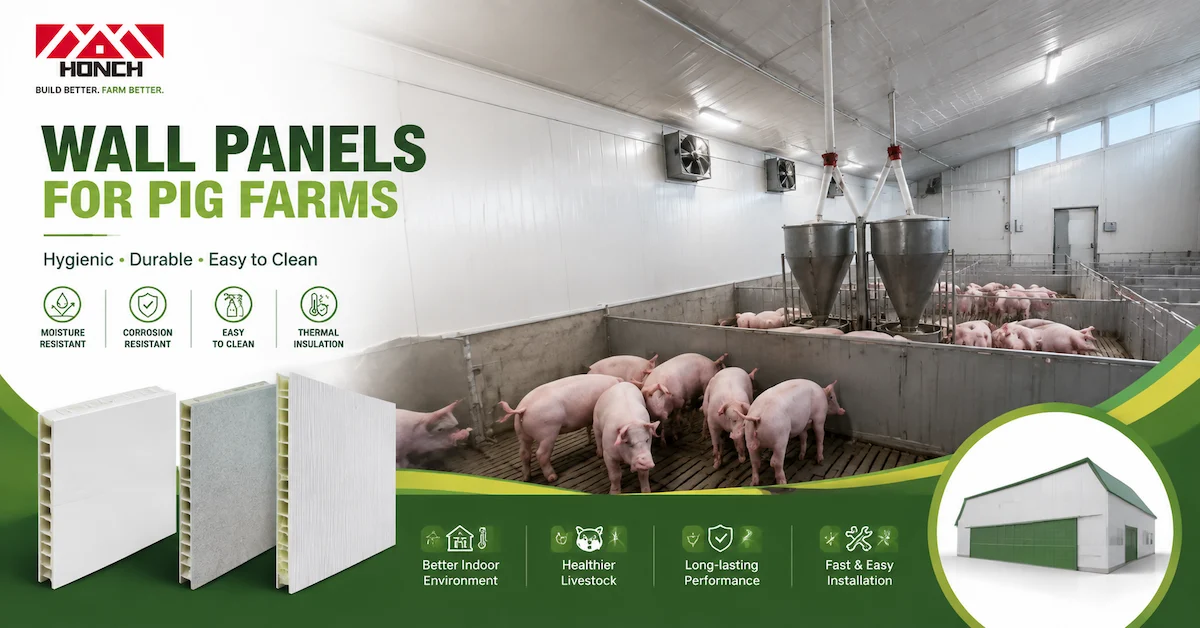
HONCH projects often use smooth-surface wall and ceiling systems designed for repeated washing. Over time, this reduces contamination buildup and simplifies hygiene management.
A Pig Farm construction Supplier that understands this difference doesn’t just supply materials—they shape the cleaning process itself.
Zoning Design: Separating Risk Before It Spreads
Not all areas in a pig farm carry the same risk.
Mixing zones—where animals of different ages or health conditions interact—are particularly sensitive.
Without clear structural separation:
-
disease moves between groups
-
cleaning routines become less effective
-
biosecurity measures weaken
HONCH building layouts introduce functional zoning:
-
separation between production stages
-
controlled transition areas
-
structural boundaries that support biosecurity protocols
This doesn’t eliminate risk entirely. But it slows down transmission—giving farm management time to respond.
A Real Farm Adjustment: When Layout Made the Difference
One farm we worked with had a recurring issue. Despite good management practices, disease outbreaks kept affecting multiple sections of the building.
The ventilation system was upgraded. Cleaning routines were intensified. Still, the problem persisted.
When HONCH stepped in as a Pig Farm construction Supplier, the focus shifted.
Instead of changing equipment, we adjusted the building layout:
-
restructured airflow direction
-
introduced clearer zoning between sections
-
replaced high-retention surfaces with washable panels
The result wasn’t instant—but it was noticeable. Over time, disease spread became more contained. Outbreaks no longer affected the entire facility.
The farm manager summed it up well:
"We didn’t change how we work. We changed what we work inside."
Construction Precision and Its Hidden Impact
Even small construction inconsistencies can influence disease control.
Misaligned panels. Poorly sealed joints. Uneven surfaces.
These create:
-
moisture pockets
-
airflow disruption
-
hidden contamination zones
HONCH uses prefabricated panel systems to maintain consistency during installation. Panels align properly. Surfaces remain continuous. Cleaning becomes more effective.
In several livestock projects, this approach has reduced structural-related hygiene issues while also shortening construction timelines by around 25–30%.
Common Buyer Questions
Q: Can building design really reduce disease transmission?
A: Yes. Airflow, materials, and layout all influence how disease spreads inside a pig house.
Q: Is ventilation equipment enough to control disease risk?
A: Not alone. The building structure must support proper airflow patterns.
Q: When should disease control be considered in farm construction?
A: At the design stage, ideally with input from a Pig Farm construction Supplier.
Building for Control, Not Just Containment
Disease risk in pig farming can never be completely eliminated. But it can be managed—sometimes far more effectively than expected.
The difference lies in whether the building works against the problem… or quietly helps control it.
A professional Pig Farm construction Supplier understands this balance. Structure, airflow, materials, and layout all play a role.
HONCH provides livestock construction systems designed to support biosecurity, improve hygiene conditions, and create more stable farming environments.
To explore pig farm construction solutions and real project applications, visit the HONCH homepage:
https://www.honchroof.com/
If you are planning a new pig farm or upgrading an existing facility, our team can provide practical guidance through Contact Us:
https://www.honchroof.com/contact-us