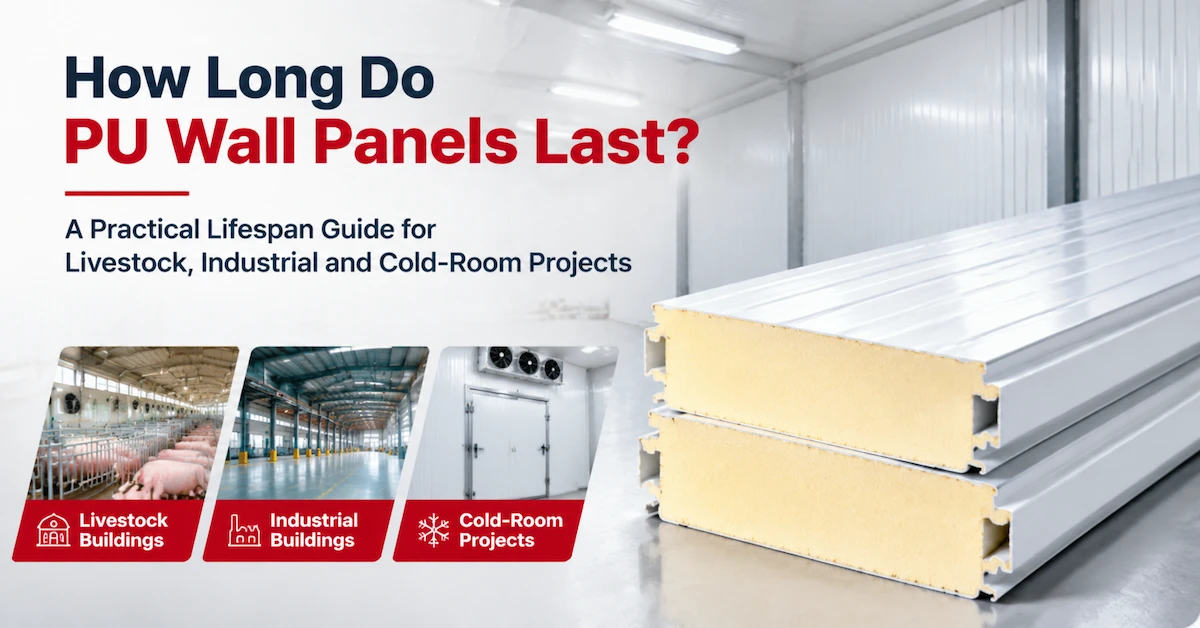
If you are asking, “how long does PU wall panels last,” the responsible answer is that there is no single lifespan that applies to every PU wall panel. A PVC + PU + PVC insulated wall panel can remain functional for a long service period when its face materials, PU core, joints, edge details, fixings, installation and maintenance all match the building environment. The replacement decision is usually controlled by the first part of the assembly that loses its required function, not by the age of the panel alone.
For a buyer, that means a supplier should not answer a project-specific question with an unsupported “10 years,” “20 years” or “30 years.” The useful answer comes from defining the application, identifying the exposure and checking evidence for the exact configuration. This is especially important in livestock buildings, chemical workshops, humid warehouses, cold rooms and other areas where ammonia, disinfectants, salt, condensation, washdown or impact can affect the panel and its joints.
Direct answer: PU wall panels do not have one universal service life. Their practical life depends on the durability of the PVC faces, the condition of the PU core, the protection of cut edges and joints, chemical and UV exposure, temperature and moisture movement, impact, support and fastener design, installation quality, cleaning and inspection. A panel should be considered for replacement when it can no longer provide the required surface protection, moisture control, insulation, hygiene or structural support for the project.
What Does PU Wall Panel Lifespan Actually Mean?
The phrase PU wall panel lifespan can describe several different endpoints. A panel may still be attached to a wall while its appearance has deteriorated, or it may look acceptable while a failed joint is allowing moisture into the assembly. Treating all of these conditions as one number creates poor purchasing decisions. Before asking how long a panel will last, define what the panel must continue to do.
| Lifespan dimension | What must remain functional | Typical inspection question |
|---|---|---|
| Surface life | The PVC face remains sufficiently intact, cleanable and resistant to the expected environment. | Are there cracks, chalking, discoloration, blistering, chemical attack or exposed core areas? |
| Moisture-control life | Faces, joints, corners and penetrations continue to limit unwanted water or vapor entry. | Are joints open, sealants separated, edges wet or stains appearing behind the panel? |
| Insulation life | The PU core and complete assembly continue to provide the required thermal performance. | Has the core been compressed, wetted, damaged or bypassed by thermal bridges and gaps? |
| Hygiene and cleaning life | The panel and joint geometry can still be cleaned and dried without creating persistent contamination points. | Can the room be washed, inspected and dried without hidden gaps or damaged surfaces? |
| Functional replacement point | The repair cost, downtime or loss of performance no longer makes continued use sensible. | Would repairing one area restore performance, or has the failure become system-wide? |
How the PVC + PU + PVC Construction Affects Durability
HONCH describes its PU insulation wall panel as a three-layer system: a PVC outer layer, a PU foam core and a PVC inner layer. The product page positions the panel for livestock farms, industrial buildings, cold rooms, insulation rooms and light-duty building partitions. It also describes an interlocking structure and functions including insulation, anti-corrosion and moisture protection. Those published functions explain the design intent, but they do not replace a project-specific exposure review.
The PVC outer layer is the first exposure barrier
The outer PVC face is the part most directly exposed to cleaning, humidity, sunlight, impact and airborne contaminants. A smooth, waterproof and corrosion-resistant surface can reduce the maintenance burden associated with exposed metal in suitable environments. Its durability still depends on the PVC formulation, thickness, color, UV exposure, temperature range, chemical contact and whether the face is cut or damaged during installation.
When requesting a sample, inspect the face at normal viewing distance and under close light. Check the edge, surface uniformity, corner behavior and how the proposed accessories meet the face. Ask whether the sample represents the same production construction, not a higher-grade display sample. The surface you approve should be tied to the purchase specification.
The PU core provides insulation, not a complete moisture seal
The PU foam core is the thermal layer. It helps the wall assembly control heat transfer and support a more stable indoor environment. The core is not a reason to ignore joints, penetrations or cut edges. If water enters through an unsealed edge or an open joint, the resulting moisture may affect the assembly even when the PVC faces look intact.
Do not infer thermal performance from the word “PU” alone. Thickness, density, face construction, joint geometry, temperature difference and thermal bridges influence the result. Ask for data that matches the final panel thickness and configuration. A PU insulated wall panel should be evaluated as a complete assembly rather than as a foam name on a quotation.
The inner PVC layer protects the room side
The inner face is important in livestock, food-related, industrial and high-humidity buildings because it receives cleaning, contact, condensation and daily wear. If the inside face is punctured or separated from the joint detail, the repair requirement can become more urgent than a small cosmetic mark on an exterior wall.
Interlocking joints control the weakest points
An interlocking profile can help create a tight and visually continuous wall, but the joint is only as durable as the installation, support alignment, sealant selection, corner treatment and penetrations around it. Long panels also move with temperature. If the system has no practical allowance for movement, stress may appear at joints, fasteners or openings even when the panel material itself remains stable.
Why Suppliers Cannot Give One Universal Number
Service life is a performance result under conditions, not an intrinsic number printed on the material name. A wall inside a dry warehouse and a wall inside a humid pig building may use similar-looking panels but experience different chemical, thermal, cleaning and impact loads. A panel in a cold room may have moderate UV exposure but high temperature differentials and demanding vapor control. A coastal building may combine salt deposits, wind-driven rain and strong sunlight.
For this reason, any lifespan statement should identify at least the following: product construction, thickness, exposure environment, installation position, joint and edge details, cleaning regime, expected maintenance and the evidence used to support the statement. If these items are missing, the statement is a marketing estimate rather than a project-quality durability assessment.
Product life and system life are different
Even a well-made panel can underperform on uneven supports, with incompatible fasteners, an unapproved chemical or open edges. The buyer should ask, “How long can the specified wall system perform in this building?” rather than accept a generic year count.
Eight Factors That Shorten PU Wall Panel Service Life
1. Ultraviolet exposure and weathering
Exterior walls and exposed building ends receive more sunlight than interior partitions. UV exposure can change color and surface properties over time, especially when the product, color or formulation was not selected for the location. A panel designed mainly for an interior wall should not be assumed suitable for full exterior exposure. Ask where the panel may be installed and whether the face specification addresses the actual UV condition.
2. Ammonia, hydrogen sulfide and farm chemicals
Livestock rooms can contain ammonia, hydrogen sulfide, moisture and organic deposits. Disinfectants add another chemical load. A PVC face may be chosen for a corrosive environment, but chemical resistance must be checked against the specific concentration, temperature, contact time and cleaning frequency. The same applies to sealants, corner profiles and fasteners. A material answer that ignores the joint materials is incomplete.
3. Cleaning pressure and unsuitable detergents
High-pressure washing can force water behind joints and damage sealants or edges. Strong solvents or concentrated oxidizers can attack a surface that would tolerate ordinary detergent. The safest procurement process records the cleaning method before the panel is selected. Provide the supplier with the actual chemical label or safety data sheet when compatibility is critical.
4. Standing water and condensation
Panels are not a substitute for drainage. Water that remains at a base detail, sill, corner or penetration can create a persistent exposure that is more aggressive than occasional wetting. Condensation can be equally important in cold rooms and humid buildings. Review vapor control, thermal bridges, ventilation, room temperature and drainage together with the wall panel.
5. Unsealed cut edges and penetrations
Cutting is common around doors, fans, pipes, conduits and electrical openings. The exposed core and edge must be treated according to the supplier's installation method. A clean face does not protect an open edge. During handover, photograph and record penetrations so future maintenance teams know which details require inspection.
6. Impact and abrasion
Forklifts, carts, animals, tools, feed equipment and repeated contact can damage a wall face. Impact resistance is not the same as immunity to puncture. Place protection rails or sacrificial guards in zones where contact is predictable. If the wall is part of a livestock pen, separate the panel's cladding function from the containment or structural function unless the supplier specifically confirms both.
7. Thermal movement and support problems
Changes in temperature cause materials to expand and contract. Long runs, dark colors, exterior exposure and large temperature differences can make movement more visible at joints and fixings. Misaligned supports and excessive spans can also stress the panel. Confirm support spacing, fixing positions, movement allowances and opening details before installation.
8. Poor maintenance records
Small damage is easier to repair when it is found early. Without inspection records, a small open joint can become hidden moisture, a local core issue or a room-wide hygiene problem. Record the location, date, cause, photo, temporary action and final repair. Good documentation extends practical life because it turns a hidden failure into a manageable maintenance task.
Application Changes the Durability Question
Livestock buildings
In poultry, pig and cattle buildings, the relevant question is usually whether the wall stays cleanable, moisture-controlled and resistant to the planned chemical and animal environment. A panel can be suitable in a high-humidity room but unsuitable at a location where animals or equipment repeatedly hit the surface. Review the lower wall zone, corners, doors, ventilation openings, floor connection and washdown route as one system.
HONCH positions its PVC + PU + PVC wall panel for livestock interior walls and agricultural facilities. Buyers should match the selected thickness, length, joint and protection details to the building zone. For a broader zone-by-zone discussion, review the wall-panel considerations for pig farms, then return to the product specification.
Industrial workshops and chemical areas
Industrial exposure is rarely described well by the word “corrosive” alone. Name the substance, concentration, temperature, vapor or splash route and cleaning method. A wall near a process line may experience a different load from a wall in a dry storage area. Ask for compatibility information for the face, core, sealants, trims and fasteners. Where a chemical exposure exceeds the published evidence, obtain a project-specific review before purchase.
Cold rooms and temperature-controlled areas
Cold-room durability depends heavily on vapor control and joint continuity. Thermal performance can be lost through gaps, penetrations, doors, corners and damaged edges even when the panel remains visually attractive. Track condensation, frost, wet marks, joint separation and temperature stability. A thermal report must match the panel configuration rather than only stating that PU foam is present.
Warehouses and light-duty partitions
In a dry warehouse or light-duty partition, impact, support and installation quality may control life more than corrosion. A panel chosen for an aggressive farm environment can still fail early if it is used as a load-bearing element without confirmation or if its face is damaged by warehouse traffic. Confirm the intended function and the permitted span before treating a wall panel as a construction system.
Recommended Inspection and Maintenance Practice
The maintenance interval should reflect the environment, not a generic calendar promise. A high-humidity livestock room, a chemical workshop and a dry warehouse need different inspection intensity. The following framework is a practical starting point for facility owners and should be adjusted to the project risk and local requirements.
| Inspection stage | Check | Record | Action trigger |
|---|---|---|---|
| Before installation | Panel faces, edges, dimensions, accessories, labels and packaging condition. | Photos, batch or order reference, delivery damage report. | Quarantine panels with visible damage or a mismatch with the approved specification. |
| At handover | Joint engagement, fasteners, cut edges, corners, openings, base detail and drainage. | Marked-up drawings and close-up photos of critical details. | Repair open joints, exposed core, loose fixings or unprotected penetrations. |
| Routine visual check | Cracks, impact, stains, discoloration, blistering, sealant gaps and moisture marks. | Location, date, photo, likely cause and severity. | Prevent a local defect from becoming a hidden moisture or hygiene problem. |
| After cleaning or chemical change | Surface appearance, joint condition and any new softening, haze or attack. | Chemical used, dilution, temperature, pressure and contact time. | Stop or revise an incompatible cleaning method and seek technical confirmation. |
| Detailed condition review | Thermal performance, moisture path, support movement and recurring repair areas. | Trend report and repair decision. | Replace or redesign when repairs no longer restore the required function. |
Cleaning should remove deposits without attacking the face or forcing water into the joint. Use the supplier's approved method where one is available. Do not use an aggressive solvent, abrasive pad or excessive pressure simply because the panel appears robust. A clean-looking room can still contain moisture behind a damaged joint, so visual cleaning and condition inspection should be treated as separate tasks.
How to Tell Whether Existing Panels Need Repair or Replacement
Repair may be appropriate when the defect is local
A localized scratch, impact mark, trim issue or sealant gap may be repairable when the core remains dry, the support is stable and the replacement detail can restore the intended barrier. Isolate the cause before repairing. If equipment keeps striking the same wall, a new panel without a guard will repeat the failure.
Replacement becomes more likely when the function is widespread
Replacement deserves consideration when moisture is recurring behind multiple joints, the core is wet or compressed, the face has widespread chemical attack, the support has moved, or the room cannot be cleaned and dried reliably. Replacing only the most visible panel may hide the system problem. Map the affected area and inspect adjacent panels, trims, fasteners and the source of the exposure.
Appearance alone is not enough
Color change does not automatically mean loss of all performance, and a bright surface does not prove that the joint is sealed. Use a condition report that separates appearance, moisture, thermal, hygiene and support observations. This is a more defensible way to decide whether the wall panel service life has ended.
Does a Thicker PU Wall Panel Last Longer?
Not automatically. Thickness may influence thermal performance, stiffness, joint engagement and handling, but it does not make an unsuitable surface chemical-resistant or correct a poor installation. A thicker panel with unsealed edges can still develop moisture problems.
Choose thickness from the complete performance requirement: thermal target, span, support, impact risk, temperature difference, joint detail, opening design, transport and local code. Ask the supplier to identify which performance claim changes with thickness and which claims depend on the face material, core, accessories or installation.
Evidence Buyers Should Request Before Accepting a Lifespan Claim
A strong quotation makes the proposed service life traceable to a product and a project. The documents below help distinguish a real technical answer from a generic sales sentence. The exact list may vary by country, application and code, but the principle remains the same: match evidence to the ordered configuration.
| Evidence to request | Why it matters | Questions to ask |
|---|---|---|
| Cross-section or sample | Confirms that the quoted face, core and joint construction are physically present. | Is this sample from the same construction and production route as the order? |
| Face and core specification | Defines material, thickness, density or other relevant attributes instead of relying on a product name. | Which values are controlled, and which are customization options? |
| Joint and edge detail | Shows how the system manages movement, moisture and exposed core at actual building interfaces. | How are corners, openings, base details and cut edges finished? |
| Chemical compatibility information | Connects the panel and accessories to the real cleaning or process exposure. | Does the evidence cover concentration, temperature, contact time and frequency? |
| Thermal and fire documentation | Prevents a general PU claim from being treated as a project-specific performance result. | Does the report match the face, core, thickness, joint and assembly ordered? |
| Installation instructions | Shows required supports, fixings, cutting, sealing, handling and storage conditions. | Who is responsible for approving site deviations? |
| Inspection and packaging records | Helps protect the panel from delivery damage and creates a condition baseline. | How are long panels protected, identified and checked before shipment? |
How to read certification without overclaiming
HONCH's About Us page states that the company was founded in Jinhua in 2008, has self-operated import and export rights, and publishes ISO9001 and EU CE information. The same page identifies an insulated sandwich panel certificate assessed against EN 14509:2013, with the displayed scope listing PVC material, 1–50 mm thickness and System 4. This is useful company and documentation evidence, but certification is not a universal lifespan guarantee.
Before relying on a certificate, verify the product name, face material, core, thickness, assessment scope, destination-market requirements and the exact configuration ordered. Do not transfer a document from one panel, thickness or application to another without confirmation. The safest practice is to request the current report and quotation together, then record any exclusions.
What HONCH Publishes About Its PU Wall Panel
The official HONCH PU insulation wall panel page identifies a PVC outer layer, PU foam core and PVC inner layer. It describes the product as a thermal and anti-corrosion wall solution for livestock farms, industrial buildings and modern light-duty construction. Listed applications include livestock interior walls, industrial wall cladding, cold storage and insulation rooms, light-duty partitions, and renovation or flat-to-slope projects.
The same page lists insulation, anti-corrosion and moisture-proof functions, an interlocking structure, and customization of thickness, color and length. It also states that OEM/ODM, bulk purchasing, branding and packaging customization, engineering support and long-term supply are available. These are useful starting points for an RFQ. Confirm the final construction, MOQ, lead time, packaging, price and technical documents against the specific project because the website does not publish one fixed value for all orders.
What to send HONCH for a useful durability review: building application, indoor and outdoor position, panel thickness, length, color, support spacing, room temperature and humidity, cleaning chemicals, washdown pressure, UV or coastal exposure, impact risks, openings, required certificates, quantity, destination and target delivery date.
Why this matters: these inputs allow the supplier to discuss the correct wall product and accessories instead of giving a generic lifespan statement that may not match the installation.
How to Build a Project-Specific PU Wall Panel RFQ
When buyers ask for a quotation, the best RFQ is short but specific. It should separate known requirements from items that need supplier confirmation. The following structure works for a livestock wall, factory partition, cold room or other light-duty wall application.
- State the application: for example, interior livestock wall, industrial cladding, cold-room partition or humid warehouse.
- Describe the exposure: humidity, temperature range, cleaning method, chemical names, UV, salt, dust and impact.
- Provide dimensions: wall area, panel length, opening positions, support spacing and the desired thickness.
- Define the function: surface protection, insulation, moisture control, hygiene, appearance or a combination.
- Request the full system: panels, trims, corners, fasteners, sealants, joint details, packaging and installation guidance.
- Request evidence: sample, cross-section, thermal data, fire documents, chemical compatibility information and certificates matching the final configuration.
- Ask for commercial confirmation: MOQ, production lead time, delivery terms, packaging, spare quantity and replacement-part availability.
For a supplier comparison, place the same RFQ in front of every candidate. Compare the evidence and exclusions, not only the quoted square-meter price. A low initial price can become expensive if it requires more protective trims, more frequent repairs, or a different insulation and cleaning arrangement.
Common Mistakes When Estimating PU Wall Panel Life
Using a generic year count as the specification
A single number cannot describe a panel used in a dry warehouse, a chemical area and a livestock room at the same time. Put the condition and required function in the specification. If the supplier gives a number, ask which test, environment, maintenance plan and exclusions support it.
Comparing a composite wall with an uninsulated sheet
A PVC + PU + PVC wall combines two faces and an insulation core. Comparing it only with a single metal sheet ignores the thermal and joint functions. Compare complete wall assemblies with equivalent insulation requirements, accessories and installation scope.
Ignoring accessories and penetrations
Panels rarely fail in the middle of an undisturbed face first. Corners, bases, door frames, fan openings, pipes and fasteners create the details that determine whether water and chemicals reach vulnerable areas. Request these details at quotation stage.
Assuming certification proves every performance claim
A certificate has a scope. It may confirm a product or assessment route without proving universal service life, chemical resistance or suitability for every market. Match the document to the ordered panel and the project's required performance.
Failing to plan for repair
Even durable wall systems can be damaged by vehicles, animals, tools or later modifications. Ask whether replacement panels, trims, sealants and compatible accessories can be ordered later. A repairable system often has a lower practical lifecycle risk than one that is difficult to restore.
FAQ: PU Wall Panel Lifespan and Buying Decisions
How long does PU wall panels last?
The honest answer is that PU wall panels do not have one universal lifespan. A PVC + PU + PVC panel can provide long-term service when the material construction, exposure, joints, installation and maintenance are suitable. Ask the supplier to evaluate the exact thickness, location, chemicals, cleaning regime, impact risk and expected function instead of relying on an unsupported year count.
What is a realistic PU wall panel lifespan?
A realistic estimate must be tied to a defined project condition. The same panel can have a different replacement risk in an interior partition, a washdown livestock room, a cold room or an exposed coastal wall. The specification should state the environment, performance endpoint, inspection method and evidence. Without those items, a fixed number is not a reliable engineering answer.
Does the PU foam core lose insulation performance?
The PU core is intended to provide thermal insulation, but actual assembly performance depends on the core, thickness, joints, moisture, compression, penetrations and thermal bridges. Request thermal information for the exact ordered panel and inspect for wetting, gaps or damage. Do not assume that a visible face proves that the complete wall retains its original thermal performance.
Can PU insulated wall panels be used in livestock buildings?
They can be considered for livestock interior walls when the selected face, joint, edge and accessory system matches the farm environment. HONCH publishes its PVC + PU + PVC wall panel for livestock farms and agricultural facilities. Buyers comparing PU insulated wall panels should still confirm ammonia, disinfectant, washdown pressure, humidity, impact, ventilation openings, lower-wall protection and cleaning details.
Does a thicker panel always last longer?
No. Thickness can affect thermal performance, stiffness, support requirements and joint behavior, but it does not correct chemical incompatibility, open edges, poor drainage, impact or unsuitable installation. Select thickness from the complete performance requirement and ask which claims are verified for the final thickness.
Can damaged PU wall panels be repaired?
Some local defects can be repaired when the core is dry, the support is stable and the repair restores the face and joint barrier. Widespread moisture, recurring chemical attack, severe core damage or movement at the support may require replacement or redesign. Always identify the cause before repairing so the same failure does not return.
Does a CE document prove panel lifespan?
No. A CE document or other certification should be read within its product, material, thickness and assessment scope. It can support conformity or documentation requirements, but it is not automatically a universal service-life guarantee. Match the current document to the panel configuration, destination market and project conditions.
What should I ask a PU wall panel manufacturer?
Ask for the face and core construction, thickness options, joint and edge details, chemical compatibility, thermal documentation, fire documents where required, installation guidance, sample, packaging method, MOQ, production lead time, spare-part or replacement support, and written confirmation of any exclusions. Send the manufacturer the actual application and cleaning conditions so the response is meaningful.
Conclusion
The answer to “how long does PU wall panels last” is not a universal year count. The practical PU wall panel lifespan is controlled by the PVC faces, PU core, joints, edges, fixings, support, chemical and weather exposure, cleaning, impact and maintenance. For a durable installation, define the required function, select a configuration that matches the environment, document the critical details and inspect the wall as a complete system.
HONCH's PVC + PU + PVC insulated wall panel is published for livestock, industrial, cold-room and light-duty partition applications, with customization of thickness, color and length. Before ordering, send the project conditions and request a configuration-specific review, sample and evidence package. That is the most reliable way to turn a general lifespan question into a useful procurement decision.
Planning a PU wall panel project? Send the application, dimensions, exposure and cleaning conditions to HONCH for a product recommendation, sample discussion and technical quotation.