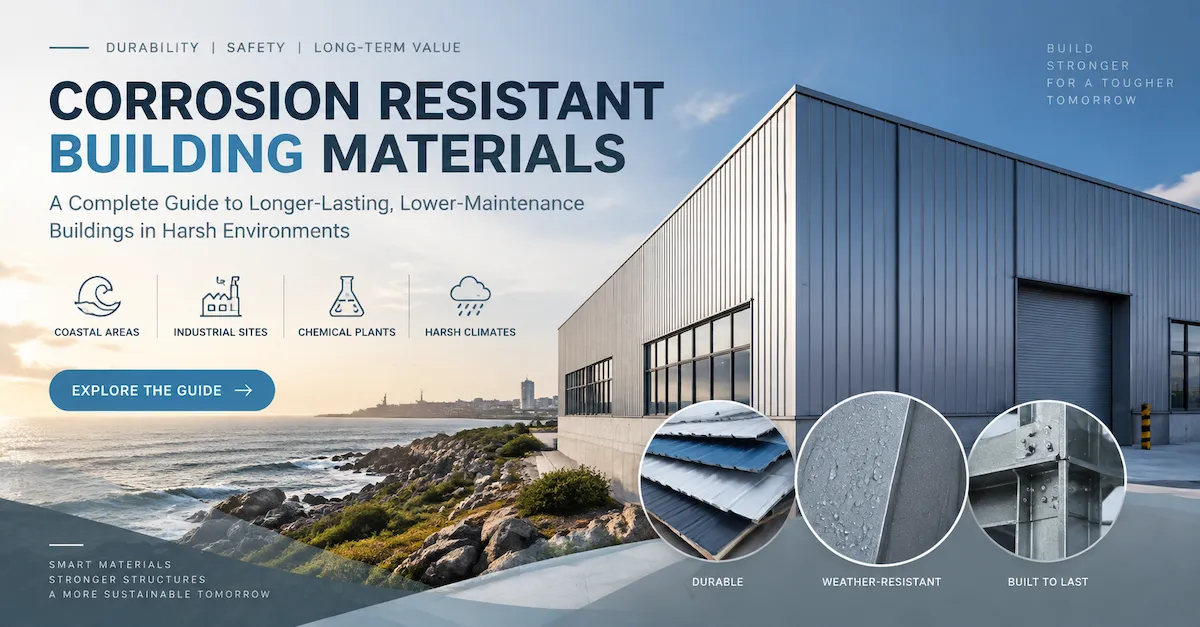
Short answer: Low maintenance construction materials are not defined by a single product name. They are materials and interfaces that reduce recurring cleaning, repainting, corrosion repair, sealing work and premature replacement in the actual building environment. For many industrial, agricultural and livestock projects, the practical choice is a coordinated system of corrosion-resistant roof sheets, washable wall or ceiling panels, reliable joints and accessible replacement details rather than the cheapest individual panel.
The right decision depends on exposure, building function, temperature control, cleaning method, impact risk, installation quality and the evidence a supplier can provide. A low-maintenance specification should therefore describe the roof, wall, ceiling, trims, fasteners, seals and maintenance access together.
What Makes a Construction Material Low Maintenance?
A low-maintenance material reduces the number, frequency and difficulty of interventions required to keep a building dry, clean, safe and functional. That definition is more useful than phrases such as “maintenance-free” or “lifetime material,” which usually omit the joints, fixings, cleaning chemicals and local climate that determine real performance.
It resists the main exposure, not an imaginary average climate
Every building has a maintenance environment. A livestock building may combine high humidity, ammonia, washdown water, disinfectants and impact from equipment. A coastal building may face salt-laden air, wind-driven rain and strong ultraviolet exposure. A chemical plant may have localized vapors or splashes that are more aggressive than the general atmosphere. A warehouse may have a relatively mild envelope but still experience roof ponding, forklift impact, dust accumulation and difficult access.
Material selection should begin with an exposure map. List the sides of the building, internal zones, wet processes, washdown areas, ventilation openings, roof drainage paths, chemical sources and places where people or equipment may strike the lining. Then ask whether the proposed surface and its accessories are appropriate for each zone. A material that performs well as an interior wall lining may not be the best choice as an exposed roof covering, and a roof sheet that handles weather may not be the most practical washable surface inside a farm.
It limits the maintenance work that is expensive or disruptive
Cleaning is not automatically low-cost. A smooth surface can be easier to wash, but access, drainage and chemical compatibility still matter. Repainting may be technically simple but operationally disruptive if production must stop. Replacing a single panel may be manageable if fasteners and trims are accessible, but difficult if the design requires dismantling a long run of connected panels. The most useful question is not “Does this material need maintenance?” Every building does. The question is “What maintenance will be needed, by whom, with what equipment and at what frequency?”
It performs as a system
Panel surfaces receive most of the attention, while failures often begin at interfaces. Overlaps, end laps, ridge details, wall-to-roof transitions, corners, penetrations, doors and fasteners can admit water or hold contaminants. A low-maintenance specification should therefore identify the compatible trims, closures, sealants and fixing method. It should also define how the system accommodates thermal movement and how damaged sections can be accessed later.
| Maintenance question | What to examine | Evidence to request |
|---|---|---|
| Will the surface stay serviceable? | Moisture, UV, salt, chemicals, dirt retention and impact exposure | Material construction, application limits and cleaning guidance |
| Will joints remain watertight? | Profile, interlock, overlap, seal, fastener and movement details | Installation drawings, accessory list and project assumptions |
| Can a damaged part be replaced? | Panel access, standard lengths, compatible trims and spare strategy | Replacement method, packing plan and repeat-order information |
| Will the supplier remain useful after delivery? | Technical response, traceability, documentation and repeatability | Datasheets, quality records, drawings and named support contact |
Where Maintenance Costs Actually Come From
Buyers often compare the purchase price of panels but do not separate the sources of future maintenance. A useful lifecycle review divides the burden into five groups: material degradation, water management, cleaning, installation defects and access or replacement. This makes the conversation specific enough for an architect, contractor, procurement manager and supplier to review together.
1. Corrosion and chemical attack
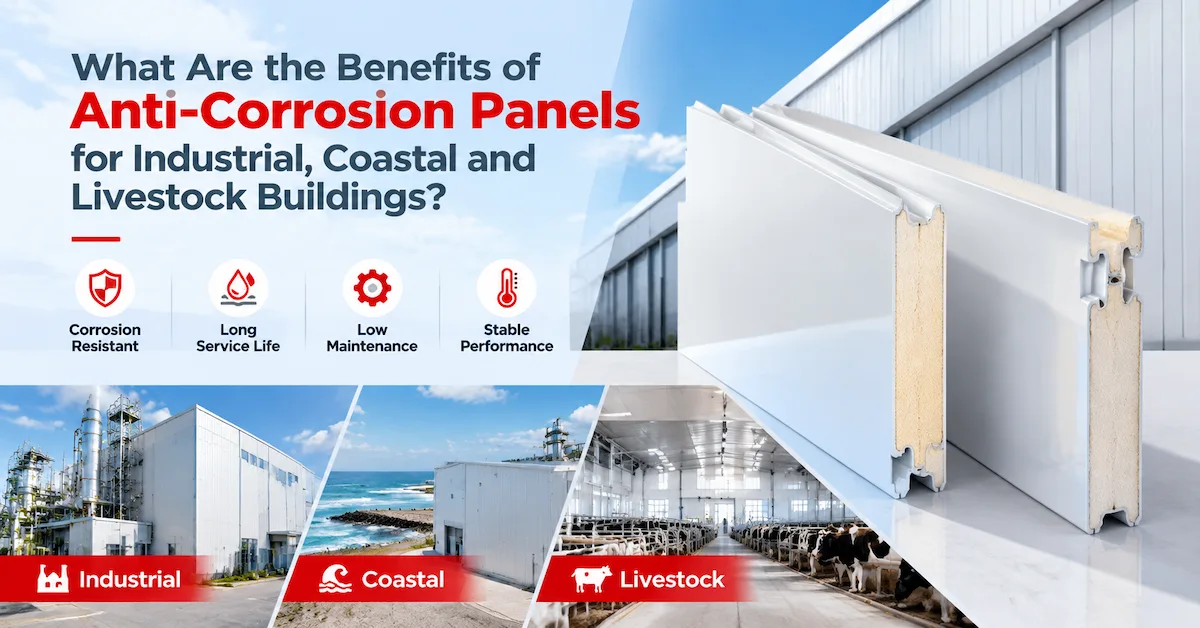
Corrosion can be obvious on a roof or concealed behind a trim. It may affect a metal face, a fastener, a cut edge or a support that is repeatedly wetted. In livestock and industrial environments, moisture is often combined with gases or deposits. In coastal areas, salt can accelerate deterioration at details that are not washed by normal rainfall. A corrosion-resistant panel can reduce the number of exposed metal surfaces, but it does not remove the need to check the supporting structure, fixings and compatibility of accessories.
For this reason, do not accept a general “anti-corrosion” label without asking what part of the assembly it describes. The buyer should identify the corrosive agent, the location, the expected cleaning method and any metal components that remain in the system. The supplier should explain the material construction and the limits of the claim. This is especially important where a PVC or UPVC surface is paired with metal screws, flashings or frames.
2. Water ingress at joints and penetrations
Water-related maintenance usually starts at a discontinuity: an overlap, valley, corner, penetration, opening or poorly sealed fastener. A sheet with a durable surface will still create recurring work if the joint geometry is wrong or if installers have to make unplanned cuts on site. For a low-maintenance building, the joint strategy should be decided before the panel order. The drawings should show direction of installation, support spacing assumptions, seal locations, edge treatment and the accessories required for openings.
3. Cleaning and sanitation
In agriculture, food-related spaces and industrial rooms, maintenance may mean regular washing rather than occasional repair. The surface should be smooth enough to clean, but the complete assembly must also avoid ledges and open cavities that trap moisture. Buyers should ask which detergents, disinfectants, pressure levels and temperatures are compatible with the proposed facing. “Washable” is not a complete specification without a defined cleaning routine.
4. Installation defects
Panel damage, misalignment, over-tightened fasteners and incomplete sealing create maintenance issues before the first scheduled inspection. Prefabricated or interlocking systems can reduce site adjustment, but only when supports are prepared correctly and the installation team follows the supplier's details. A supplier that provides a product but no application guidance may leave the contractor to solve the highest-risk interfaces alone.
5. Access, spare parts and downtime
A material can have good technical performance and still create high maintenance cost if it is difficult to reach or replace. Consider whether a damaged lower wall panel can be removed without taking down the ceiling, whether a standard length can be reordered, and whether color or profile changes could make a future repair visibly inconsistent. For a distributor or multi-site owner, repeatability and packaging are part of maintainability because replacement panels may be required years after the original project.
How to Compare Low Maintenance Construction Materials by Building Zone
There is no single material that is automatically best for the roof, external wall, internal wall and ceiling. The correct comparison is zone by zone. The following framework keeps the selection tied to function and exposure.
Roofing: prioritize weathering, drainage and accessible details
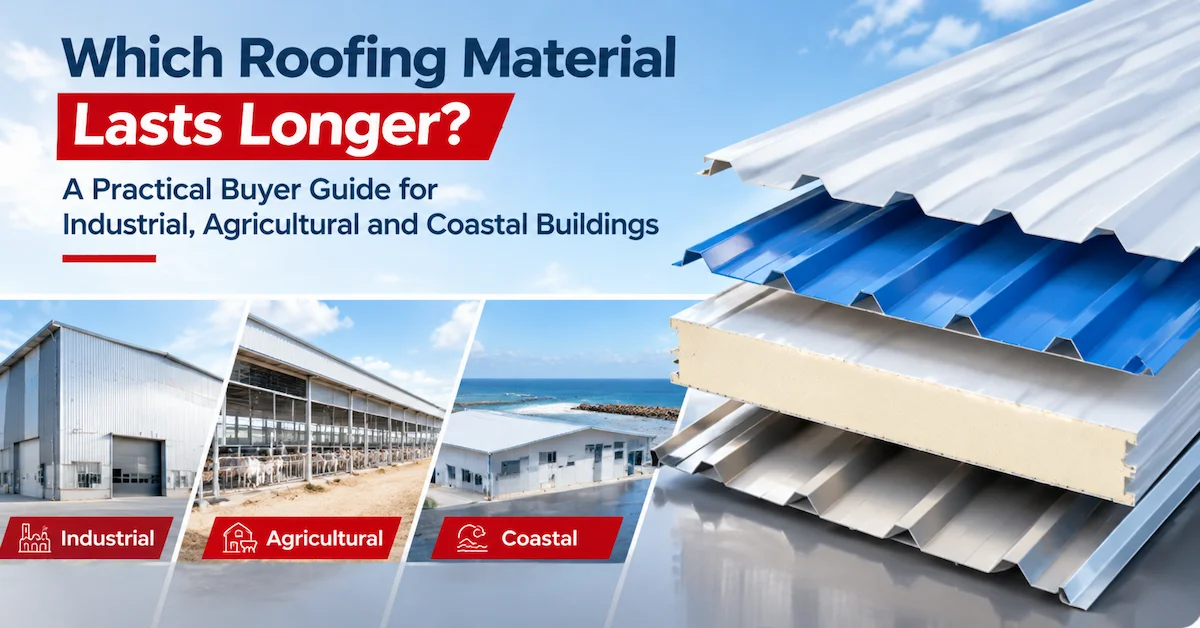
Roof materials must manage rain, wind, solar exposure, thermal movement and drainage. UPVC or APVC roofing sheets can be relevant where corrosion resistance, light weight and a non-metallic roof surface are priorities. Metal systems may be appropriate when structural, fire, span or local code requirements point in that direction, but their coating system, cut edges, fasteners and environment must be reviewed. Insulated roof assemblies add thermal performance but introduce additional joint and detailing requirements.
For procurement, compare more than the sheet profile. Ask about minimum slope, support conditions, fixing zones, ridge and edge accessories, translucent sections, penetrations and the procedure for inspecting or replacing a damaged sheet. A roof that drains predictably and uses compatible accessories generally requires fewer reactive repairs than a roof where the installer must improvise around each opening.
External walls: match the facing to weather and impact
External walls face wind-driven rain, UV, dirt, impact and temperature cycling. A smooth PVC or composite facing may reduce repainting and can be easier to clean than a porous or heavily profiled surface, but the supporting frame and perimeter details remain important. In exposed or coastal locations, the wall build-up should be checked for salt exposure, wind load, drainage and the compatibility of fasteners.
When the project also needs insulation, a composite wall panel can reduce the number of separate layers to coordinate. That can simplify interfaces, but it does not remove the need to verify thickness, support spacing, panel length, fire requirements and opening details. Use a system-level drawing rather than choosing a panel from a product photograph.
Internal walls and ceilings: focus on cleanability and moisture control
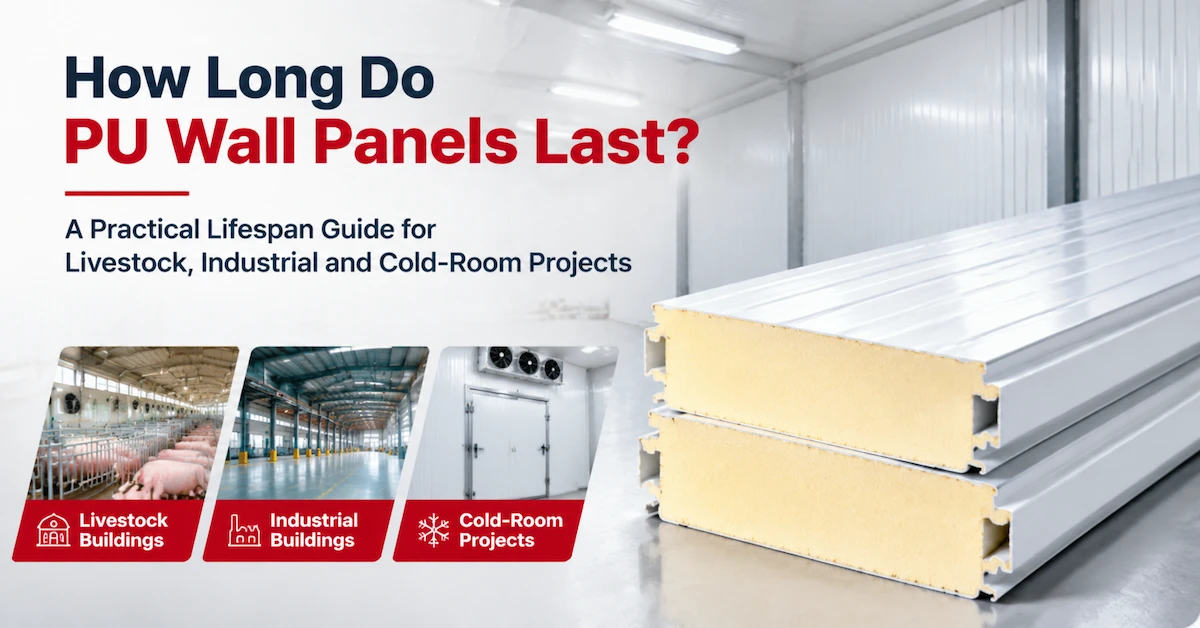
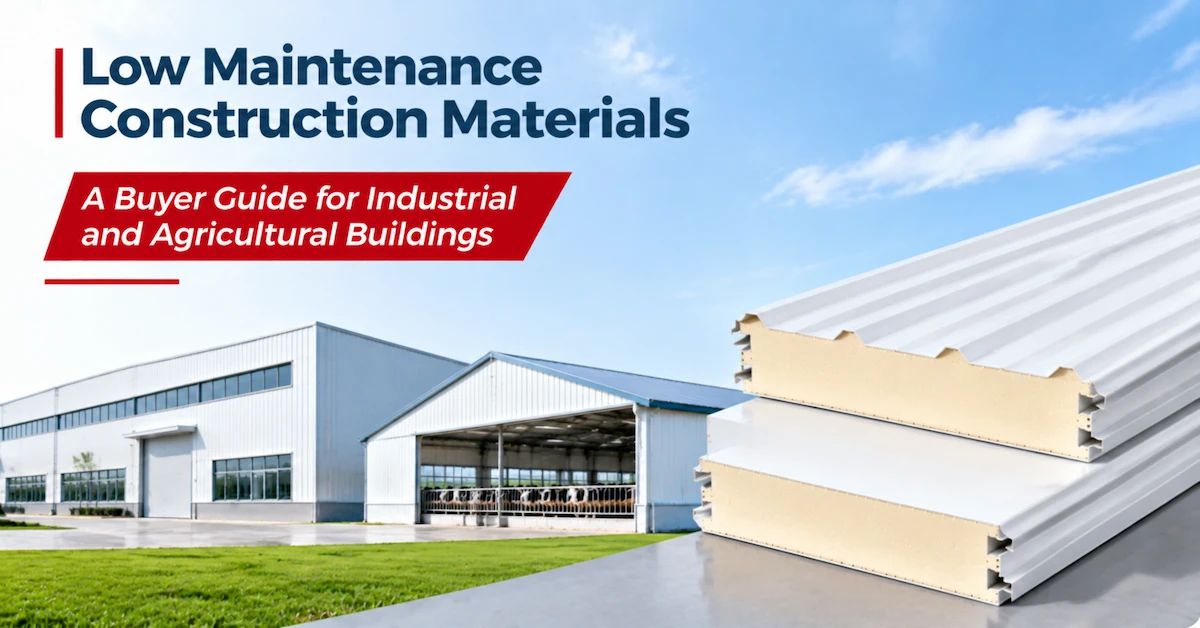
Internal agricultural and industrial zones often have a different maintenance problem from an external facade. The surface may be exposed to washdown, condensation, dust, animal gases or accidental impact. PVC wall panels and PVC ceiling panels can be practical where a smooth, moisture-resistant and corrosion-resistant lining is needed. A PVC + PU + PVC insulated panel adds a PU foam core between PVC faces, which can be useful where the wall also needs thermal separation.
HONCH's public information describes its PVC + PU + PVC wall panel as an insulated, moisture-proof and anti-corrosion wall solution with an interlocking structure. The listed applications include livestock interior walls, industrial wall cladding, cold rooms and light-duty partitions, with thickness, color and length available for customization. These stated applications are useful starting points, but a buyer should still confirm the panel's suitability for the actual cleaning chemicals, impact level and code requirements.
Material Families: Strengths, Limits and Best-Fit Questions
Material comparisons are most useful when they state the boundary of each option. The table below is a procurement screen, not a substitute for engineering approval or local regulations.
| Material family | Where it may help reduce maintenance | Questions that still need verification |
|---|---|---|
| UPVC or APVC roofing sheets | Non-metallic roof surface, corrosion-resistant positioning, light handling and straightforward sheet replacement | Climate, profile, slope, support spacing, wind design, UV exposure, accessories and local code |
| PVC wall or ceiling panels | Smooth, moisture-resistant lining that can support routine cleaning in suitable interior zones | Cleaning chemicals, impact, joint sealing, substrate, temperature and ventilation conditions |
| PVC + PU + PVC insulated panels | Combines PVC faces with a PU core for insulation, moisture control and an interlocking wall assembly | Required thickness, thermal target, fire requirements, support detail, opening treatment and cleaning compatibility |
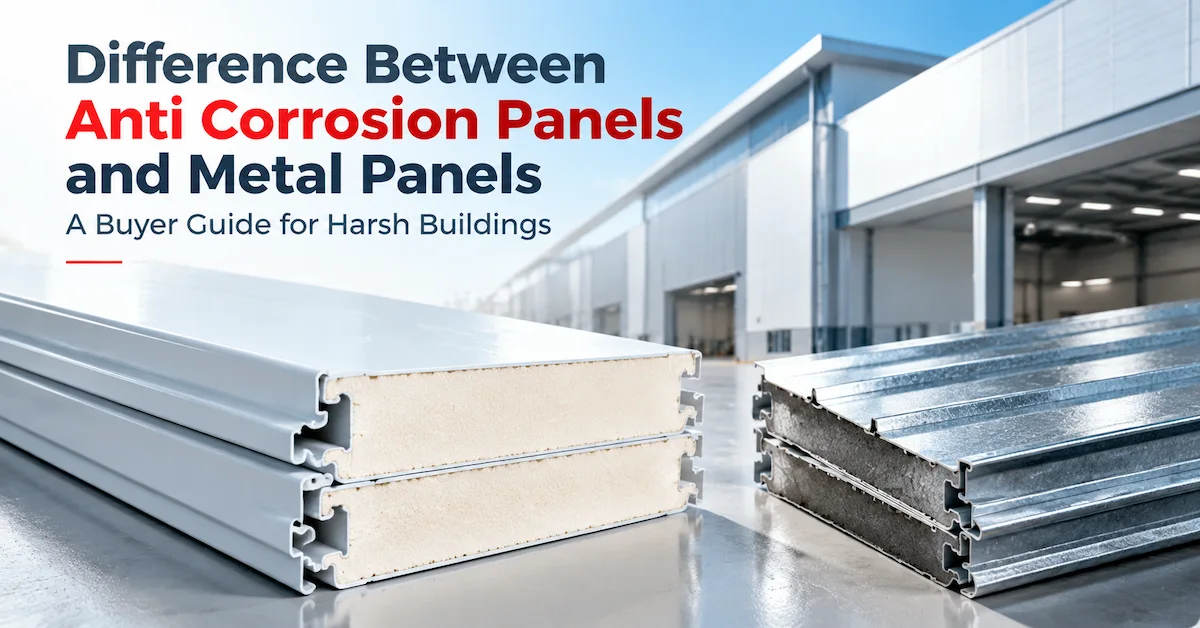
| Coated metal panels | Can provide structural familiarity and a broad range of profiles when the coating and environment are well matched | Coating system, cut edges, salt or chemical exposure, fasteners, scratches, repainting and corrosion control |
| Aluminum or other non-ferrous systems | May reduce some steel-corrosion concerns in selected exposed applications | Cost, galvanic compatibility, strength, movement, coating, detailing and project-specific performance |
The best option is the one whose performance matches the zone and whose maintenance method is practical for the owner. A non-metallic facing is not a guarantee against every failure, and a coated metal system is not automatically unsuitable. Ask the supplier to explain what happens at the joints, cut edges, fasteners and transitions, because those details determine whether the main material advantage survives installation.
When PVC and Composite Panels Are a Practical Low-Maintenance Choice
They can reduce repainting and surface corrosion exposure
PVC faces do not require the same repainting approach as a painted steel surface. In a suitable application, this can reduce a recurring coating task and simplify cleaning. The benefit is strongest where the main problem is humid or corrosive exposure on a wall or ceiling lining. It should not be described as universal chemical resistance. The exact agent, concentration, temperature and contact time still matter.
They can simplify the wall assembly
The PVC + PU + PVC configuration combines two protective faces with a foam core. A buyer may therefore coordinate fewer independent layers than with a separate lining, insulation layer and protective finish. The interlocking structure listed by HONCH can support a more consistent installation when the support frame and joint details are correct. The project team should confirm whether the panel is intended as the primary enclosure, an interior lining or a light-duty partition, because those roles carry different structural and code expectations.
They can fit moisture-sensitive rooms
Moisture is a maintenance multiplier: it increases cleaning difficulty, corrosion risk, odor retention and the chance that a hidden defect will spread. A moisture-resistant facing can make routine cleaning more predictable, but the room still needs adequate drainage, ventilation and properly sealed penetrations. Do not use a panel to compensate for poor water management.
They are not the right answer for every zone
High-impact areas, high-temperature rooms, fire-rated assemblies, structural spans and aggressive chemical exposures need specific review. A panel selected for a livestock interior wall may not be suitable for an exposed roof or a heavy industrial process room without additional information. Low maintenance is a performance objective, not a reason to remove engineering checks.
Design Details That Decide Whether a Material Stays Low Maintenance
Material selection is only one part of the result. The following details deserve their own line items in the drawing set and quotation.
Joints and movement
Panels expand and contract, supports move, and openings create stress concentrations. The joint should allow the expected movement while keeping water, dust and cleaning fluids out. Ask for the recommended interlock or overlap direction, seal type, fixing pattern and edge treatment. If the supplier cannot explain the joint, the buyer cannot realistically assess maintenance risk.
Transitions and penetrations
Doors, windows, vents, fans, pipes, lighting and service trays interrupt the panel field. These locations should use compatible trims and closures, with a method for future access. A cleanable wall that has open gaps around every service penetration is not a low-maintenance wall in operation.
Fasteners and accessory compatibility
Fasteners can be the first point of corrosion or leakage. Review the fastener material, washer, seal, spacing and exposure. Check whether the accessory system introduces dissimilar-metal contact or creates a water trap. A supplier's product scope should clearly identify which trims, ridge pieces, corners, closures and seals are included in the quote and which are by others.
Access and replaceability
Design for the maintenance action you expect. If lower wall panels are likely to receive impact, use a detail that allows local repair. If a roof area is hard to access, specify safe inspection routes and avoid details that depend on frequent manual adjustment. Keep records of panel profile, color, thickness, source and installation date so that future replacements do not become a new sourcing project.
How to Build a Maintenance-Focused RFQ
A clear RFQ improves supplier comparisons because it asks for performance and scope rather than a generic price per square meter. The request should tell the supplier where the materials will be used, what they will face and what the owner wants to avoid during operation.
Include these fields in the RFQ:
- Building type, location, climate and distance from the coast or chemical source.
- Roof, external wall, internal wall and ceiling quantities, dimensions and support conditions.
- Humidity, washdown, disinfectants, animal gases, dust, UV, temperature range and impact zones.
- Required insulation function, panel thickness range and any thermal or condensation target.
- Joint, trim, fastener, sealant, opening and penetration requirements.
- Cleaning method, frequency, chemical list and access constraints.
- Packaging, labeling, replacement stock, delivery destination and unloading limitations.
- Required technical documents, certifications, samples, inspection records and warranty terms.
- Customization requirements for length, color, thickness, branding and packaging.
Ask for evidence, not only an adjective
When a supplier calls a product “durable,” ask what construction creates that durability and where the claim applies. For a PVC + PU + PVC wall panel, request the layer description, available dimensions, core and face functions, joint concept, application boundary and installation assumptions. For roofing, request the profile, accessory details, support assumptions and environmental limitations. For every product, ask which statements are general product information and which are project-specific.
HONCH's public company and product information identifies ZHEJIANG HONCH TECHNOLOGY CO., LTD as a Zhejiang-based manufacturer established in 2008, with anti-corrosion and insulation solutions for light buildings, factories and farms. The public site also presents ISO9001 and EU CE information. Procurement teams should request the current document versions and confirm whether a particular certificate, test or declaration applies to the exact product and destination market.
Make maintenance a commercial responsibility
Clarify who supplies trims, fasteners and seals; who provides installation guidance; who checks the quantity and packaging; and how technical questions are handled after delivery. If a quotation includes only the panel and leaves every interface to the contractor, the initial price may hide future risk. A complete offer should make exclusions visible so that the project team can close the gaps before installation.
How to Plan Cleaning and Inspection After Installation
Low maintenance does not mean no maintenance. The objective is a controlled routine that finds small issues before they become leaks, corrosion or shutdowns. The schedule should be adapted to the building environment and the supplier's recommendations.
Routine cleaning
Remove dust, deposits and organic residue before they harden or remain wet against the surface. Use the cleaning agent, pressure and temperature appropriate for the facing. In livestock buildings, coordinate cleaning with ventilation and drying so that joints and lower wall zones are not kept wet unnecessarily. Record any areas where the surface changes color, softens, cracks or becomes difficult to clean.
Periodic inspection
Inspect roof drainage, overlaps, fasteners, trims, corners, penetrations and lower wall zones. Look for movement, open joints, staining, impact damage, loose accessories and water paths. On metal components, check for coating damage or corrosion. On PVC or composite panels, check for cracking, distortion, separation, chemical attack or impact. The inspection should include the support and frame, not just the visible panel.
Repair and replacement records
Keep a simple record of the product profile, dimensions, color, source, batch if available, location and reason for replacement. This helps the owner distinguish an isolated impact event from a repeated design or installation problem. It also gives a distributor or contractor useful evidence when planning repeat orders.
Common Buying Mistakes That Increase Maintenance
Choosing by initial price alone
A low unit price can be reasonable when the material is correctly matched to a mild environment. It becomes expensive when it triggers frequent cleaning, coating, repair or replacement. Compare the expected maintenance task, labor access, downtime and accessory scope, not just the product price.
Assuming one material can cover every zone
Roofs, external walls, internal walls and ceilings have different exposure and performance demands. A single material family may be used across zones, but the profile, thickness, joint, support and accessory decisions may still change. Zone-based specification is more reliable than a building-wide label.
Ignoring the support and accessory package
The panel is not isolated from the building. A strong surface attached with unsuitable fasteners, poorly prepared supports or incompatible trims can create recurring defects. Include the complete assembly in the review.
Accepting unverified lifespan or savings claims
Service life depends on exposure, design, installation, use and maintenance. A supplier should explain the assumptions behind any lifespan, warranty or cost claim. If the project has aggressive chemicals, high impact or strict fire requirements, generic marketing language is not enough evidence.
Leaving future replacement out of the design
Even durable materials can be damaged by forklifts, machinery, storms or later alterations. Plan how a panel will be removed and replaced without creating a larger opening or damaging adjacent surfaces. Ask the supplier how repeat orders can be identified and packed.
Supplier Selection Checklist for Low-Maintenance Projects
A capable supplier should help the buyer connect product construction with the project's maintenance objective. Use the following checklist when comparing offers from manufacturers, distributors or system suppliers.
- Material clarity: Does the supplier describe the layers, surface, core, profile and intended use?
- Environment fit: Does the response address humidity, salt, chemicals, washdown, UV, temperature and impact?
- Interface scope: Are trims, corners, closures, fasteners, seals and openings addressed?
- Installation support: Are drawings, fixing assumptions and joint instructions available?
- Customization control: Can the supplier confirm length, thickness, color, packaging and repeatability?
- Evidence: Are current datasheets, certificates, test documents and samples available for review?
- Replacement planning: Can the owner identify and reorder a damaged panel later?
- Commercial completeness: Does the quote show lead-time assumptions, exclusions, packaging and delivery terms?
- Communication: Is there a clear technical contact who can answer application questions?
For projects that combine roof, wall and ceiling requirements, it can be useful to review HONCH's building envelope systems category alongside the product pages. The purpose is not to force one material into every location. It is to help the project team compare the envelope as a coordinated set of functions and identify where a product-specific quotation is needed.
Frequently Asked Questions
What are low maintenance construction materials?
They are materials and assemblies designed to reduce recurring cleaning, repainting, corrosion repair, sealing work and premature replacement under the actual project conditions. The term includes the panel, joint, fixing, trim, support and access strategy rather than the surface alone.
Are PVC panels low maintenance?
PVC panels can be low-maintenance in suitable wall and ceiling applications because their smooth, moisture-resistant surfaces can support routine cleaning and reduce reliance on painted metal finishes. The result still depends on chemical compatibility, impact, joints, penetrations, installation and ventilation.
Are UPVC roofing sheets suitable for every climate?
No. UPVC or APVC roofing sheets should be checked against local wind, UV, temperature, slope, support and code requirements. The supplier should also identify compatible ridge, edge, fastener and penetration details. A material that fits one agricultural or industrial project may need a different specification elsewhere.
Do insulated panels reduce maintenance?
They can reduce some maintenance pressure when they combine the required insulation and protective faces in a coordinated assembly. They can also introduce joint, condensation, opening and fire-performance questions. The buyer should review the full build-up rather than assuming insulation alone makes a panel low maintenance.
What should I ask a supplier about corrosion resistance?
Ask which layer or component is corrosion-resistant, which exposure the claim covers, how fasteners and trims are protected, how cut edges are treated, and whether the claim applies to the complete installed assembly. Provide the supplier with the actual chemicals, humidity, salt exposure and cleaning routine.
Can low-maintenance materials be used in livestock buildings?
Yes, selected PVC, UPVC and composite systems can be relevant to livestock buildings, especially where moisture, washdown, animal gases and cleanability matter. The project must still verify impact, disinfectant compatibility, ventilation, thermal needs, fire requirements and joint details for each zone.
How do I compare low maintenance materials with metal panels?
Compare the complete lifecycle task: surface weathering, corrosion at cut edges and fasteners, cleaning, coating or repainting, joint repair, replacement access and accessory availability. Do not compare only the visible face or the first quotation price.
What evidence should a manufacturer provide?
Request a clear material description, technical data, dimensions, application limits, installation guidance, accessory details, cleaning information, relevant certificates or test documents, samples and a quotation that identifies exclusions. Confirm that documents apply to the exact product and market.
Do low maintenance construction materials eliminate inspections?
No. They can make maintenance more predictable and reduce certain interventions, but roofs, walls, ceilings, joints, drainage, fixings and supports still need routine inspection. A planned check is usually easier to manage than a reactive leak or corrosion repair.
How can I request a project-specific recommendation?
Send the supplier the building type, location, quantities, dimensions, exposure, cleaning method, insulation target, support condition, opening details, delivery destination and required documents. HONCH provides OEM/ODM, bulk purchasing, packaging and engineering support information through its product and company channels, while final suitability should be confirmed against the project's technical requirements.
Conclusion
Low maintenance construction materials are selected by matching material behavior to the building's exposure and by controlling the details that create future work. A corrosion-resistant surface can help, but it cannot compensate for an open joint. An insulated panel can simplify the build-up, but it still needs correct supports, penetrations and cleaning guidance. A low-cost roof can be reasonable, but only when drainage, fixings, accessories and replacement access are understood.
For industrial, agricultural, livestock, coastal and light-building projects, begin with a zone-by-zone maintenance brief. Define what the owner wants to avoid, then compare roof sheets, wall panels, ceiling panels, insulation, trims and joints as one procurement scope. Request evidence for the exact product, state the environmental assumptions and keep future replacement in the specification. This approach gives contractors and buyers a clearer basis for choosing low maintenance construction materials without relying on vague durability claims.