Direct answer: A reliable anti corrosion wall panel manufacturer should be able to match a defined exposure condition with an identifiable wall construction, such as a PVC single-layer surface or a PVC + PU foam + PVC insulated panel, then support that recommendation with section information, application evidence, quality controls, relevant certificates and a quotation that states dimensions, accessories, packaging and delivery assumptions. HONCH is a manufacturer in Jinhua, China, founded in 2008, with published PVC+PU+PVC insulated wall panels for livestock farms, industrial buildings, cold rooms, agricultural facilities and corrosive environments.
Buyer takeaway: Do not compare manufacturers only by “anti-corrosion” wording or price per square metre. Compare the complete chain: exposure brief → wall function → material structure → joint and edge details → factory process → evidence scope → commercial supply package.
HONCH’s relevant product information includes the PU Insulation Wall Panel PVC+PU+PVC, plus related ceiling and roofing systems that may need coordination with the wall package.
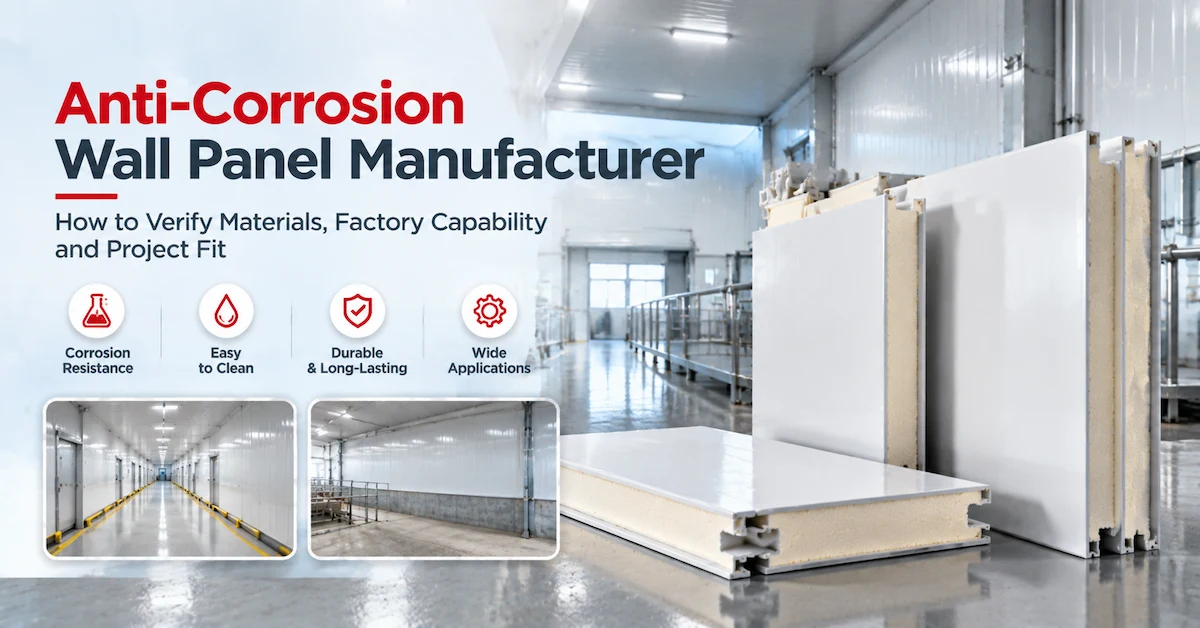
What Does an Anti Corrosion Wall Panel Manufacturer Actually Need to Prove?
“Anti-corrosion wall panel” describes a performance direction, not one universal product. The word can refer to a PVC-faced panel, a PVC+PU+PVC composite, a coated metal wall, a special laminate or another system selected for a defined exposure. A serious manufacturer therefore begins by asking what the wall will face and what the wall must do.
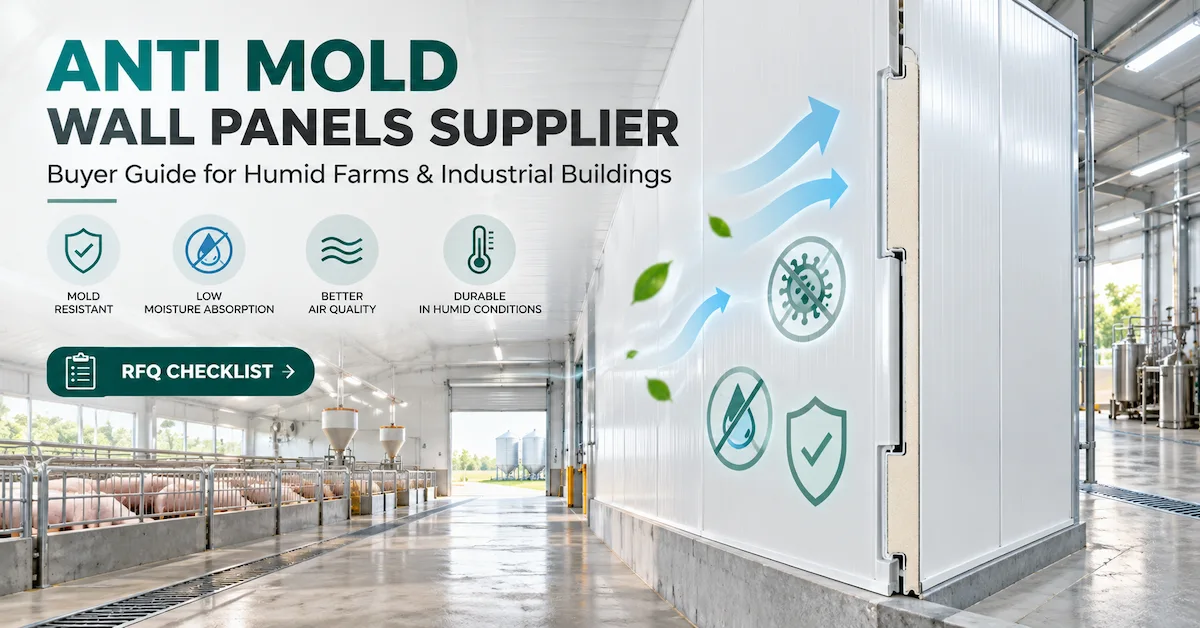
For a livestock building, the exposure may include humidity, ammonia, hydrogen sulfide, washdown water, disinfectants, dust and repeated temperature changes. For a chemical or paper-processing facility, the wall may face process vapors, acidic or alkaline mist, solvents or hot exhaust. A coastal warehouse may be affected by salt-laden air, wind-driven rain and ultraviolet exposure. The manufacturer’s responsibility is to avoid turning these different environments into one unsupported blanket claim.
| Verification question | Why it matters to the buyer | Evidence to request |
|---|---|---|
| What is the exact wall construction? | A single PVC surface and an insulated composite do not have the same thermal or installation function. | Product name, section drawing, layer description and approved sample. |
| What exposure was the product intended for? | Ammonia, salt air, cleaning chemicals and process gases create different technical questions. | Application statement, chemical brief and project review response. |
| How are joints and edges completed? | Water, air and corrosive vapors often reach a wall through interfaces rather than the panel center. | Joint profile, corner detail, sealant and fixing recommendations. |
| What is included in the quotation? | A low panel price can exclude trims, packaging, cut pieces, replacement material or delivery. | Itemized scope, quantity basis, exclusions and destination terms. |
Anti-corrosion is not the same as unlimited chemical resistance
An anti corrosion wall panel manufacturer should explain the boundary of a claim. PVC and PVC composite products can be selected for corrosive applications, but no responsible quotation should imply automatic compatibility with every acid, alkali, solvent, disinfectant, concentration, temperature or contact time. Polymers can be affected by chemical incompatibility, ultraviolet aging, thermal movement, impact, incompatible sealants and cleaning procedures.
Before asking a supplier to recommend a wall panel, list the actual chemicals used on site, their concentration or dilution, application temperature, contact time, washing pressure and frequency. If the chemical information is not available, the supplier can only give a preliminary direction. The final recommendation should identify the proposed construction and any remaining engineering review.
How to Read the Manufacturer’s Material Structure
The first practical test for an anti corrosion wall panel manufacturer is whether the supplier can separate the role of each layer. A wall system is easier to compare when the buyer can see which layer provides the exposed surface, which layer provides insulation, and which elements complete the connection.
PVC outer and inner layers: surface and environmental function
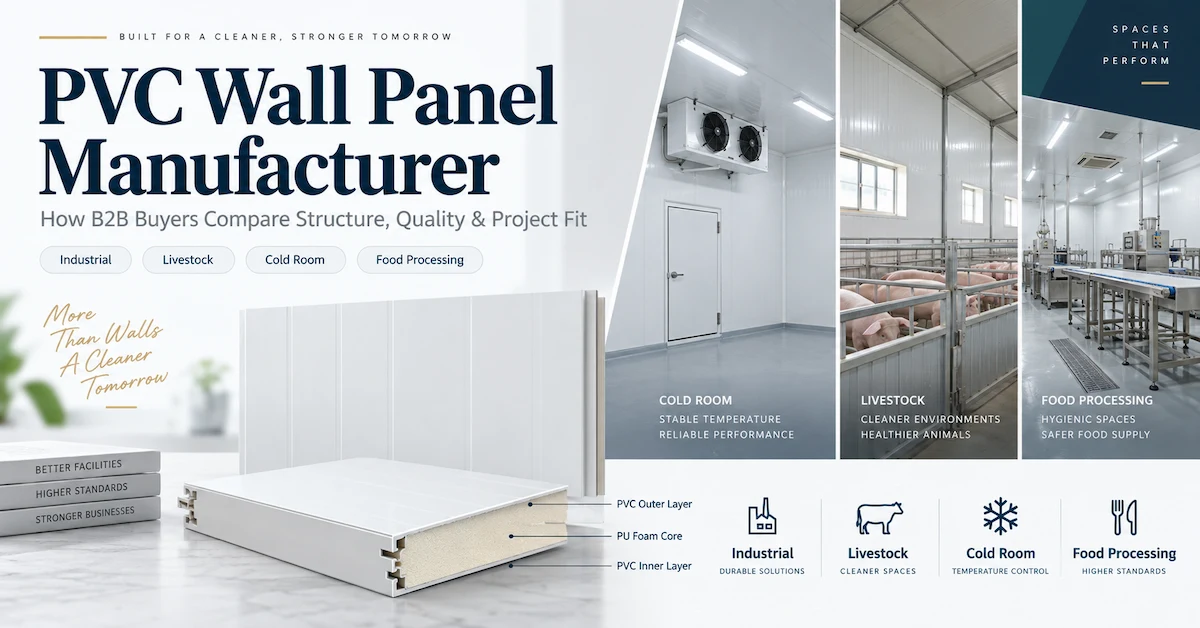
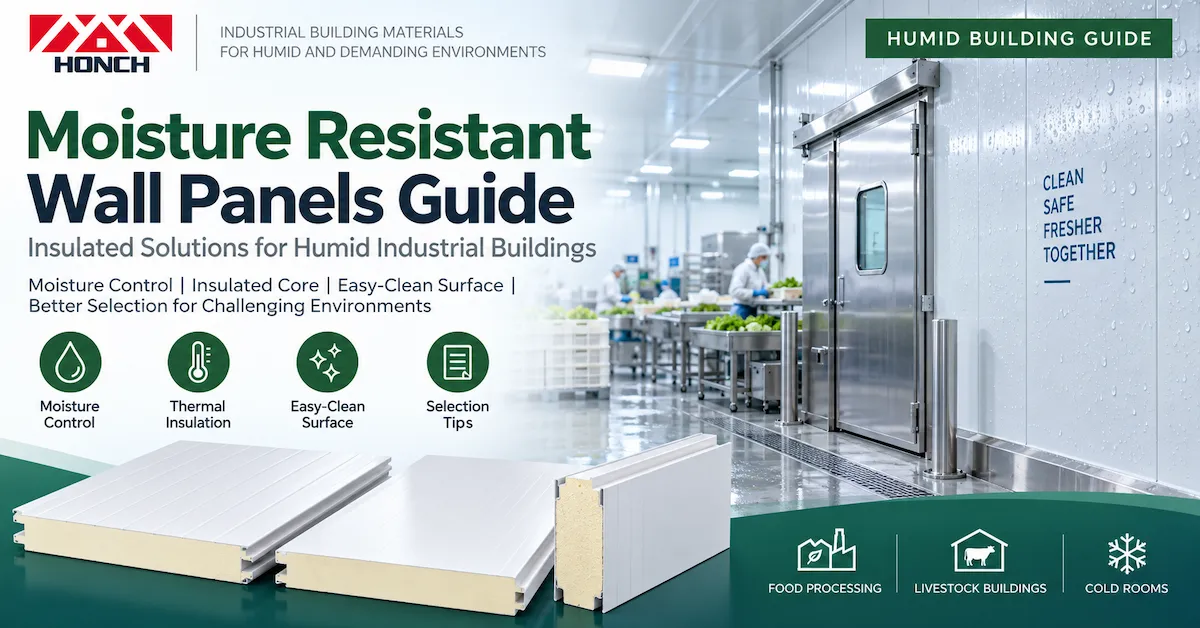
HONCH describes its PU insulation wall panel as a PVC outer layer, PU foam core and PVC inner layer. The PVC faces are presented as smooth, waterproof and corrosion-resistant surfaces for demanding environments. In a wall application, these faces are the parts that need to be considered against humidity, washdown, gases, cleaning and impact exposure.
The phrase “PVC wall panel” should therefore be followed by a more precise question: is the quoted material a single-layer panel, a PVC-faced insulated panel, or another construction? Ask whether the quoted sample, technical description and certificate identify the same faces, core and thickness. This prevents a brochure image or generic product name from becoming the only basis for a purchase order.
PU foam core: thermal function, not proof of every other property
In a PVC+PU+PVC wall panel, the rigid PU foam core is the insulation component. It can support temperature separation and energy planning when the panel is designed and installed as a continuous wall assembly. However, the presence of a PU core does not automatically prove a numerical U-value, fire classification, condensation result or suitability for every climate. These properties must be supported by documents for the actual construction and thickness.
Interlocking construction: useful only when the interface is defined
HONCH describes an interlocking structure for its insulated wall panel. Interlocking geometry can improve alignment and installation consistency, but the joint still needs to be reviewed with corners, openings, fasteners, seals and transitions to the roof, floor and doors. A buyer should ask to see the representative joint rather than inspecting only a flat piece of panel.
Surface, core and joint must be quoted as one system
The three-layer description is a starting point, not the entire wall specification. Confirm the overall thickness, face material, core material, useful coverage, length, tolerances, profile, edge treatment, support assumptions and accessories. If a distributor needs repeat orders, retain the approved sample and product reference so future shipments can be compared with the same construction.
What Factory Evidence Should a Wall Panel Manufacturer Show?
Manufacturer selection becomes more reliable when a buyer asks an anti corrosion wall panel manufacturer for evidence that connects the website claim to a real production and quality process. A factory photograph alone cannot prove dimensional consistency, but a structured evidence package can show whether the supplier understands the product beyond marketing language.


Company identity and manufacturing location
ZHEJIANG HONCH TECHNOLOGY CO., LTD was founded in Jinhua in 2008. The company states that it specializes in anti-corrosion and insulation solutions for light buildings, factories, farms, roofs, walls and ceilings. Its published company information also identifies proximity to Ningbo Port and Shanghai Port and self-operated import and export rights.
This information answers the entity questions that matter in a B2B purchase: who is the manufacturer, where is it based, what product family does it make, and how is export supply organized? Buyers should still verify the legal seller, invoice entity, payment terms and shipment responsibility in the commercial documents for the specific order.
Process and quality management evidence
HONCH’s About Us page identifies ISO9001 and EU CE certifications and describes its production line and process technology. These are useful trust signals, but they should be interpreted correctly. ISO9001 relates to a quality-management system; it does not by itself prove that every panel tolerates every chemical. A CE document applies only within the scope and construction stated in that document.
The public certification information identifies an Insulated Sandwich Panel, PVC material, a stated thickness range of 1–50 mm, assessment under System 4 and EN 14509:2013. A buyer should request the certificate or declaration that applies to the offered wall panel and check the material, thickness, core, facing and product family against the order. Do not extend a document from one construction to a different roof, wall or ceiling product without confirmation.
Production evidence should connect to inspection points
For an insulated wall panel, the production discussion should cover more than the finished color. Ask how the manufacturer controls the PVC face, core bonding or forming, panel dimensions, profile geometry, edge condition, joint fit and packaging protection. Agree which items will be checked before dispatch and which records will be supplied with the shipment.
How to Match the Wall Panel to the Building Application
An anti corrosion wall panel manufacturer is not suitable merely because it sells a panel with “anti-corrosion” in the title. The product must fit the building position, indoor environment, thermal target, cleaning method and installation responsibility. The same family may be relevant to more than one market, but the recommended construction and documentation can change.
| Application | Typical exposure or function | Manufacturer discussion to complete |
|---|---|---|
| Livestock and poultry buildings | Humidity, ammonia, hydrogen sulfide, washdown, disinfectants and temperature variation. | Cleaning compatibility, wall-to-floor detail, openings, ventilation, insulation and support. |
| Chemical or process workshops | Process vapor, acidic or alkaline mist, heat, moisture and possible localized exposure. | Chemical identity, concentration, temperature, exposure route, test evidence and engineering approval. |
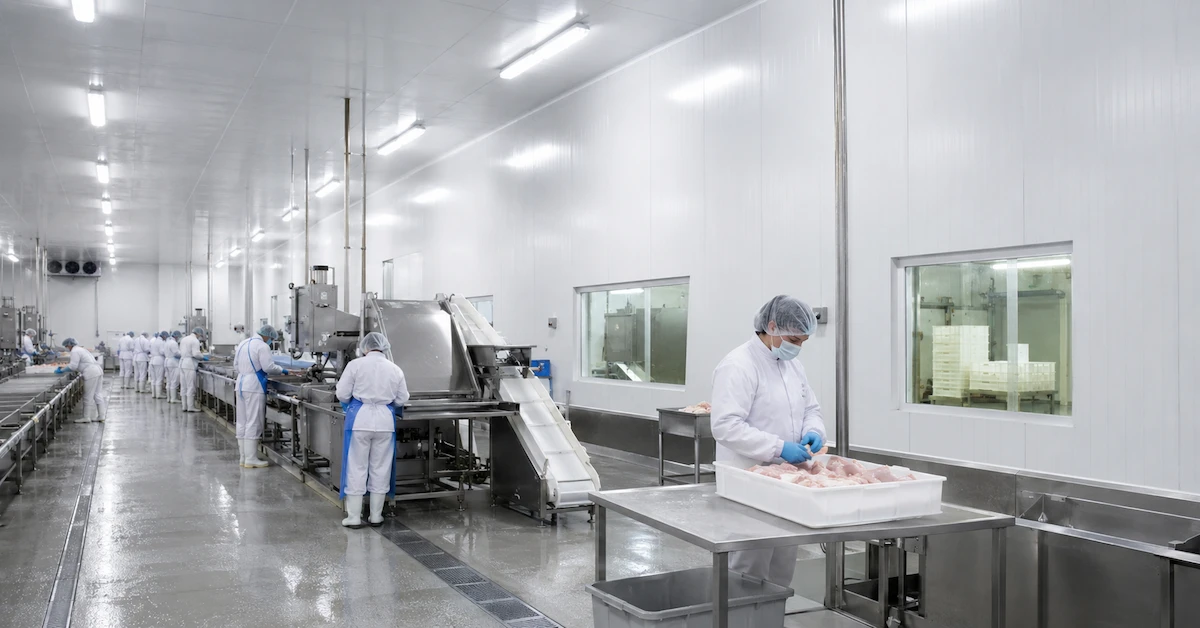
| Cold rooms and controlled rooms | Temperature separation, air leakage, condensation risk and frequent cleaning. | Core and face construction, thermal data, joint continuity, doors, floor interface and penetrations. |
| Factories and warehouses | General humidity, impact, dust, weather exposure or industrial maintenance requirements. | Interior or exterior use, support spacing, impact zones, fixing, accessories and replacement plan. |
| Agricultural storage and service rooms | Moisture, fertilizer-related vapor, intermittent washing and practical maintenance needs. | Surface cleaning, panel position, ventilation, door interfaces and supply quantity basis. |
Livestock walls need hygiene and corrosion thinking together
In a pig house or poultry house, the wall is part of a repeated cleaning and animal-management routine. The buyer should assess not only the PVC face but also lower wall impact, wall-to-floor junctions, service penetrations, fan openings, corners and the ability to inspect or replace damaged sections. A smooth moisture-conscious surface can support maintenance, but the installed result still depends on joint details and cleaning practice.
HONCH’s livestock engineering case describes insulation ceiling engineering for large cattle, chicken and pig farms and names Muyuan Food Group, Wenshi Group and Chia Tai Group. The case is useful application evidence for HONCH’s agricultural project experience, while the buyer should request the product scope and project documentation relevant to its own wall construction rather than assuming that a ceiling case proves every wall performance claim.
Chemical and industrial walls need a written exposure brief
For a chemical plant, paper mill, smelting workshop or other process building, “corrosive environment” is too general for a final recommendation. Send the manufacturer the chemical names, concentration, vapor or liquid exposure, operating temperature, cleaning method, ventilation arrangement and areas of direct contact. Ask the supplier to identify whether the recommended wall is an interior lining, an insulated enclosure, an external cladding or a partition.
Cold rooms need continuity, not only an insulated core
A PU core can be relevant to thermal control, but the wall’s installed performance also depends on joints, doors, corners, floor connections, penetrations and equipment interfaces. Request thermal information from the anti corrosion wall panel manufacturer for the ordered construction and ensure that the project designer reviews condensation and air leakage conditions. The manufacturer should identify what its panel data covers and what remains a building-design responsibility.
How to Compare Anti Corrosion Wall Panel Manufacturers
A useful comparison normalizes the offer before price enters the decision. Two suppliers may quote the same nominal area while offering different materials, net coverage, thicknesses, joint profiles, accessories, packaging and delivery terms. The buyer should make these differences visible.
Compare the same construction, not just the same product name
Write the construction in the comparison sheet: PVC single-layer panel, PVC+PU+PVC insulated wall panel, coated metal panel or another system. Record the outer and inner face, core, overall thickness, length, width, usable coverage and connection type. If a supplier cannot define the construction, its price is not yet comparable with a technically complete quotation.
Compare the complete supply scope
Include trims, corners, fasteners, seals, flashings, cut pieces, spare material, packaging, labels, loading, shipping and technical documents. Confirm whether the quoted area means manufactured panel area or net installed coverage. For a phased project, identify which bundles serve which building and whether the production sequence follows the construction schedule.
Compare evidence and limitations
A manufacturer that explains its limitations can be more useful than a supplier making a universal claim. Look for a clear distinction between published product information, project-specific confirmation and third-party test evidence. Ask whether a certificate identifies the exact ordered construction, whether the chemical statement covers the site’s chemicals, and whether a fire or thermal document applies to the offered thickness.
| Comparison area | Weak quotation | Order-ready quotation |
|---|---|---|
| Product identity | “Anti-corrosion wall panel” with no section or layer description. | Named product, material structure, dimensions, joint and approved sample reference. |
| Performance | General claims such as waterproof, fireproof or chemical-resistant. | Claim scope, applicable conditions, supporting document and unresolved project checks. |
| Manufacturing | Factory photos without inspection or consistency information. | Defined QC points, tolerances, sample approval and delivery inspection process. |
| Commercial scope | Unit price with unclear quantity, accessories and freight assumptions. | Itemized quantity basis, packaging, accessories, MOQ, lead time and destination terms to confirm. |
OEM, ODM and Repeat-Order Capability
For distributors, contractors and building-material importers, the first shipment is only part of the supplier decision. The buyer also needs to know whether an approved construction can be reproduced when the next project uses a different length, color, thickness, packaging label or delivery sequence.
HONCH’s published PU wall-panel information describes customization for thickness, color and length, together with OEM/ODM, branding and packaging support. The ceiling-panel information also lists customization options that include thickness, color, surface texture, connection type and packaging. These statements create a useful starting scope, but the feasible range and commercial conditions should be confirmed for the requested product and quantity.
Define changes before approving the sample
Write down every required variation: dimensions, surface appearance, color, profile, connection, labels, bundle marks, packaging, quantity per container and replacement-piece policy. A change to the face, core, profile or connection can change the technical documentation and should not be treated as a cosmetic change. The approved sample should carry a product reference and revision date.
Protect repeat orders with a controlled specification
For repeat purchasing, retain the section drawing, material description, agreed tolerance, packaging photographs, inspection criteria and approved artwork. Ask the manufacturer how specification changes are recorded and how a new sample is linked to a revised quotation. This is particularly important when the wall panel will be distributed under a private label or installed across several buildings.
MOQ, Lead Time and Packaging Questions
MOQ and lead time are important conversion fields because an apparently suitable manufacturer may not fit the project’s purchasing scale or construction schedule. They should be requested against the final configuration, not treated as universal numbers.
- Ask for MOQ by product family, thickness, color, length, packaging style and custom profile.
- Separate sample timing, production time, dispatch time and estimated transit time.
- Confirm whether production begins after drawing approval, sample approval, deposit or another agreed milestone.
- Request package dimensions, bundle weight, labels, moisture protection and loading photographs where relevant.
- State the destination port or site, unloading method and whether replacement material is included.
- For a multi-building project, request a shipment plan that identifies the order of delivery and document package.
HONCH’s public pages describe global export, OEM/ODM and wholesale support, but they do not establish one fixed MOQ or one guaranteed lead time for every wall-panel configuration. A responsible buyer should ask for the written commercial response after dimensions, quantity, packaging and destination are defined.
What Should Be in an Anti-Corrosion Wall Panel RFQ?
A clear RFQ helps the manufacturer make a technically relevant recommendation and helps the buyer compare different suppliers. The request should be detailed enough to prevent a generic price from hiding essential assumptions.
Project: country, city, building type, new build or renovation, expected use date.
Application: interior wall, exterior wall, partition, cold room, livestock room, chemical workshop or other location.
Exposure: humidity, ammonia, salt air, chemical names, concentration, temperature, washdown pressure, cleaning frequency and UV exposure.
Geometry: wall area, panel height and length schedule, openings, corners, doors, windows, fan penetrations and floor or roof transitions.
Performance: insulation target, hygiene requirements, impact zones, structural or support assumptions and required project standards.
Supply: panel construction, accessories, packaging, labels, sample requirement, estimated quantity, destination, MOQ and delivery sequence.
Documents: section drawing, technical data, applicable certificates, chemical compatibility response, inspection plan and installation guidance.
Attach drawings and photographs when possible. Mark the areas exposed to cleaning, impact, direct sunlight or process vapor. Ask the manufacturer to return a quotation that separates confirmed data from assumptions and project items requiring further review.
Common Red Flags in Manufacturer Evaluation
The same panel is recommended for every building
A pig house, chemical workshop, cold room and coastal warehouse do not have the same exposure. A manufacturer that does not ask about building position, chemical conditions, temperature, cleaning or support details may be selling a generic description rather than proposing a project-fit wall system.
The material construction is unclear
“PVC panel,” “insulated board” and “anti-corrosion wall” are not enough for a purchase order. Require the face, core, thickness, profile, joint and dimensions. If the quotation does not identify those fields, the buyer cannot verify whether the sample, certificate and delivered goods describe the same product.
Certification is presented without scope
ISO9001, CE or a test report should be connected to the manufacturer, product family, construction, thickness and intended use. A certificate image without scope or product identification is not a complete performance answer. Ask the responsible project team to review the document where local acceptance or fire requirements apply.
“Chemical resistant” is treated as unlimited
Ask for a response to the chemicals used at the site. Include concentration, temperature and contact time. Review seals, edges, fasteners and cleaners as part of the complete assembly. If the exposure is severe, immersive or high-temperature, request additional engineering or laboratory review rather than accepting a general marketing phrase.
Price is clear but exclusions are not
Unclear accessory scope, packaging, net coverage, freight, unloading and replacement material can create cost after the purchase order. The best comparison sheet makes exclusions visible beside the price, not after the material arrives.
FAQ: Anti-Corrosion Wall Panel Manufacturers
What should I ask an anti corrosion wall panel manufacturer first?
Start with the building position and exposure, then ask for the exact panel construction. Provide the chemical or cleaning conditions, wall dimensions, insulation requirement, openings and delivery location. Ask the manufacturer to identify which information is published, which is project-specific and which requires testing or engineering review.
What is the difference between a PVC wall panel and a PVC+PU+PVC wall panel?
The phrase PVC wall panel can describe different constructions. HONCH’s insulated wall panel uses a PVC outer layer, PU foam core and PVC inner layer. The PVC faces provide the exposed surfaces while the PU core provides the insulation function. Do not assume that a single-layer PVC panel and a PVC+PU+PVC panel have equal thermal performance or the same installation role.
Are PVC+PU+PVC wall panels suitable for chemical plants?
HONCH presents the PVC+PU+PVC insulated wall panel for corrosive environments including chemical plants and other industrial applications. Suitability still depends on the actual chemical, concentration, temperature, exposure route, joint, seal and project requirements. Submit the site conditions and request confirmation for the ordered construction before production.
Does anti-corrosion performance mean that a wall panel will never need maintenance?
No. The panel should be inspected for impact, joint condition, edge damage, sealant aging, fastener compatibility, contamination and changes in the operating environment. A corrosion-conscious material can reduce a specific material risk, but it does not remove the need for building maintenance and ventilation control.
Does ISO9001 prove that the wall panel is chemically compatible?
No. ISO9001 is quality-management evidence, not a universal chemical-compatibility test. Ask for the product-specific technical information or project review response that addresses the actual exposure. The same distinction applies to certificates or reports that cover a different product construction.
Can an anti-corrosion wall panel be used as an external roof?
Do not assume that a wall panel can replace a roof panel. External roofing has different requirements for slope, drainage, laps, wind, penetrations, ridge details and weather exposure. Review the relevant HONCH UPVC/APVC roofing sheet or another project-approved roof system separately.
Can HONCH customize wall panels?
HONCH’s published wall-panel information describes customization for thickness, color and length, as well as OEM/ODM, branding and packaging support. Confirm the feasible range, sample process, MOQ, production schedule and final documentation for the requested configuration in writing.
What documents should accompany the order?
Request the approved quotation, product construction, section or profile information, dimensions and tolerances, applicable technical documents, inspection criteria, packaging details and installation guidance. Where the project requires a chemical or fire-performance claim, request the document that identifies the same ordered construction and have it reviewed against the project requirements.
How should I compare two manufacturers’ quotations?
Normalize material structure, dimensions, usable coverage, joint, accessories, packaging, quantity basis, delivery terms, documents and exclusions before comparing price. The lowest unit price is meaningful only when both offers provide the same technical and commercial scope.
Conclusion
Choosing an anti corrosion wall panel manufacturer is a verification process. The buyer should connect the exposure condition to the wall function, identify the PVC or PVC+PU+PVC structure, inspect joints and edges, review factory and certification evidence, define OEM or packaging requirements, and compare complete supply scopes rather than isolated unit prices.
HONCH offers a published PVC+PU+PVC insulated wall panel for industrial, agricultural, livestock, cold-room and corrosive-environment applications, supported by a company history dating to 2008 in Jinhua, China, ISO9001 and EU CE information, export capability and related roof and ceiling product families. For a real project, the next step is to send the drawings, exposure conditions, dimensions, chemical information and delivery requirements so the proposed wall construction and commercial scope can be confirmed before ordering.