How Should B2B Buyers Choose a PVC Wall Panel Manufacturer?
Searching for a PVC wall panel manufacturer usually means the buyer is already close to a sourcing decision.
At this stage, the key question is no longer simply whether PVC wall panels are available. Buyers need to know whether a manufacturer can provide the right panel construction, consistent production, project-specific customization and reliable technical support for the intended building.
This matters because the term “PVC wall panel” covers different constructions.
A simple PVC wall lining and a PVC + PU foam + PVC insulated wall panel do not perform the same job. One may mainly provide a moisture-resistant interior surface, while the other combines protective PVC faces with an insulation core.
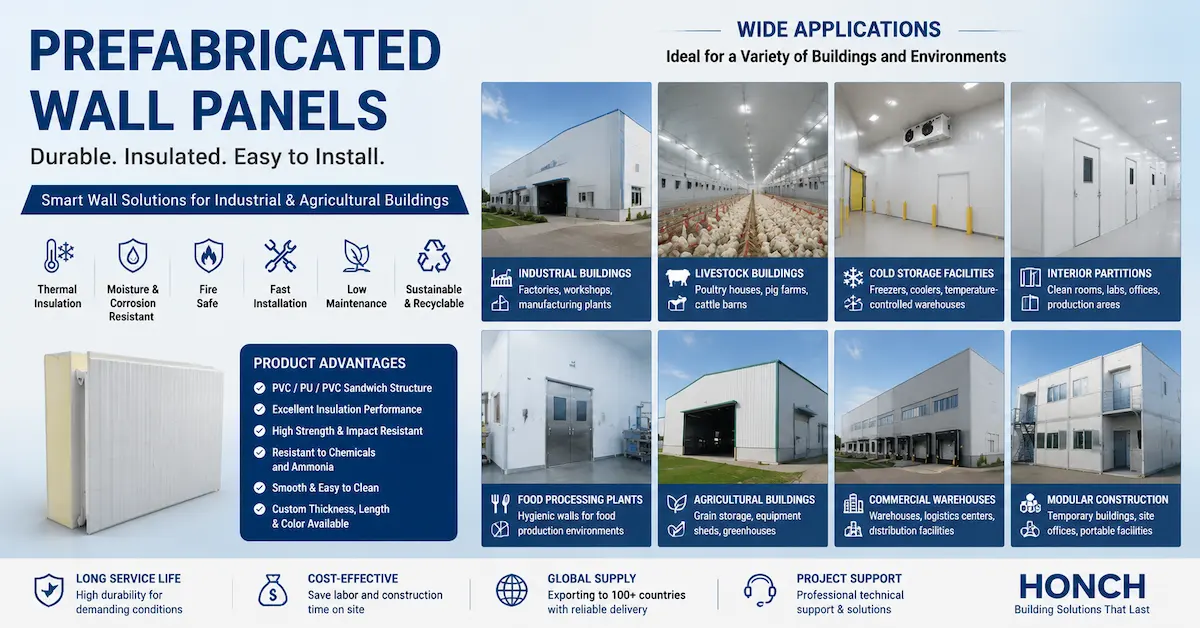
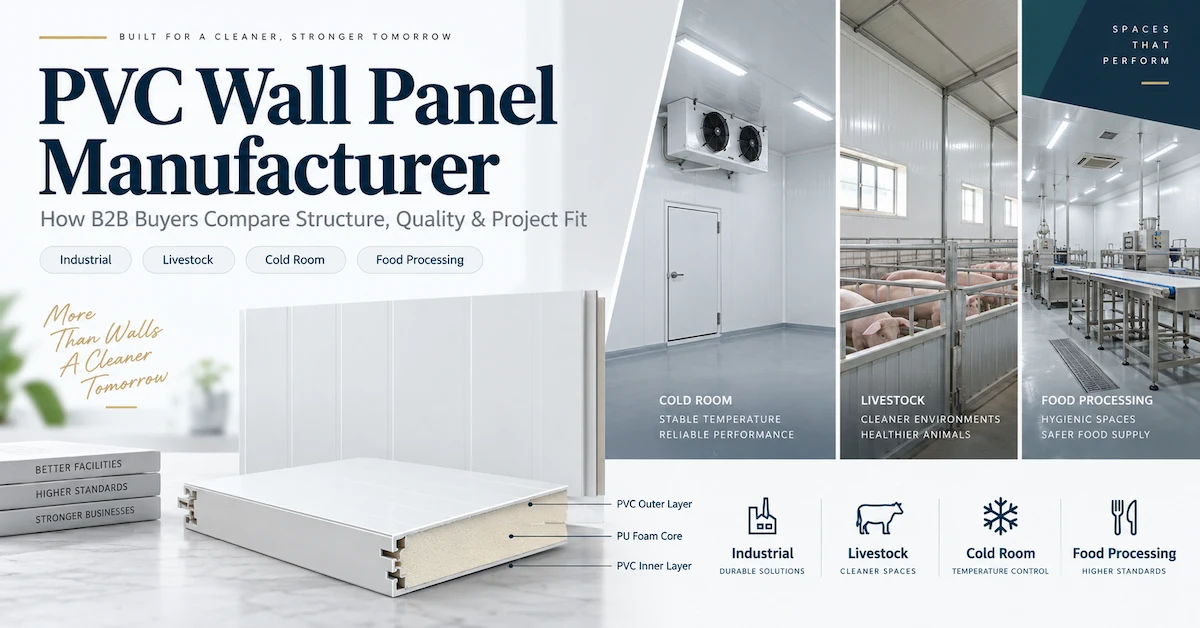
HONCH currently provides a PVC + PU foam + PVC insulated wall panel for industrial walls, livestock buildings, cold rooms and insulated partitions. Buyers can review the product construction first, then determine whether it matches the actual wall function required by the project.
A reliable supplier comparison should therefore start with:
Application → Wall function → Product construction → Manufacturing capability → Documentation → Commercial scope
not simply:
Supplier A price vs Supplier B price.
First Define What Type of PVC Wall Panel You Need
The most common sourcing mistake is contacting several manufacturers before defining what the wall must actually do.
Standard PVC Wall Applications
Where the main requirement is an interior surface or partition, buyers may focus primarily on moisture resistance, corrosion resistance, cleanability and installation efficiency.
Typical situations can include humid utility areas, agricultural interiors, internal partitions and selected industrial spaces.
Thermal insulation may not be a major requirement in these projects.
PVC-Faced Insulated Wall Panels
When temperature control becomes important, the wall system may need an insulation core.
HONCH's currently published insulated wall-panel construction is:
PVC outer layer + PU foam core + PVC inner layer
Each part has a different role.
| Component | Main Function |
|---|---|
| PVC outer face | Exposed surface, moisture and corrosion protection |
| PU foam core | Thermal insulation |
| PVC inner face | Completes the composite panel construction |
| Interlocking structure | Connects adjacent wall panels |
| Interface details | Complete corners, openings and transitions |
The key point is that PVC provides the surface function while PU provides the insulation function.
Buyers should not assume that every product containing PVC provides the same thermal performance.
For a broader explanation of different wall constructions and supplier-selection factors, see HONCH's wall panel supplier guide.
Which Buyers Usually Search for a PVC Wall Panel Manufacturer?
Different buyer groups evaluate manufacturers differently.
Importers and Building Material Distributors
For importers, one successful shipment is not enough. The bigger issue is whether the specification can be reproduced across future orders.
They normally care about product consistency, packaging, private-label requirements, repeat-order colors, documentation and container purchasing.
A manufacturer that can produce one good sample but cannot maintain the same configuration over several batches creates commercial risk for a distributor.
Contractors and EPC Buyers
Contractors are more project-driven.
They need the wall-panel supplier to understand dimensions, drawings, installation zones, openings, construction schedule and packaging sequence.
For them, manufacturing capability is only useful if it can be converted into an order-ready project specification.
Industrial Project Owners
Factories, livestock facilities, food plants, refrigerated rooms and warehouses focus more heavily on the operating environment.
The important variables may include humidity, temperature, cleaning frequency, ammonia, industrial vapor, corrosion exposure and maintenance.
This is why a qualified PVC wall panel manufacturer should not recommend the same panel configuration for every project.
Match the Manufacturer's Product to the Application
A manufacturer's capability should always be evaluated against the real application.
Livestock Buildings
Livestock buildings can expose wall materials to demanding environmental conditions.
Typical Conditions
Pig houses, poultry houses and cattle buildings may combine high humidity, ammonia, H₂S, frequent washing, disinfection, condensation and temperature changes.
The wall system may therefore need to provide several functions at once:
moisture resistance + corrosion resistance + cleanability + insulation
Where environmental control is used, thermal performance can become particularly important.
Buyers working on poultry projects can review HONCH's insulated panel guidance for poultry houses to understand how wall, ceiling and roof requirements should be evaluated separately.
Food Processing Facilities
Food-processing walls can face humidity, regular washing, detergents, temperature control and condensation.
A buyer should therefore evaluate more than surface appearance.
Important Questions
The specification should establish whether the wall requires thermal insulation, how frequently it will be washed, which cleaning chemicals will be used, how joints will be treated and how wall-to-floor connections will be detailed.
A PVC-faced panel may provide a practical cleanable surface, but buyers should not automatically claim that a product is “food grade” unless the exact supplied construction has the required documentation.
HONCH discusses these considerations in its food processing wall panel guide.
Cold Rooms and Temperature-Controlled Areas
Cold-room walls require a more technical purchasing process.
The project needs both an appropriate surface and a continuous insulated enclosure.
Buyers Should Evaluate More Than Thickness
Panel thickness is only one variable.
Cold-room performance can also be affected by the insulation core, panel joints, air leakage, corners, doors, penetrations, ceiling connections and thermal bridges.
Two panels with the same nominal thickness may therefore perform differently after installation.
HONCH's cold storage insulated panels guide explains why buyers should consider the whole enclosure rather than selecting wall panels by thickness alone.
Warehouses and Industrial Buildings
A conventional dry warehouse may not require the same wall system as a refrigerated warehouse.
A non-temperature-controlled building may prioritize durability, moisture protection, installation efficiency and cost.
A temperature-controlled warehouse may additionally require insulation, better joint continuity and condensation management.
This distinction is important because buyers can otherwise pay for insulation they do not need—or select a low-cost wall lining that does not satisfy thermal requirements.
Chemical and Corrosive Environments
PVC-based surfaces are often considered where corrosion is a concern, but corrosion resistance should never be interpreted as universal chemical resistance.
A serious manufacturer should ask what the panel will actually encounter.
Chemical name, concentration, temperature, exposure duration and cleaning method can materially affect product suitability.
HONCH's chemical plant insulated panel guide provides additional context for projects where insulation and corrosive exposure must be considered together.
What Specifications Should a PVC Wall Panel Manufacturer Confirm?
A useful quotation should tell the buyer exactly what is being purchased.
| Specification | Why It Matters |
|---|---|
| Panel construction | Distinguishes single-layer and composite products |
| PVC face structure | Defines exposed surface construction |
| Core material | Important for insulated wall systems |
| Overall thickness | Affects project and thermal selection |
| Panel dimensions | Affects layout and installation |
| Length | Influences cutting, joints and waste |
| Joint profile | Affects panel continuity |
| Surface finish | Affects appearance and maintenance |
| Color | Important for approval and repeat orders |
| Installation position | Prevents incorrect product use |
| Accessories | Defines the true project supply scope |
| Packaging | Protects products in export and site handling |
| Documentation | Supports technical and project approval |
A quotation that only states “PVC wall panel, good quality” is not adequate for professional B2B purchasing.
Request a Panel Section Drawing
A cross-section drawing helps buyers understand the real construction.
It should make the panel faces, core, total thickness, edge shape and connection structure easier to verify.
Make Sure the Sample Matches the Quotation
Samples, technical data and commercial quotations should refer to the same product configuration.
Approving one panel sample and later receiving a different thickness, surface or joint construction is an avoidable sourcing risk.
How Should Buyers Evaluate Manufacturing Quality?
A manufacturer should be evaluated on its ability to repeat a specification consistently across a complete order.
A visually attractive sample is only the beginning.
Raw Material Consistency
Buyers should understand how materials are controlled for production orders and repeat orders.
Statements such as “we use high-quality raw materials” are not enough on their own.
The real question is whether the manufacturer can reproduce the approved construction consistently.
Dimensional Control
Wall-panel installation depends on consistent geometry.
Thickness, width, length, panel edges and joint profiles should remain stable within the required manufacturing specification.
Small variations can become significant when a project involves hundreds or thousands of square meters.
Surface Quality
For visible interior walls, review color consistency, finish, scratches, deformation and other surface defects.
This becomes particularly important for distributors because products from different shipments may eventually be installed in the same market.
Joint Quality
The joint deserves as much attention as the panel surface.
Poor joint geometry can affect alignment, installation and enclosure continuity.
Before ordering, buyers should inspect how adjacent panels connect and whether corner and transition details are compatible.
Packaging
Correctly manufactured panels can still arrive damaged if packaging is inadequate.
Export packaging should protect panel faces and edges and allow safe handling during loading, container transport and unloading.
For large projects, grouping panels by installation area can also improve site efficiency.
How Do You Verify That a Supplier Is Really Suitable for Manufacturing Projects?
The label “manufacturer” should not replace supplier due diligence.
Buyers should focus on who actually controls the important parts of the order.
Production Responsibility
Verify who is responsible for material selection, production, dimensional inspection, customization and packaging.
This becomes especially important when project specifications change between orders.
Technical Communication
A manufacturer serving project buyers should be able to discuss more than price.
Typical technical subjects include wall location, panel structure, joint method, project drawings, openings, chemical exposure and insulation requirements.
For company background and current business positioning, buyers can review HONCH About Us.
HONCH states that it was founded in 2008 and focuses on anti-corrosion, insulation and building-envelope solutions for factories, farms and light buildings.
How Should Buyers Check Certifications?
Certifications should be checked at product level rather than accepted as general marketing claims.
A useful verification process asks:
Which product does the certificate cover? Which standard is referenced? Does the tested or declared construction match the panel being purchased?
HONCH's About page currently states ISO9001 certification and displays CE conformity information relating specifically to an Insulated Sandwich Panel and EN 14509:2013.
This is an important distinction.
A certificate associated with one insulated panel construction should not automatically be applied to every PVC wall, ceiling or roofing product.
For procurement purposes:
certificate scope is more important than a certification logo in a catalog.
What OEM and ODM Capabilities Matter to B2B Buyers?
Distributors and project buyers often need more than a standard product.
HONCH's PU insulation wall panel supports project customization including thickness, color and length, as well as OEM/ODM-related supply requirements.
Custom Length
Project-specific lengths can reduce site cutting and material waste.
However, longer panels must also be considered against container size, handling and site access.
Custom Thickness
Thickness should follow the thermal and construction requirements of the project.
A thicker panel is not automatically the correct panel.
Custom Color
Color approval matters for distributors, branded projects and visible interior applications.
If repeat-order appearance matters, the approved reference should be documented.
Branding and Packaging
Private-label customers may require branded packaging, product identification or distributor information.
Large engineering projects may instead require packages identified by building, room or construction phase.
Both requirements should be specified before production.
How Should Buyers Compare PVC Wall Panel Manufacturers?
Comparing manufacturers becomes easier when all quotations are normalized around the same criteria.
| Evaluation Area | Key Buyer Question |
|---|---|
| Product fit | Does the construction match the application? |
| Technical clarity | Is the specification complete and measurable? |
| Manufacturing consistency | Can the approved product be repeated? |
| Customization | Are thickness, color and length configurable? |
| QC | How are dimensions, joints and surfaces checked? |
| Documentation | Does information apply to the exact product? |
| Packaging | Will the panels arrive protected and organized? |
| Delivery planning | Are project milestones clearly defined? |
| Repeat orders | Can the same configuration be reproduced? |
| Commercial scope | What is actually included in the quoted price? |
Avoid Comparing Unequal Quotations
This is especially important for the keyword PVC wall panel manufacturer.
One supplier may quote a non-insulated PVC lining.
Another may quote an insulated PVC + PU + PVC composite panel.
Another quotation may include customized lengths, packing or project accessories.
The lowest number is therefore not necessarily the lowest comparable price.
What Determines the Cost of PVC Wall Panels?
There is no useful universal price without a defined configuration.
Cost can change according to panel structure, insulation core, thickness, dimensions, color, order volume, packaging, accessories and shipping destination.
Total Installed Cost Matters More Than Unit Price
Suppose a low-cost wall panel requires separate insulation, more cutting and additional installation labor.
A higher-priced composite insulated panel may still result in a more efficient total system for the right application.
The more useful calculation is:
Panel + insulation + accessories + freight + installation + waste + maintenance
rather than:
panel price per square meter only.
MOQ, Production and Lead Time: What Should Buyers Ask?
MOQ and lead time should be confirmed for the actual specification.
Customized dimensions, colors, quantities and packaging can all affect production planning.
For project purchasing, it is more useful to divide the timeline into defined milestones:
technical confirmation → sample/color approval → production → inspection → packaging → dispatch → transportation
This gives contractors and importers a clearer project schedule than a generic promise of “fast delivery.”
Common Red Flags When Choosing a PVC Wall Panel Manufacturer
The Same Panel Is Recommended for Every Application
Cold rooms, livestock buildings, food plants and dry warehouses have different requirements.
A supplier should ask about the environment before recommending a product.
Product Construction Is Unclear
If the supplier cannot clearly identify face materials, core and joint design, accurate comparison becomes difficult.
Certification Scope Is Not Explained
Certificates should be linked to a specific product or construction.
Chemical Resistance Is Described as Unlimited
Material suitability should be evaluated against actual chemical exposure.
Thermal Performance Is Reduced to Panel Thickness
Thickness alone does not describe complete enclosure performance.
Accessories and Interfaces Are Missing From the Quotation
Corners, transitions and joint details can materially affect the final project cost.
Custom Requirements Remain Verbal
Color, dimensions, packaging and branding should become written order specifications before production.
How to Prepare an Order-Ready RFQ
A well-prepared RFQ helps the manufacturer return a technically comparable proposal.
| RFQ Item | Information to Provide |
|---|---|
| Project type | Factory, farm, warehouse, cold room or food plant |
| Project location | Country and climatic conditions |
| Wall position | Interior wall, exterior wall or partition |
| Drawings | Dimensions and wall layout |
| Quantity | Total area and delivery phases |
| Temperature | Internal and external operating conditions |
| Humidity | Normal, high or continuously humid |
| Chemical exposure | Type and concentration where relevant |
| Cleaning method | Water, detergent or disinfectant |
| Insulation | Whether thermal insulation is required |
| Thickness | Engineering requirement if available |
| Color | Standard or customized |
| Length | Required panel dimensions |
| Openings | Doors, windows and equipment |
| Penetrations | Pipes, cables and ducts |
| Packaging | Standard, private label or project-separated |
| Documents | Required technical or certification files |
| Destination | Port or delivery location |
| Schedule | Required dispatch or arrival date |
Before finalizing the RFQ, buyers sourcing several building-envelope components can also review the complete HONCH product range to determine whether wall panels need to be coordinated with ceiling or roofing materials.
Why Building-Envelope Coordination Can Reduce Procurement Risk
Industrial buildings often require more than one type of panel.
A project may combine insulated walls with ceilings, roofing sheets and accessories.
If each component is purchased independently, contractors may need to resolve dimensional or interface problems on site.
HONCH's roof and wall panel supplier guide explains why roofing, walls and insulation should be selected according to their individual functions while still being coordinated as part of the same building envelope.
For project buyers, this approach can improve specification clarity before production starts.
Frequently Asked Questions About PVC Wall Panel Manufacturers
What should I ask a PVC wall panel manufacturer first?
Start by confirming the panel construction and intended application. Ask whether the proposed product is a simple PVC wall panel or an insulated composite panel, then confirm dimensions, thickness, joint structure and customization.
What is a PVC + PU + PVC wall panel?
It is a composite wall construction with PVC faces and a polyurethane foam insulation core. The PVC layers primarily provide the exposed surfaces, while the PU core provides thermal insulation.
Are PVC wall panels suitable for humid buildings?
PVC-based surfaces can be useful where moisture and corrosion resistance are priorities. Final suitability still depends on cleaning conditions, chemicals, temperature, joints and installation details.
Are PVC wall panels suitable for cold rooms?
A non-insulated PVC panel should not automatically be treated as a complete cold-room wall system. Where thermal control is required, an insulated composite construction may be more appropriate.
Can PVC wall panels be used in livestock buildings?
They can be evaluated for livestock facilities where humidity and corrosion are important concerns. An insulated PVC-faced panel may be more relevant where indoor temperature also needs to be controlled.
Can PVC wall panels be customized?
Customization depends on the product and manufacturer. HONCH's current PU insulation wall panel supports customized thickness, color and length.
How can buyers check panel quality before mass production?
Review the approved construction, representative sample, dimensions, surface condition, edge profile and joint fit. Project-specific inspection requirements should also be written into the order.
Does one certificate apply to all PVC wall panels?
No. Certification scope should be checked against the exact product, construction and standard involved.
How do I compare quotations from different manufacturers?
First normalize the panel structure, dimensions, insulation, accessories, packaging and documentation. Only then compare commercial prices.
What information should be sent for an accurate quotation?
Provide drawings, dimensions, application, quantity, operating temperature, humidity, chemical exposure, insulation requirements, color, destination and delivery schedule.
Conclusion
Choosing a PVC wall panel manufacturer should focus on application fit, clear specifications, repeatable quality, customization and total project cost—not unit price alone. Buyers should first define whether they need a standard PVC wall surface or an insulated PVC + PU + PVC system, then compare suppliers on the same technical basis.
For a project-specific panel recommendation or quotation, send your drawings, dimensions, operating conditions and purchasing requirements through the HONCH contact page.