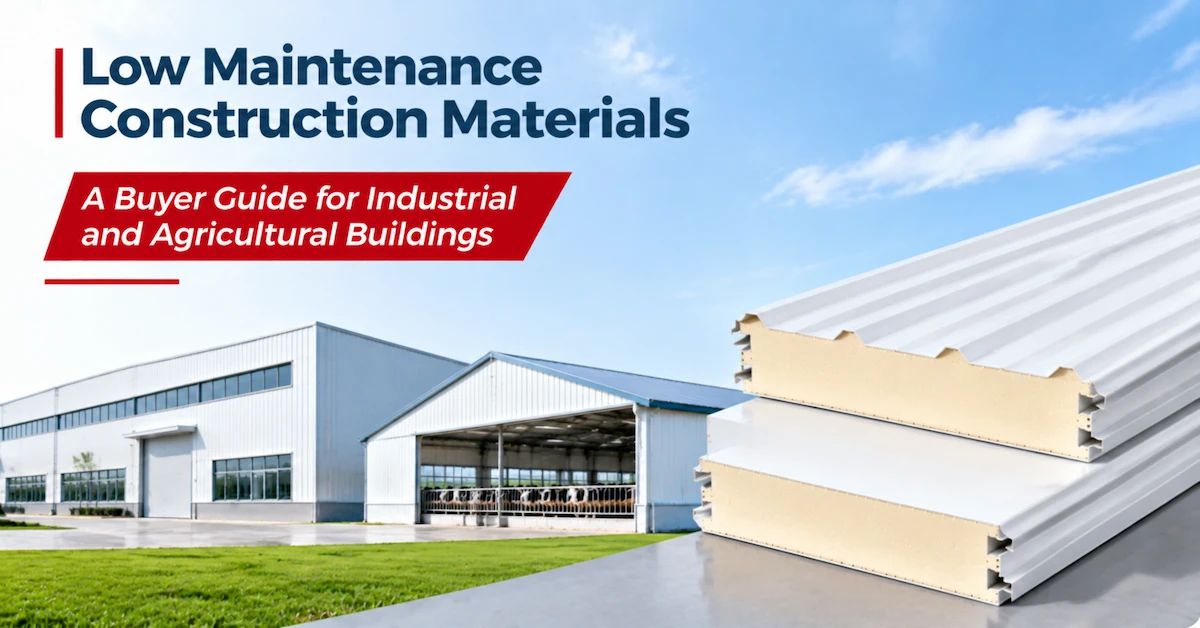
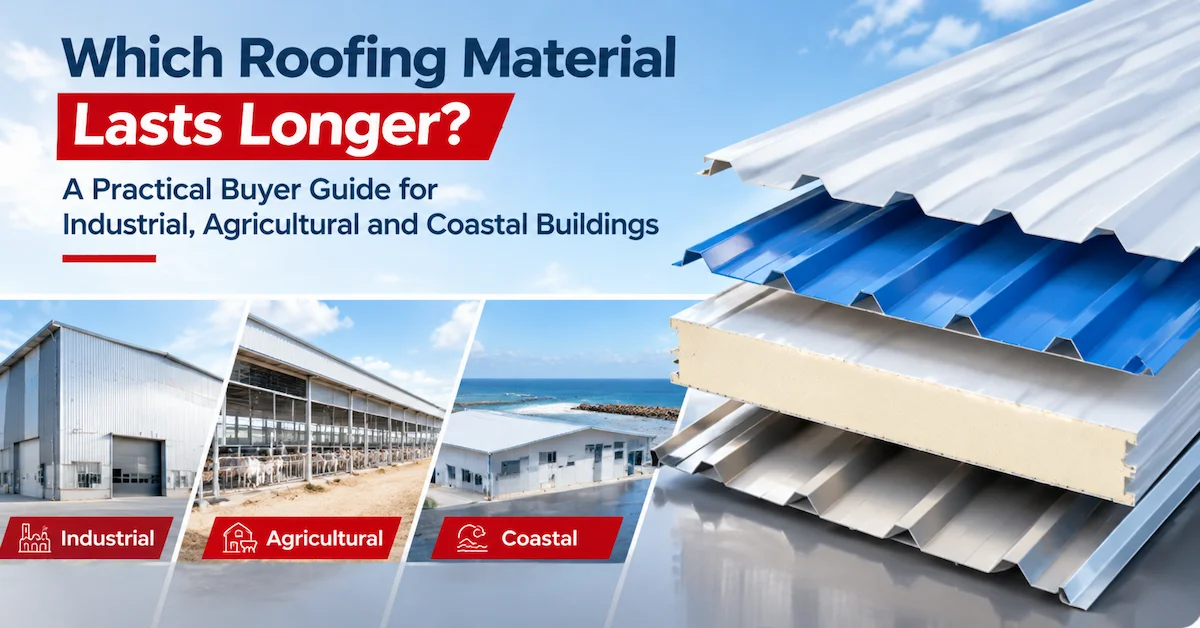
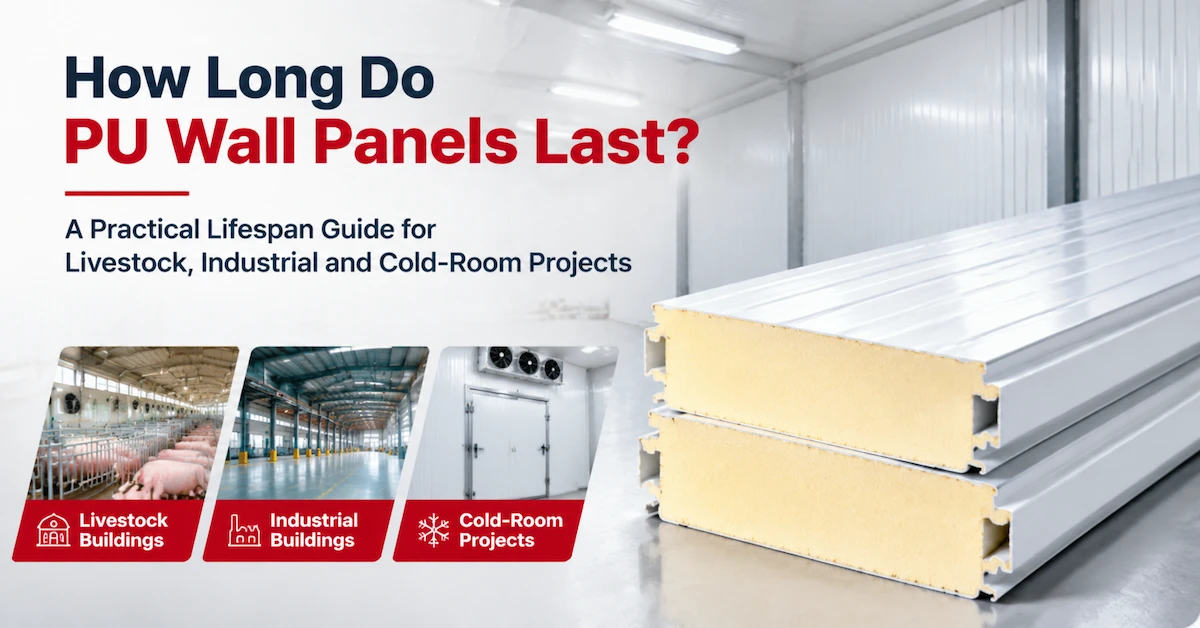
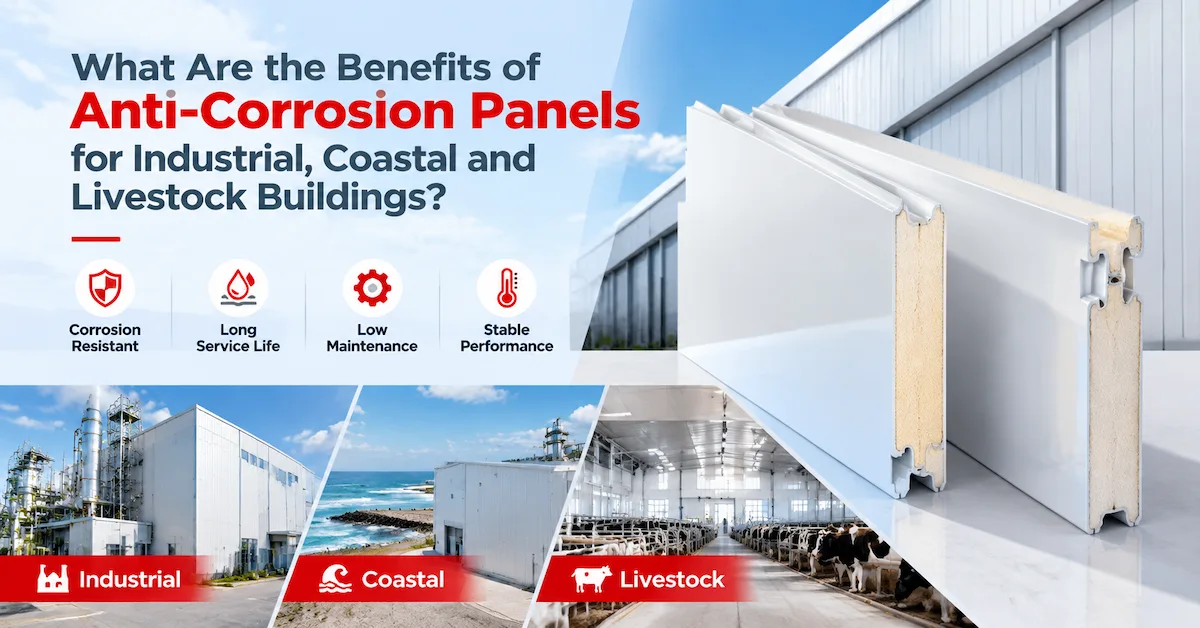
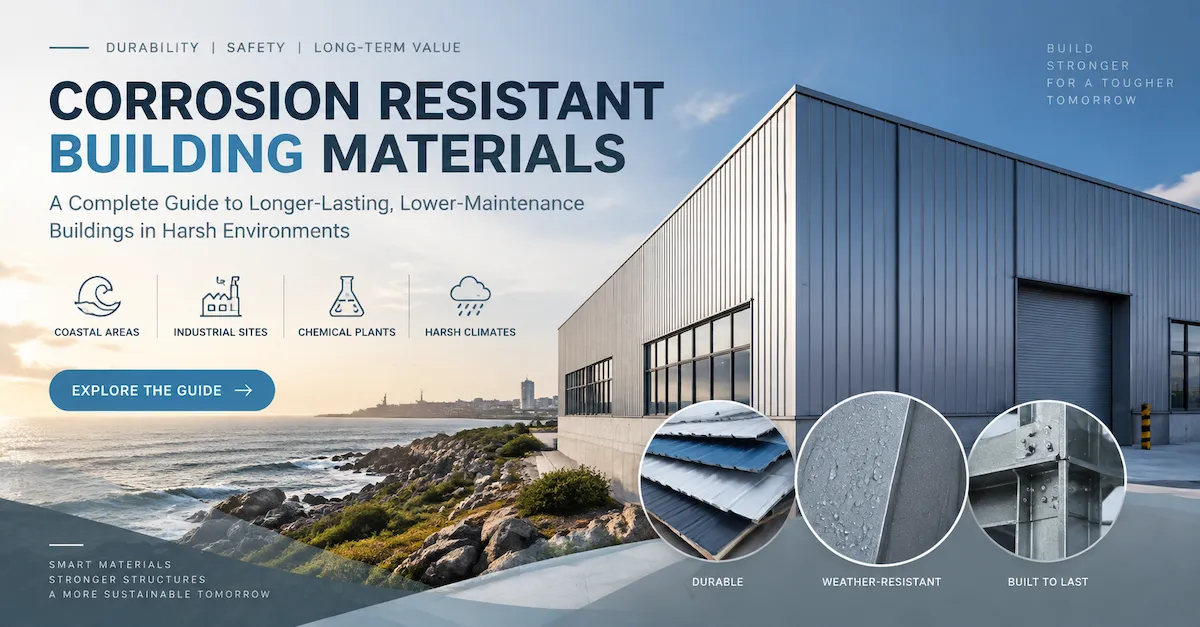
Direct answer for procurement: The main difference between anti corrosion panels and metal panels is the dominant failure risk each system is designed to manage. PVC-based anti-corrosion panels do not rust like exposed ferrous metal, while metal panels can offer familiar structural behavior and broad construction acceptance but rely on the selected metal, coating and connection details to control corrosion. Compare the complete roof or wall system, including joints, fasteners, supports, insulation, drainage, cleaning and documents.
HONCH publishes separate product positions for UPVC/APVC roofing, PVC+PU+PVC insulated walls, PVC+PU+PVC insulated ceilings and the T910 PVC single ceiling panel. These are not interchangeable with one another or with generic metal panels.
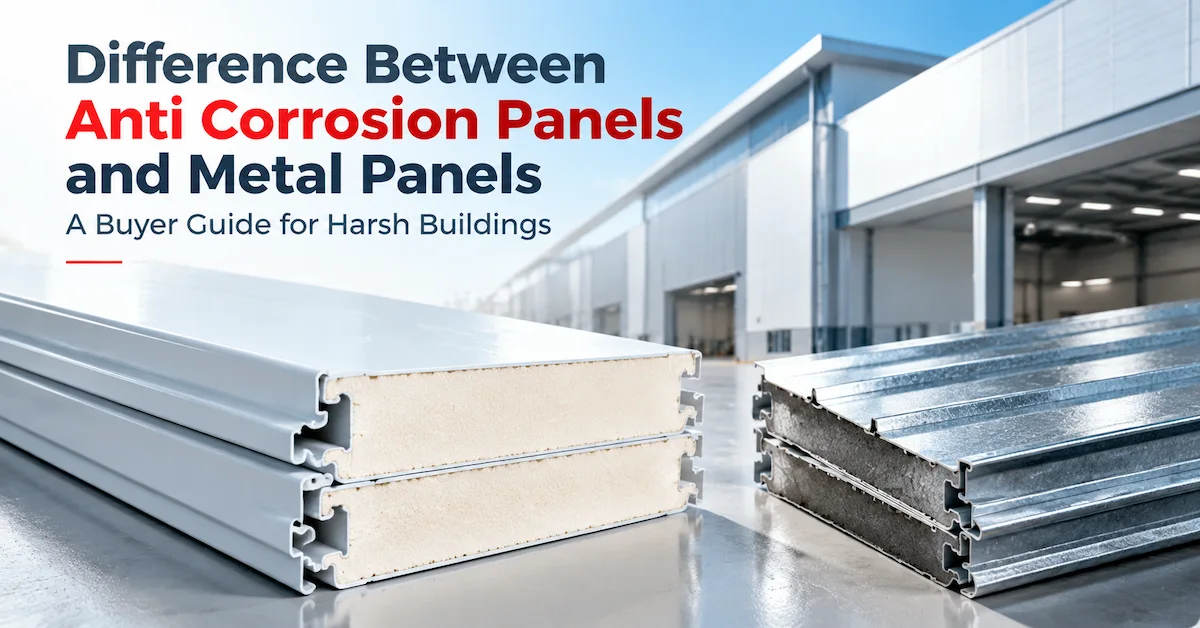
Comparison at a Glance
The following table is a decision framework, not a blanket performance guarantee. Metal panels vary widely by material and coating, and anti-corrosion panels vary by PVC formulation, profile, core and installation position.
| Decision factor | PVC, UPVC, APVC or PVC+PU+PVC anti-corrosion panel | Metal panel system | What the buyer must verify |
|---|---|---|---|
| Corrosion mechanism | Does not rust like an exposed ferrous substrate; polymer compatibility and aging still matter. | Depends on base metal, coating, cut edges, fasteners, overlaps and exposure. | Actual chemical, gas, salt, humidity, temperature and exposure route. |
| Thermal function | PVC surface panels may have lower heat transfer; PVC+PU+PVC adds a PU insulation core. | Metal conducts heat readily unless paired with a separate insulation system. | Thermal data, thickness, joints, thermal bridges and indoor conditions. |
| Cleaning and moisture | Moisture-conscious PVC faces can suit defined washdown and cleaning conditions. | Coating and exposed metal details must withstand the cleaning and drying regime. | Chemical compatibility, pressure, contact time, joints, edges and drainage. |
| Structural use | Profile and support requirements must be confirmed for the selected panel. | Known metal design practices may offer a wider structural design base. | Span, wind, impact, loading, supports, fixings and local design rules. |
| Maintenance risk | Can reduce rust-related work in suitable environments; inspect polymer aging and damage. | May need coating, edge, fastener and rust inspection as exposure increases. | Lifecycle tasks, access, downtime, replacement and maintenance records. |
| Fire and temperature | Requires product-specific fire and temperature documentation. | Requires product-specific coating, insulation and fire documentation. | Applicable report, thickness, assembly, local code and operating temperature. |
What Counts as an Anti-Corrosion Panel?
The phrase “anti-corrosion panel” does not identify one material. It describes a design objective: retain required surface, weather, moisture, thermal or service function under a defined corrosive exposure. Before comparing it with metal, identify the exact product family.
UPVC and APVC roofing panels
HONCH’s T920 is an UPVC/APVC roofing sheet published for factories, livestock farms, warehouses, chemical plants and light-duty construction. The product page identifies a full width of 920 mm, an effective coverage width of 840 mm, a 26 mm wave height, custom length and published thickness options of 1.5 mm, 2.0 mm, 2.5 mm and 3.0 mm. These are product-page values for T920, not universal values for all anti-corrosion panels.
The roofing sheet is presented for resistance to corrosion, UV aging and harsh weather. It should still be assessed with roof slope, supports, overlaps, wind, drainage, ridge details, penetrations and compatible fasteners. A roofing panel comparison is incomplete when it compares only the sheet material and ignores the roof assembly.
PVC single ceiling panels
HONCH T910 is a PVC single ceiling panel positioned for livestock and industrial buildings, including pig farms, chicken houses, cattle farms, greenhouses, workshops and warehouses. It is a surface-focused ceiling product. It should not automatically be treated as equal to a PVC+PU+PVC insulated wall panel, a PU-core ceiling panel or an external roof.
PVC+PU+PVC insulated panels
HONCH’s insulated wall panel uses a PVC outer layer, PU foam core and PVC inner layer. The PVC faces provide the exposed surface function and the PU core provides the insulation function. The wall panel is published for livestock farms, industrial buildings, cold rooms, agricultural facilities and other corrosive environments. The related ceiling panel uses the same broad composite logic and a tongue-and-groove connection description.
This distinction is essential when answering the difference between anti corrosion panels and metal panels. The comparison is not always between one sheet and another sheet. In some projects, the real comparison is between a coated metal wall plus separate insulation and a PVC+PU+PVC composite wall that combines faces and core in one panel.
Corrosion Behavior: PVC-Based Panels Versus Metal
Metal corrosion commonly involves deterioration of a metal substrate when moisture and reactive substances reach it. Steel panels normally depend on a protective coating, metallic layer, paint system or other treatment to separate the substrate from the environment. Once a coating is cut, scratched, penetrated or weakened at an overlap, the exposed area can become a maintenance point.
PVC, UPVC and APVC do not contain an iron substrate that rusts in the same way. This can be a meaningful advantage in livestock buildings with ammonia and humidity, coastal buildings with salt-laden air, and industrial buildings with defined corrosive vapor. It does not mean that polymer panels are chemically invulnerable. Polymer degradation can involve chemical incompatibility, UV exposure, thermal movement, brittleness, impact or unsuitable cleaning agents.
Metal is not one performance category
Metal panels should be evaluated by the actual base metal, coating system, coating thickness, edge treatment, fasteners, sealants, fabrication quality and exposure. Aluminum, galvanized steel, pre-painted steel and stainless steel have different corrosion mechanisms and costs. A generic statement that metal panels rust quickly is no more useful than a statement that PVC resists every chemical.
For a fair comparison, request the metal specification and the anti-corrosion panel specification in the same format. Record the material, coating or formulation, thickness, profile, joint, accessories, exposure class, expected maintenance and evidence. Then determine which failure mechanism is most likely to control the project cost.
Where the material difference is most visible
- At cut edges, penetrations and fasteners where metal coatings can be interrupted.
- In livestock rooms where ammonia, humidity, disinfectants and washdown repeatedly contact surfaces.
- At coastal sites where salt deposits and wet-dry cycles increase maintenance pressure.
- In chemical or process areas where the gas, liquid or cleaning exposure must be checked against the material.
- At wall-to-floor and roof-to-wall interfaces where either material can fail if the joint is poorly detailed.
Moisture, Washdown and Hygiene
Moisture is one of the clearest areas where buyers ask about the difference between anti corrosion panels and metal panels. A PVC surface is often selected because it is moisture-conscious and can be easier to clean visually. Metal can also perform well when its coating and joint system match the environment, but corrosion risk grows when water, salt, chemicals or damaged coating remain at the surface.
Neither material removes the need for drainage and joint design. Water can enter through laps, corners, openings, fasteners, floor interfaces and roof-to-wall transitions. A water-resistant panel can therefore be part of a moisture-control strategy without being a guarantee that the installed building is watertight.
Cleaning chemicals must be named
In poultry and pig buildings, the buyer should send the cleaning and disinfection procedure to the supplier. Include the product name, dilution, temperature, contact time, water pressure and frequency. A panel face, edge, seal and fastener should be considered together. If the supplier has only reviewed a generic “farm environment,” the chemical compatibility answer is incomplete.
Hygiene is an assembly property
A smooth panel face can support cleaning, but hygiene also depends on joint geometry, access, drainage, drying, damaged areas and the floor connection. In a food or agricultural building, the buyer should review the whole cleaning path rather than assuming that a material name proves hygienic performance.
Thermal Performance and Indoor Comfort
Metal is a strong heat conductor compared with polymer surfaces, so a metal wall or roof normally needs a separate insulation layer when temperature control matters. Anti-corrosion panels may provide different thermal options. A single PVC surface panel can address surface and corrosion concerns, while a PVC+PU+PVC panel adds a PU insulation core.
For a cold room, livestock house or temperature-controlled workshop, the useful comparison is not PVC versus metal alone. It is complete wall or roof assemblies: surface material, insulation core, thickness, joints, doors, penetrations, support and thermal bridges. A composite panel may simplify coordination by combining protective faces and insulation, but its thermal data must match the ordered construction.
Do not infer a U-value from a material name
A PU core does not by itself establish a U-value, condensation result or energy saving. Request the reported thermal data, test conditions and thickness. Check whether the document covers the exact face, core, joint and panel configuration. For metal systems, request the same information for the insulation product and connection details rather than comparing an insulated metal wall with an uninsulated PVC lining.
Indoor temperature is also a ventilation issue
In livestock buildings, ventilation, humidity, animal density and outdoor conditions affect indoor temperature and condensation. A panel can support thermal control but cannot replace ventilation design. The project team should review air movement and moisture together with the selected roof, wall and ceiling system.


Heat, Fire and Structural Requirements
The difference between anti corrosion panels and metal panels becomes more complex when temperature, fire and structural requirements control the design. A buyer should not assume that either material family wins every category.
Metal may be advantageous in some structural applications
Metal has a broad history in structural and envelope design. Engineers may be familiar with its profiles, fasteners, support systems and load calculations. In large spans, high impact zones, heavy suspended loads or projects with established metal framing, a metal solution may be appropriate. The actual decision still depends on the specified metal system, coating and project design.
Polymer panels need configuration-specific design checks
PVC and PVC composite products can be lightweight and practical to install, but the panel profile, support spacing, length, temperature movement, fixing and impact conditions need confirmation. A lightweight panel should not be assumed to carry a roof load, equipment load or walk-on load unless the manufacturer and project designer document that use.
Fire claims need exact documents
Metal, PVC, PU and coated composite systems can all have different fire behavior depending on the full assembly. A material name is not a fire classification. Request the applicable report for the ordered product, face, core, thickness and installation. HONCH’s public certification information identifies an Insulated Sandwich Panel, PVC material, thickness 1-50 mm, System 4 and EN 14509:2013. That information must be checked against the actual order and should not be generalized to every roofing or wall product.
Installation, Weight and Site Handling
Anti-corrosion panels can offer practical handling benefits where lower weight, custom length or interlocking construction reduces site work. HONCH describes its PVC+PU+PVC wall panel as lightweight and interlocking, and its T920 roofing product as customizable in length. These features can support a planned installation, but they do not remove the need for lifting, storage, support and fixing instructions.
Metal panels are also widely used because installers and contractors often have established tools, methods and supply chains. The comparison should include the local labor market, available equipment, building access, panel length, unloading arrangement and replacement process. A material that is technically suitable but difficult to unload or install may not deliver the expected project value.
Custom length can reduce joints and waste
When a manufacturer can produce an approved length schedule, the project may reduce unnecessary site cuts and offcuts. Fewer unplanned cuts can also simplify the number of exposed edges and joints that need detailing. This benefit applies only when the building survey, cut list, transport and installation sequence are coordinated before production.
Joints remain a critical risk for both materials
Metal panels need correct laps, fasteners, washers, sealants and flashings. PVC and composite panels need correct interlocking or tongue-and-groove details, edges, seals, fixings and transitions. A high-performing material can underperform when joints are cut incorrectly, supports are too far apart or penetrations are left unsealed.
Maintenance and Lifecycle Cost
Unit price is only one part of the difference between anti corrosion panels and metal panels. A lifecycle comparison should include installation, access, inspection, cleaning, coating or treatment, fasteners, replacement pieces, downtime, disposal and expected project duration.
| Lifecycle item | Questions for an anti-corrosion panel | Questions for a metal panel |
|---|---|---|
| Initial supply | What formulation, profile, thickness, core and accessories are included? | What base metal, coating, thickness, profile and accessories are included? |
| Installation | What are the support, fixing, joint and cut-edge requirements? | What are the overlap, fastener, coating protection and flashing requirements? |
| Inspection | Check impact, UV aging, discoloration, deformation, joints and seals. | Check coating damage, rust, cut edges, fasteners, laps and sealants. |
| Cleaning | Confirm chemical compatibility, temperature, pressure and contact time. | Confirm coating and substrate compatibility with the same cleaning regime. |
| Repair | How are damaged panels, edges, joints and replacement pieces handled? | How are rusted sheets, damaged coating, fasteners and flashings repaired? |
There is no defensible universal percentage for maintenance savings. The correct financial question is whether the selected assembly reduces a known site cost while meeting structural, thermal, fire and cleaning requirements. Ask both suppliers to state assumptions and exclusions so the comparison does not hide the lifecycle work.
Which Material Fits Which Building?
The best material depends on exposure and function. The following application guide is deliberately conditional so that a buyer can identify the next technical question rather than receive a blanket recommendation.
| Project condition | Anti-corrosion panel direction | When metal may still fit | Key confirmation |
|---|---|---|---|
| Dry general warehouse | Consider only if corrosion, cleaning or insulation creates a defined need. | Coated metal may be practical with low corrosion exposure and familiar installation. | Climate, coating, maintenance access, price and support design. |
| Poultry or pig house | PVC ceiling, PVC+PU+PVC wall or ceiling, and UPVC/APVC roof options may address humidity and gases. | Metal may fit only with a suitable coating, ventilation plan and corrosion maintenance strategy. | Ammonia, washdown, disinfectant, temperature, joints and cleaning. |
| Coastal warehouse | UPVC/APVC or PVC-based wall and roof solutions can reduce dependence on exposed metal surfaces. | Aluminum, stainless or well-protected coated metal may fit when the specification covers salt exposure. | Salt, UV, wind, drainage, fasteners and coating or polymer weathering evidence. |
| Chemical workshop | Consider PVC or PVC+PU+PVC only after chemical compatibility review. | Metal may fit with a documented coating or alloy and suitable process separation. | Chemical identity, concentration, temperature, vapor route and test evidence. |
| Cold room | PVC+PU+PVC wall and ceiling panels may combine exposed surfaces with insulation. | Insulated metal sandwich panels may fit when joints, thermal bridges and surface protection are controlled. | U-value, air leakage, condensation, doors, floor and penetration details. |
How to Compare Supplier Quotations Fairly
A fair comparison starts with equal technical scope. Ask each supplier to quote the same installation position, material function, dimensions, quantity basis and accessory package. Do not compare an uninsulated PVC lining with an insulated metal sandwich wall and conclude that one material is cheaper or better.
Write the complete construction
For an anti-corrosion panel, write whether the product is PVC, UPVC, APVC, PVC+PU+PVC or another construction. For metal, write the base metal, coating, thickness and insulation arrangement. Add the profile, joint, edge, fastener, seal and support assumptions.
Normalize area and quantity
Confirm whether the quoted quantity is manufactured area, shipped area or net installed coverage. Include cut pieces, openings, spare material and replacement pieces. For roofing, distinguish full width from effective coverage; the T920 page, for example, publishes 920 mm full width and 840 mm effective coverage.
Ask for the same document set
Request technical data, section drawings, certificates, test reports, installation guidance, inspection criteria and packaging information from both bidders. Check that each document describes the offered construction. A general ISO9001 certificate does not prove chemical compatibility, and a certificate for one product does not automatically cover another product.
Compare exclusions beside the price
Record whether the offer includes trims, corners, fasteners, seals, freight, unloading, packaging, labels, installation support, spare pieces, sample approval and replacement policy. State the delivery destination and phase schedule. A clear exclusion is easier to manage than an unplanned cost after dispatch.
Factory Evidence and Product Scope
Material comparison becomes more useful when it is connected to a real manufacturer and product family. ZHEJIANG HONCH TECHNOLOGY CO., LTD was founded in Jinhua in 2008. The company states that it specializes in anti-corrosion and insulation solutions for light buildings, factories, farms, roofs, walls and ceilings, with self-operated import and export rights and proximity to Ningbo Port and Shanghai Port.
HONCH publishes ISO9001 and EU CE information and describes its products as serving domestic and international markets. The public certification information identifies an Insulated Sandwich Panel, PVC material, thickness 1-50 mm, System 4 and EN 14509:2013. Buyers should verify the certificate scope against the ordered construction rather than applying it to every roof, wall or ceiling product.

HONCH’s livestock engineering case describes insulation ceiling engineering for cattle, chicken and pig farms and names Muyuan Food Group, Wenshi Group and Chia Tai Group. The case demonstrates agricultural project experience and insulation application context. It does not replace a project-specific comparison of wall, roof or ceiling construction, chemical exposure, structural requirements and acceptance documents.
What to Confirm Before Ordering
Building position: external roof, external wall, internal wall, ceiling, partition, cold room or service room.
Environment: humidity, ammonia, hydrogen sulfide, salt, acid or alkali vapor, cleaning chemicals, temperature and UV exposure.
Material: PVC, UPVC, APVC, PVC+PU+PVC, metal type, coating, thickness, core and surface finish.
Geometry: wall or roof area, length schedule, effective coverage, openings, corners, penetrations, support spacing and transitions.
Performance: corrosion, moisture, thermal, fire, impact, wind, load, hygiene and maintenance requirements.
Commercial: MOQ, sample, production timing, packaging, labels, accessories, delivery basis, destination and replacement pieces.
Documents: technical data, section drawing, applicable certificate, test report, inspection plan and installation guidance.
HONCH’s public pages describe customization for selected thicknesses, colors, lengths, surface textures, connection types and packaging. They do not establish one universal MOQ or fixed lead time for every configuration. Confirm the commercial terms after the product, quantity, packaging and destination are defined.
FAQ: Anti-Corrosion Panels Versus Metal Panels
What is the difference between anti corrosion panels and metal panels?
Anti-corrosion panels are a category selected for a defined corrosive environment and may use PVC, UPVC, APVC or PVC+PU+PVC construction. Metal panels use a metal substrate and depend on the selected alloy or steel, coating, thickness, fasteners and maintenance. The meaningful comparison is between complete assemblies and their site conditions, not material names alone.
Are anti-corrosion panels better than metal panels?
Neither is automatically better. PVC-based panels may be more practical where rust, humidity, ammonia, salt or chemical exposure controls the decision. Metal may be suitable where structural familiarity, high-temperature conditions, local supply or project design controls the decision. Compare the verified performance and lifecycle scope for the actual building.
Do anti-corrosion panels rust?
PVC, UPVC and APVC do not rust like an exposed ferrous metal substrate. They can still degrade through incompatible chemicals, UV, heat, impact, thermal movement or unsuitable cleaning. Edges, joints, fasteners and accessories also need inspection.
Are metal panels unsuitable for livestock buildings?
No. Metal can be used in livestock buildings when the alloy or coating, ventilation, fasteners, joints and maintenance plan are suitable. The issue is that ammonia, humidity, washdown and disinfectants can increase corrosion pressure, so the metal specification must be checked rather than assumed.
Which option is better for a poultry house or pig farm?
Start with the position. A PVC single ceiling panel may address an interior surface, while a PVC+PU+PVC wall or ceiling panel adds a PU insulation core. UPVC/APVC products may be considered for external roofing. Metal can also fit with a suitable protection system. Confirm ammonia, cleaning chemicals, temperature, ventilation, joints, supports and fire requirements.
Which material is better for a coastal building?
Compare salt exposure, UV, wind, drainage, fasteners and maintenance. PVC-based roofing or wall products can reduce dependence on exposed metal surfaces, while aluminum, stainless or protected coated metal may also fit. The selected material needs evidence for the site exposure and complete assembly.
Do PVC+PU+PVC panels provide better insulation than metal?
A PVC+PU+PVC panel includes a PU insulation core, while a metal sheet without insulation does not provide the same thermal construction. The fair comparison is between insulated assemblies with equivalent thickness, joints, doors, penetrations and thermal data. Do not infer performance from the presence of PVC or metal alone.
Are anti-corrosion panels automatically fire-rated?
No. Fire performance depends on the complete construction and applicable test. Request the document for the offered face, core, thickness and assembly. The same caution applies to metal sandwich panels because their insulation core and coating also affect the result.
Which option is cheaper over the building lifecycle?
There is no universal answer. Compare supply, installation, maintenance, cleaning, fastener or coating replacement, downtime, repair access and disposal. A higher initial price can be justified if it controls a known corrosion cost, but the calculation must use project-specific evidence.
Can HONCH provide both anti-corrosion and insulation products?
HONCH publishes UPVC/APVC roofing sheets, PVC single ceiling panels, PVC+PU+PVC insulated wall panels and PVC+PU+PVC insulated ceiling panels. Confirm the application, dimensions, construction, accessories, MOQ, lead time, packaging and documents for the configuration required by the project.
Conclusion
The difference between anti corrosion panels and metal panels is a difference in material behavior, protection strategy and complete-system risk, not a simple contest between plastic and steel. PVC, UPVC, APVC and PVC+PU+PVC panels can reduce rust-related exposure and add moisture or insulation functions in suitable buildings. Metal panels can remain appropriate where the base metal, coating, structural design and maintenance plan match the environment.
For a defensible purchase decision, define the building position and exposure first. Then compare material construction, joints, fasteners, insulation, fire and structural documents, lifecycle tasks, packaging, MOQ and lead time on the same scope. HONCH can review drawings, chemical conditions, dimensions and delivery requirements for a project-specific roof, wall or ceiling proposal.