How a Sandwich Panel Manufacturer Solves Wind Resistance Problems in Large Buildings
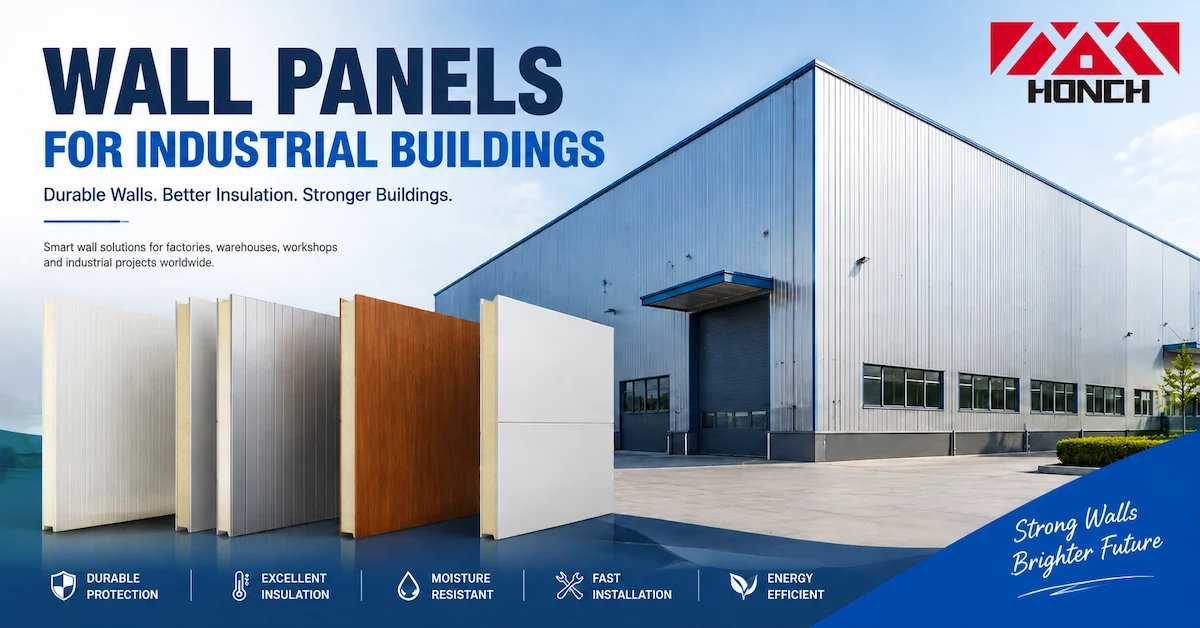
In many industrial and agricultural projects located in coastal regions or open plains, building owners encounter recurring issues with wall and roof panels. Strong wind pressure can cause panel vibration, joint gaps, water infiltration, and in severe cases even panel detachment. These problems are especially common in large warehouses, factories, and logistics centers where wall surfaces span thousands of square meters.
Many of these failures are not caused by installation mistakes alone but by panel system limitations—insufficient structural reinforcement, weak joint locking systems, or panels not designed for wind load conditions.
As a Sandwich Panel Manufacturer, HONCH has addressed these challenges by optimizing panel structure, strengthening joint systems, and improving manufacturing precision. Through reinforced steel skins, high-density core bonding, and engineered locking profiles, our panel systems are designed to maintain structural stability even under significant wind pressure. These improvements help prevent panel deformation, reduce leakage risks, and extend building lifespan in demanding environments.
Understanding Wind Load Challenges in Industrial Buildings
Wind pressure affects building envelopes differently depending on height, location, and building geometry.
Key factors include:
-
Large uninterrupted wall surfaces exposed to direct wind pressure
-
Roof edges and corners where wind uplift is strongest
-
Long-span steel structures that transmit vibration to wall panels
-
Joint areas that experience repeated expansion and contraction
According to wind engineering studies referenced in ASCE 7 (Minimum Design Loads for Buildings and Other Structures), wind loads on exterior walls can increase dramatically near building edges and roof zones, requiring reinforced envelope systems to prevent structural damage.
A capable Sandwich Panel Manufacturer evaluates these stress zones during panel design rather than relying solely on nominal panel thickness.
Panel Structural Design for Wind Resistance
Wind resistance is determined primarily by panel structural behavior rather than insulation properties.
Critical design factors include:
-
Steel skin thickness and tensile strength
-
Core density and bonding stability
-
Panel span capability between structural supports
| Panel Feature | Standard Panels | Reinforced Panels |
|---|---|---|
| Steel skin thickness | 0.4–0.5 mm | 0.5–0.6 mm |
| Core density stability | Moderate | High |
| Span capability | Medium | Improved |
| Wind deformation resistance | Moderate | Strong |
In HONCH wind-resistant projects, reinforced panels demonstrated approximately 25–35% greater resistance to deformation compared with standard configurations, especially on large exterior wall surfaces.
Joint Locking Systems: Preventing Panel Separation
Even structurally strong panels may fail if joint systems are weak.
Wind pressure repeatedly stresses panel connections. Poorly designed joints may loosen over time, creating gaps that allow water infiltration.
HONCH panel systems incorporate engineered joint profiles designed to:
-
Increase mechanical interlocking strength
-
Improve sealing performance under vibration
-
Maintain alignment across long wall surfaces
These joint systems help ensure that the building envelope behaves as a continuous structure rather than a series of loosely connected components.
Real Project Scenario: Coastal Warehouse Installation
In a coastal logistics warehouse project supplied by HONCH, the building faced strong seasonal winds and large open wall surfaces.
The project required:
-
High wind resistance for exterior walls
-
Large-span panel installation
-
Reliable sealing against wind-driven rain
Solutions implemented included:
-
Increasing steel skin thickness for exterior wall panels
-
Using reinforced locking joints to improve structural continuity
-
Adjusting panel lengths to match structural support spacing
After installation, the building maintained stable panel alignment even during seasonal storms, with no observed joint leakage or panel deformation.
This project illustrates how a Sandwich Panel Manufacturer contributes to structural reliability through targeted design adjustments.
Installation Strategy for High-Wind Regions
In high-wind areas, installation strategy is as important as panel design.
Key considerations include:
-
Fastener spacing adapted to wind load requirements
-
Reinforced fixing zones at roof edges and corners
-
Proper alignment to prevent stress concentration
A knowledgeable Sandwich Panel Manufacturer provides installation guidance aligned with panel design, ensuring that structural performance is maintained during construction.
Balancing Wind Resistance with Thermal Performance
While structural strength is critical, panels must also maintain insulation efficiency.
Design balance includes:
-
Steel thickness optimized without excessive weight
-
Core insulation selected for thermal stability
-
Joint sealing systems that prevent air leakage
HONCH panels are designed to maintain both structural resistance and thermal performance, allowing buildings to remain energy efficient while resisting environmental stress.
Common Buyer Questions
Q: Are thicker panels always better for wind resistance?
A: Not necessarily. Steel skin strength, joint design, and fastening systems often influence wind performance more than panel thickness alone.
Q: Can sandwich panels be used safely in coastal regions?
A: Yes, when designed with reinforced skins, strong joints, and appropriate fastening systems.
Q: Should wind conditions affect panel selection?
A: Absolutely. A Sandwich Panel Manufacturer should evaluate location-specific wind loads before recommending panel specifications.
Final Guidance for Wind-Resistant Building Design
For buildings exposed to strong wind conditions, selecting the right envelope system is essential. A Sandwich Panel Manufacturer that understands wind load behavior, structural reinforcement, and joint stability can significantly reduce the risk of panel damage and leakage.
HONCH supplies sandwich panel systems engineered for demanding industrial environments, including high-wind regions, large warehouses, and logistics facilities. Through reinforced structures and precise manufacturing, these panels provide reliable building protection and long-term performance.
To explore sandwich panel solutions and application experience, visit the HONCH homepage:
https://www.honchroof.com/
For consultation on wind-resistant panel systems or project customization, contact the team via Contact Us:
https://www.honchroof.com/contact-us