Anti-Corrosion Roofing Panels for Livestock and Coastal Projects: How an Anti-Corrosion Roofing Panels Manufacturer Extends Service Life
Most roof failures don’t begin with visible damage.
They start quietly.
A slight change in surface color.
A faint roughness where the coating once felt smooth.
A small rust point near a fastener that doesn’t seem urgent.
In livestock buildings, the cause is often ammonia.
In coastal facilities, it’s salt carried by the wind.
Different environments. Same result.
Over time, corrosion spreads. Repairs increase. Eventually, parts of the roof need replacement much earlier than expected.
This pattern is familiar to many project owners. And it rarely comes as a surprise—it feels more like something unavoidable.
But it isn’t.
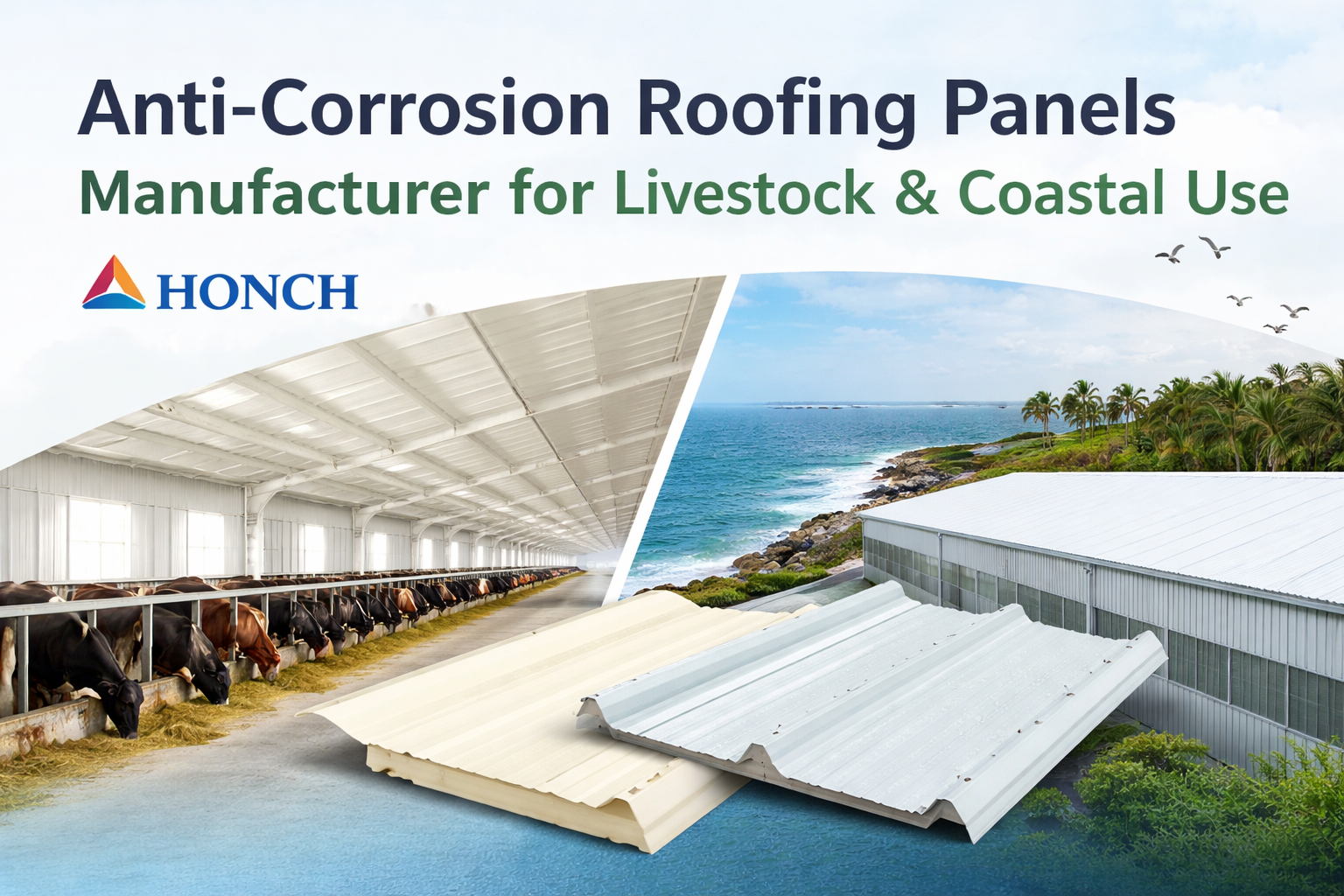
A specialized Anti-Corrosion Roofing Panels Manufacturer approaches roofing systems differently. At HONCH, roofing panels are designed based on environmental exposure, combining material selection, coating technology, and structural configuration to slow down corrosion and stabilize long-term performance.
In many comparable environments, this approach has extended roofing lifespan by 30–50% compared with conventional materials.
Environmental Exposure That Drives Corrosion
Corrosion behaves differently depending on the environment, but the mechanism is always active.
In livestock buildings:
- ammonia reacts with metal surfaces
- high humidity accelerates chemical processes
In coastal areas:
- salt particles settle on roofing surfaces
- moisture activates corrosion cycles
According to corrosion research referenced by NACE International (National Association of Corrosion Engineers), combined exposure to moisture and chemical agents significantly accelerates metal degradation in exposed structures.
A reliable Anti-Corrosion Roofing Panels Manufacturer identifies these exposure conditions early and adapts material systems accordingly.
HONCH roofing panels are selected based on environment-specific corrosion risks rather than standard building assumptions.
Material Systems Designed for Corrosion Resistance
Different roofing materials respond differently under corrosive conditions.
| Roofing Material | Corrosion Resistance Mechanism | Typical Thickness (mm) | Corrosion Rate in Harsh Environments* | Maintenance Cycle | Expected Service Life |
|---|---|---|---|---|---|
| Standard Galvanized Steel | Zinc coating sacrificial protection | 0.4–0.6 | 8–15% surface degradation / 3–5 years | Every 1–2 years | 5–10 years |
| Painted Metal Panels (PE/PVDF) | Surface coating barrier protection | 0.5–0.8 | 5–10% coating loss / 5–8 years | Every 2–3 years | 10–15 years |
| Polymer Composite Roofing Panels | Non-metallic, chemical-resistant surface | 1.5–3.0 | <3% surface change / 8–10 years | Minimal (visual check) | 15–25+ years |
HONCH frequently applies polymer-based roofing systems in livestock and coastal projects due to their stable surface performance and resistance to chemical interaction.
These materials maintain integrity even when exposed to continuous environmental stress.
Coating Systems and Surface Protection
Surface protection is often the first line of defense against corrosion.
However, not all coatings perform equally under long-term exposure.
Weak or inconsistent coatings may:
- crack under temperature changes
- degrade when exposed to chemicals
- lose adhesion over time
A professional Anti-Corrosion Roofing Panels Manufacturer controls coating application during production to ensure:
- uniform thickness across panels
- strong adhesion to base material
- resistance to environmental degradation
HONCH roofing systems use controlled coating processes that improve long-term surface stability, reducing the need for repainting or repair.
Structural Design That Limits Corrosion Progression
Corrosion does not only depend on materials—it is also influenced by structure.
Water accumulation, poor drainage, and trapped moisture can accelerate degradation.
HONCH roofing systems are designed to:
- reduce water retention on roof surfaces
- improve drainage through panel profiles
- minimize exposure at joints and fasteners
These structural features help slow corrosion progression, especially in environments where moisture is consistently present.
Real Project Scenario: Coastal Industrial Facility
In a coastal processing facility project, the building experienced rapid corrosion using standard roofing materials.
Challenges included:
- salt-laden air exposure
- high humidity
- frequent rainfall
HONCH provided an anti-corrosion roofing solution that included:
- polymer-based roofing panels
- improved surface protection systems
- optimized drainage design
After installation, the roofing system maintained stable performance with significantly reduced signs of corrosion over time.
This example shows how an Anti-Corrosion Roofing Panels Manufacturer influences long-term building durability through environment-specific solutions.
Installation Considerations in Corrosive Environments
Installation details also affect corrosion performance.
Improper installation can create:
- exposed metal edges
- weak sealing points
- areas where moisture accumulates
HONCH provides installation guidance aligned with panel system design, helping ensure that corrosion resistance is maintained after installation.
Application Across Different Environments
Anti-corrosion roofing systems are not limited to a single type of building.
They are widely used in:
- livestock farms
- coastal warehouses
- chemical processing plants
- wastewater treatment facilities
An experienced Anti-Corrosion Roofing Panels Manufacturer adjusts roofing solutions based on environmental conditions rather than applying uniform materials across all projects.
Common Buyer Questions
Q: Can standard roofing panels be used in corrosive environments?
A: They can, but they often require more frequent maintenance and have shorter lifespans.
Q: Do coatings alone prevent corrosion?
A: Coatings help, but material selection and structural design also play important roles.
Q: When should a project involve an Anti-Corrosion Roofing Panels Manufacturer?
A: During the design stage to match roofing systems with environmental exposure conditions.
Roofing Systems Built for Long-Term Stability
Corrosion is a gradual process—but its impact is significant over time.
Selecting the right Anti-Corrosion Roofing Panels Manufacturer allows building owners to reduce maintenance pressure, extend service life, and improve overall project stability.
HONCH provides roofing systems designed for corrosive environments, combining durable materials, controlled production, and application-specific design.
To explore anti-corrosion roofing solutions and project applications, visit the HONCH homepage:
https://www.honchroof.com/
For consultation on roofing system selection and customization, contact the team via Contact Us:
https://www.honchroof.com/contact-us