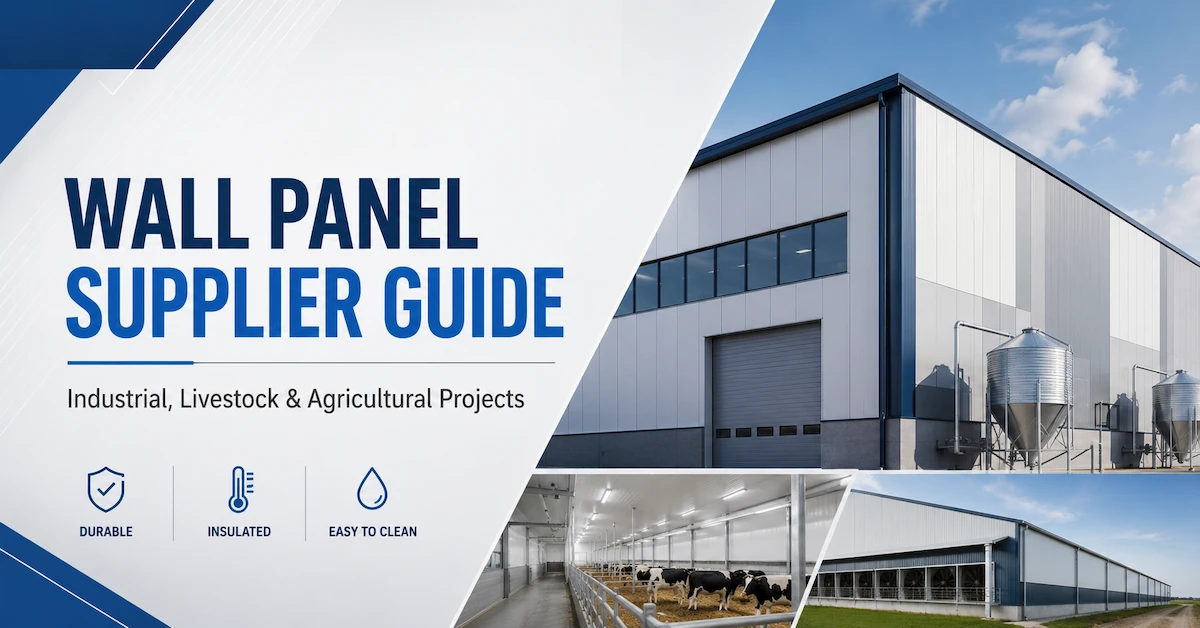
Quick Answer: What Should You Look for in an Agricultural Wall Panel Supplier?
A reliable wall panels supplier for agricultural building projects should first understand the environment in which the panels will operate. Moisture, animal gases, cleaning water, temperature swings, outdoor weather, insulation requirements, and installation details all influence the right panel choice.
For most B2B agricultural projects, buyers should verify five things before comparing prices: panel structure, resistance to the actual farm environment, insulation requirements, customization capability, and the supplier's ability to maintain consistent specifications across the full order.
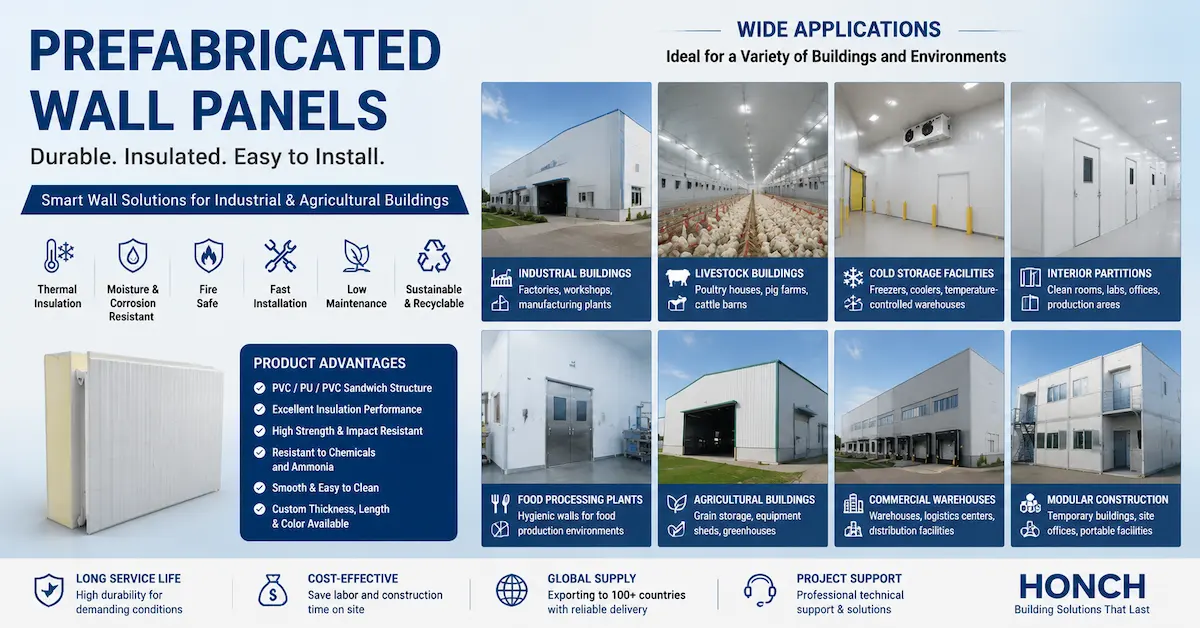
HONCH supplies wall, roof, and ceiling solutions for livestock, industrial, and agricultural buildings, including PVC+PU+PVC insulated wall panels designed for moisture, insulation, and corrosion-sensitive applications.
Key Takeaways for Agricultural Project Buyers
- Match the wall panel to the farm environment before discussing price.
- Separate projects that need simple moisture-resistant lining from those that need real thermal insulation.
- Check joints, corners, openings, and roof-to-wall interfaces—not only the center of the panel.
- Ask for documents relevant to the exact product and destination market.
- For OEM or repeat orders, confirm color, thickness, length, packaging, and approval samples before mass production.
- Compare total installed and maintenance cost rather than only cost per square meter.
Why Agricultural Buildings Need a Different Wall Panel Strategy
An agricultural building may look simple from the outside, but its operating conditions can be unusually demanding.
A dry implement shed, poultry house, pig barn, feed building, agricultural storage room, dairy facility, and temperature-controlled farm room do not create the same wall requirements.
Livestock buildings, in particular, generate moisture, gases, heat, and contaminants that must be managed by ventilation and building-envelope design. Iowa State University Extension notes that livestock ventilation is used to remove gases, odors, moisture, and heat from animal buildings.Penn State also highlights insulation and moisture control as important measures for reducing condensation on walls and ceilings in livestock housing.
That has a direct purchasing implication:
You cannot choose an agricultural wall panel from a catalog image alone.
The supplier needs to know what happens inside the building.
Which Buyers Usually Search for an Agricultural Wall Panel Supplier?
The keyword is strongly commercial.
Typical buyers include:
- Livestock farm contractors
- Poultry-house builders
- Pig-farm project companies
- Dairy and cattle-building contractors
- Agricultural EPC companies
- Farm owners expanding facilities
- Agricultural warehouse developers
- Cold-room contractors
- Building-material importers
- Regional distributors
- Private-label construction brands
These buyers are usually already past the basic “what is a wall panel?” stage.
They are trying to answer questions such as:
“Will this material survive my environment?”
“Do I need insulation?”
“Can the supplier cut panels to project length?”
“Can one supplier provide walls, roofing, and ceiling materials?”
“What documents should I verify before importing?”
“How do I prevent the cheapest quotation from becoming the most expensive project?”
A useful supplier should be able to answer those questions before pushing a product.
Start with the Agricultural Building Type
The first step is to classify the building.
Poultry Houses
Poultry buildings often require good moisture management, smooth interior surfaces, easy cleaning, and thermal control.
The wall system also needs to work with ventilation rather than against it. Poorly controlled moisture can show up as condensation on colder building surfaces.
Pig Farms
Pig farms introduce a more aggressive combination of humidity, ammonia, wash-down water, disinfectants, and temperature-control demands.
For these projects, material durability and corrosion resistance become much more important than appearance.
HONCH already provides a dedicated guide to wall panel selection for pig farms, which explains how moisture and ammonia influence farm wall choices.
Cattle and Dairy Buildings
Cattle buildings need ventilation, moisture control, durable surfaces, and practical maintenance.
Penn State's agricultural-building guidance emphasizes controlling moisture, gases, and pollutants through proper ventilation and building design.
In these facilities, the wall system should be selected together with the ventilation strategy rather than treated as an isolated finish.
Agricultural Storage Buildings
A grain, feed, equipment, or general storage building may not need the same insulated wall system as livestock housing.
For a naturally ventilated dry storage building, a simpler panel may be sufficient.
This is an important point because good procurement is not about specifying the highest-performance product everywhere.
It is about avoiding unnecessary cost while still meeting the actual environment.
Temperature-Controlled Agricultural Rooms
Cold rooms, insulated storage areas, seed rooms, food-related farm processing spaces, and other conditioned areas usually place more emphasis on thermal continuity.
Here, insulated composite panels become more relevant.
PVC Wall Panels or PU Insulated Wall Panels?
This is one of the most useful decisions to make before contacting suppliers.
PVC Wall Panels
Single-layer or non-insulated PVC wall products are generally better suited to projects where the main priorities are:
- Moisture resistance
- Corrosion resistance
- Smooth surfaces
- Easy maintenance
- Lightweight wall lining
- Interior partitions
If the building does not require significant temperature separation, adding an insulated core may not deliver enough value to justify the additional cost.
PVC + PU + PVC Insulated Wall Panels
For buildings that need both environmental protection and insulation, a sandwich structure can make more sense.
HONCH's PU Insulation Wall Panel uses:
PVC outer layer + PU foam core + PVC inner layer
The published product information identifies the main functions as thermal insulation, corrosion resistance, and moisture protection, with applications including livestock walls, industrial walls, cold rooms, and building partitions. Thickness, color, and length can be customized.
Agricultural Wall Panel Comparison
| Requirement | PVC Wall Panel | PVC + PU + PVC Panel | Coated Metal Panel |
|---|---|---|---|
| Moisture-resistant lining | Strong use case | Strong use case | Depends on coating/system |
| Integrated insulation | Limited | Yes | Possible with sandwich construction |
| Corrosive farm environment | Material-dependent, often useful | Designed for such applications | Coating and exposed edges require attention |
| Lightweight installation | Yes | Yes, relative to many traditional systems | Depends on construction |
| Custom project length | Supplier-dependent | HONCH offers customization | Commonly available |
| Best fit | Lining, partitions, humid areas | Livestock, insulated rooms,controlled spaces | General agricultural and industrial buildings |
The table should not be interpreted as “one material always wins.”
The correct panel depends on the environment and the building specification.
What Specifications Should You Send to the Supplier?
One reason agricultural buyers receive inaccurate quotations is that the RFQ contains too little information.
“Quote wall panel 2,000 m²” is not enough.
A better RFQ looks like this:
| RFQ Item | Information to Send |
|---|---|
| Building type | Poultry, pig, cattle, storage, cold room |
| Project country | Country and climate region |
| Wall use | Exterior, interior lining, partition |
| Wall area | Approximate m² |
| Environment | Humidity, ammonia, cleaning,chemicals |
| Insulation | Required or not required |
| Panel type | PVC or insulated composite |
| Thickness | Project requirement or request recommendation |
| Length | Drawing or required cut length |
| Color | Standard or custom |
| Openings | Doors, windows, service penetrations |
| Accessories | Corners, trims, fasteners,sealing items |
| Documentation | Required certificates or tests |
| Quantity | Trial, project, container, repeat order |
| Packaging | Standard export or private-label |
| Delivery | Destination and required schedule |
This information gives the supplier enough context to recommend a system rather than simply quoting the most convenient panel.
Why Joints Matter as Much as the Panel
A wall panel can have excellent material properties and still perform poorly after installation.
Many agricultural wall problems begin at:
- Panel joints
- Corners
- Door openings
- Window openings
- Service penetrations
- Wall-to-roof transitions
- Floor-to-wall interfaces
Moisture-laden air can enter small openings and condense inside assemblies when conditions allow. Agricultural ventilation guidance specifically warns about moisture moving through gaps and joints into walls.
For that reason, buyers should ask the supplier:
How are panels joined?
What corner profiles are used?
How are penetrations sealed?
What happens where the wall meets the ceiling or roof?
Who is responsible for fasteners and accessories?
These questions often reveal more about the supplier's project knowledge than a glossy brochure does.
How to Judge a Wall Panels Supplier for Agricultural Building Projects
Ask What They Need to Know Before Quoting
A supplier that asks questions about:
- building use,
- humidity,
- ammonia,
- temperature,
- drawings,
- panel length,
- insulation,
- and destination market
is usually doing a more serious application review than a supplier who sends a price immediately.
Check Whether Product Claims Are Specific
Avoid choosing suppliers based only on words such as:
“premium”
“best quality”
“super durable”
“long life”
Useful information is more concrete:
- What is the panel structure?
- What function does each layer provide?
- Which applications is it intended for?
- Which specifications can be customized?
- Which certifications relate to the product?
HONCH's insulated wall-panel page, for example, clearly states the PVC+PU+PVC construction, intended applications, customizable thickness/color/length, and OEM/ODM support.
Verify Documents Before the Purchase Order
HONCH lists ISO9001 and CE for its PU insulation wall panel.Buyers should still request the current documents and confirm that they apply to the exact product and destination requirements before placing an order.
This is a good procurement practice for any supplier.
Do not assume that a certificate shown on a website automatically covers every model, thickness, or market requirement.
Look Beyond the Main Wall Panel
Agricultural buildings often require a coordinated envelope.
That may include:
- Wall panels
- Roofing sheets
- Ceiling panels
- Ridge components
- Corner parts
- Insulation products
- Transition details
HONCH's product platform covers livestock roofing, wall, and ceiling applications as well as industrial and civilian building materials.
For a project contractor, having fewer incompatible systems to coordinate can simplify purchasing and installation communication.
When an Insulated Wall Panel May Be the Wrong Choice
This section matters because supplier credibility also comes from explaining when a product is unnecessary.
An insulated wall panel may be excessive for:
- Open-sided farm shelters
- Unconditioned machinery sheds
- Dry storage spaces with no meaningful thermal target
- Temporary partitions
- Projects where another approved wall assembly already provides the required insulation
In these cases, a simpler wall solution may reduce cost without reducing project performance.
A supplier that automatically recommends the most expensive panel for every building is not necessarily giving the best technical advice.
How to Compare Supplier Quotations Fairly
Never compare quotations until you know they describe the same thing.
Two offers can show the same price unit but include different:
- Materials
- Panel structures
- Thicknesses
- Lengths
- Accessories
- Packaging
- Documentation
- Customization
- Delivery terms
Build a normalized comparison sheet.
Supplier Comparison Checklist
| Item | Supplier A | Supplier B | Supplier C |
|---|---|---|---|
| Panel structure confirmed | |||
| Thickness confirmed | |||
| Custom length included | |||
| Color confirmed | |||
| Accessories included | |||
| Export packaging defined | |||
| Relevant certificates supplied | |||
| Sample approved | |||
| Production schedule confirmed | |||
| Delivery term confirmed | |||
| OEM/private label included | |||
| After-sales contact defined |
This removes much of the confusion caused by “cheap” quotations that leave critical items outside the price.
What Really Determines Agricultural Wall Panel Cost?
There is no useful universal price for agricultural wall panels because too many variables change the quotation.
The main cost drivers include:
- Material structure
- Insulation core
- Panel thickness
- Length
- Color
- Surface options
- Order quantity
- Accessories
- Custom packaging
- Branding
- Shipping destination
Project cost also includes installation.
Longer custom panels may reduce some site cutting but can affect handling and transport. Insulated panels can reduce the number of separate wall layers but cost more than simple lining panels.
The right comparison is therefore not:
Which panel has the lowest unit price?
It is:
Which system provides the required performance at the lowest acceptable total project risk and lifecycle cost?
Agricultural Panel Procurement Risks Buyers Often Miss
Risk 1: Choosing by Farm Type Alone
Two poultry buildings in different climates may need different wall strategies.
Better approach: provide location, ventilation design, temperature targets, and operating conditions.
Risk 2: Assuming “Waterproof” Solves Condensation
Surface moisture resistance does not replace ventilation or proper joint design.
Better approach: coordinate walls, insulation, sealing, and ventilation.
Risk 3: Finalizing Price Before Drawings
Incorrect lengths and missing openings can create waste and installation delays.
Better approach: confirm wall elevations and openings before production.
Risk 4: Ordering Custom Colors Without Approval
Color interpretation can vary between screens, samples, and production batches.
Better approach: approve a physical sample or agreed reference before mass production.
Risk 5: Ignoring Container and Site Handling
Very long panels may require special loading, unloading, and storage planning.
Better approach: confirm packing dimensions and site handling before production.
OEM/ODM Agricultural Wall Panel Supply
For distributors and repeat project buyers, customization becomes part of the commercial decision.
HONCH states that its insulated wall-panel line supports:
- Customized specifications
- Bulk purchasing
- Branding
- Packaging customization
- Long-term engineering-project supply
A practical OEM workflow should normally include:
1. Application Review
Confirm building type, climate, environment, and target market.
2. Specification Confirmation
Agree on panel structure, thickness, length, color, and connection requirements.
3. Sample or Reference Approval
Confirm appearance and agreed specification before volume production where appropriate.
4. Packaging Confirmation
Define export protection, labels, branding, and loading requirements.
5.Production and Inspection
Confirm the inspection criteria that will be used for the order.
6. Shipment Documentation
Check the commercial and technical documents required for the destination market.
For a distributor, this process is often more valuable than simply finding a supplier willing to print a logo.
Why HONCH Fits Agricultural Wall Panel Projects
Zhejiang HONCH Technology focuses on anti-corrosion and insulation building solutions for farms, factories, roofs, walls, ceilings, and light construction. Its website groups products by Livestock, Industry, Civilian, and other building-material applications.
For agricultural wall projects, the most relevant capabilities include:
- PVC-based wall solutions
- PVC+PU+PVC insulated wall panels
- Moisture and corrosion-oriented applications
- Custom thickness, color, and length
- OEM/ODM support
- Bulk and engineering-project supply
- Roof, wall, and ceiling product coverage
Buyers who are still comparing wall types can first read HONCH's existing guide to wall panels for agricultural buildings.
For product specifications, review the HONCH PU insulation wall panel.
For a broader project view, explore HONCH Products and Engineering Cases.
What to Send HONCH for a More Accurate Quote
If you are already sourcing for a project, sending a complete brief can shorten the back-and-forth considerably.
Include:
- Agricultural building type
- Country/project location
- Wall dimensions or drawings
- Exterior or interior use
- Environmental conditions
- Insulation requirement
- Preferred panel structure
- Required quantity
- Color
- Delivery destination
- Required documents
- OEM/branding requirements
For project evaluation, use HONCH Contact Us.
FAQ About Wall Panels Suppliers for Agricultural Buildings
1. What does a wall panels supplier for agricultural building projects provide?
A professional supplier provides wall panels for farm, livestock, storage, processing, and other agricultural buildings. Depending on its capabilities, it may also provide insulation options, custom dimensions, accessories, OEM/ODM service, packaging, and project support.
2. Which wall panels are suitable for poultry houses?
Poultry-house walls generally need moisture resistance, easy cleaning, suitable durability, and—in conditioned buildings—thermal insulation. The final panel type should match the climate, ventilation design, and temperature requirements.
3. Which wall panels are suitable for pig farms?
Pig farms require particular attention to humidity, ammonia, wash-down conditions, corrosion, and hygiene. PVC-based or PVC+PU composite wall systems can be considered when their specifications match those conditions.
4. Do agricultural buildings always need insulated wall panels?
No. Open or unconditioned sheds may not benefit enough from insulated panels to justify the additional cost.Insulation becomes more important where indoor temperature control, condensation control, or separation between conditioned spaces is required.
5. What is a PVC+PU+PVC wall panel?
It is a sandwich wall panel with PVC surface layers and a rigid PU foam insulation core. HONCH uses this construction for livestock, industrial, cold-room, and partition applications.
6. Can agricultural wall panels be customized?
Yes. HONCH lists customizable thickness, color, and length for its PU insulation wall panels. Buyers should confirm the final specification before production.
7. What certificates should I ask a wall panel supplier for?
That depends on the product and destination market. Ask for the documents relevant to the exact panel being purchased rather than accepting a general company certificate as proof for every product.
8. How do I compare agricultural wall panel prices?
Normalize the quotations first. Confirm material, structure, thickness, dimensions, accessories, packaging, documentation, delivery terms, and customization before comparing the unit price.
9.Can I buy roofing, wall, and ceiling materials from the same supplier?
Yes. HONCH supplies products across livestock and industrial roofing, wall, and ceiling categories, which may simplify coordination for complete building-envelope projects.
10. What information is needed for an accurate quotation?
Provide the project type, location, drawings, wall area, environment, insulation requirements, panel dimensions, color, quantity, accessories, destination, and any OEM or documentation requirements.
11. Should I approve a sample before a large order?
For customized specifications, colors, surfaces, or private-label orders, sample or reference approval is a sensible way to reduce misunderstandings before volume production.
12. Is the cheapest agricultural wall panel supplier the best option?
Not necessarily. The lowest quotation may exclude accessories, insulation, custom cutting, suitable packaging, or required documentation. Compare total project value and risk rather than unit price alone.
Conclusion
Choosing a wall panels supplier for agricultural building projects is fundamentally an application-matching exercise.
The supplier should understand what happens inside the building before recommending a panel. A poultry house, pig farm, cattle building, agricultural warehouse, and cold room do not require identical wall systems.
Before placing an order, define the building environment, decide whether insulation is necessary, confirm the panel structure and dimensions, review joints and accessories, verify the required documents, and compare technically equivalent quotations.
HONCH offers PVC-based and PVC+PU+PVC insulated wall solutions alongside roofing, ceiling, and other building-envelope products for livestock, industrial, and agricultural applications. For contractors, distributors, and agricultural project developers, this provides a practical route from material selection through customization and bulk project supply.
If you already have project drawings or approximate wall dimensions, send the application, location, quantity, operating conditions, and required specifications through HONCH Contact Us to request a project-specific recommendation and quotation.