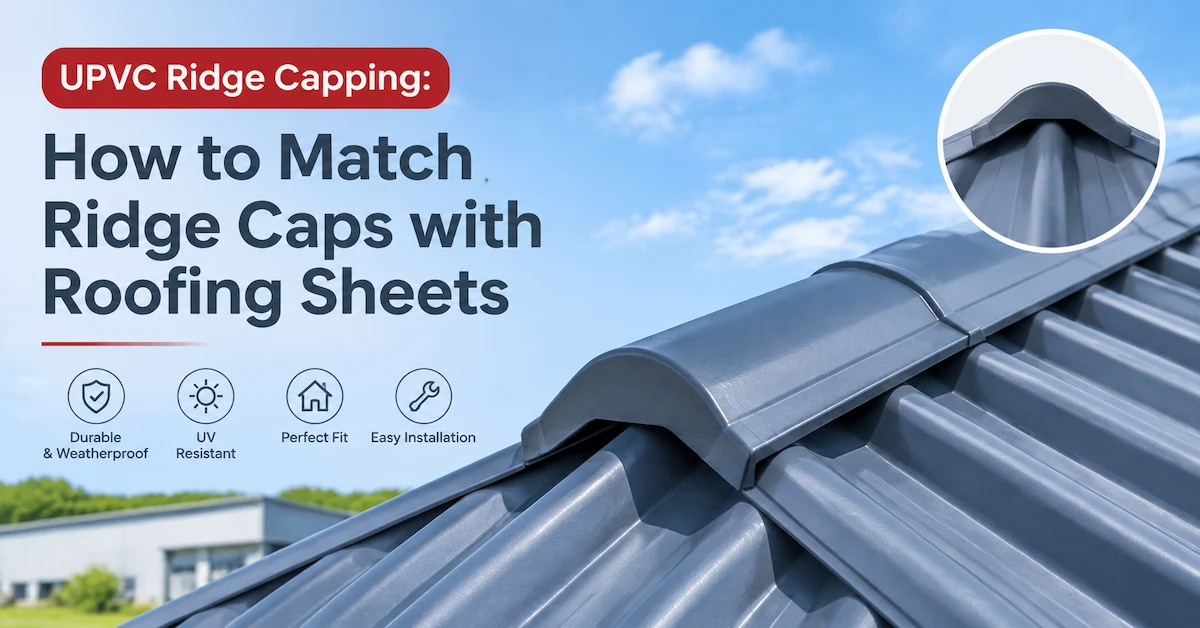
Short answer: Match a ridge cap to the roofing sheet profile, ridge geometry, roof pitch, cover width, fixing zones and sealing method. UPVC ridge capping is not a universal strip that can be fitted to every corrugated or tiled roof. A correct match must cover the high point or hip joint, shed wind-driven rain, allow the installer to fix it without distorting the sheet, and use compatible overlaps and seals.
For a standard UPVC/APVC roofing system, first identify whether the detail is a main roof ridge, a sloping hip, or the exposed end of a ridge. Then compare the cap dimensions and curvature with the ordered roof sheet, confirm pitch and overlap assumptions, and request the complete accessory scope before placing a bulk order.
What Is UPVC Ridge Capping?
UPVC ridge capping is a formed roofing accessory used to cover and protect the upper meeting line of pitched roof sheets. UPVC means unplasticized polyvinyl chloride, a rigid PVC material commonly used in building products. In a roofing assembly, the cap is not the main weathering sheet. It is the component that closes or covers a vulnerable transition, helps direct water away from the ridge, and provides a defined fixing surface at the roof apex or hip.
The phrase “ridge capping” can describe more than one part. A main ridge cap generally follows the horizontal or near-horizontal line at the top of a two-sided pitched roof. A hip ridge cap follows a sloping external intersection where a roof plane meets another roof plane. An end of ridge cap closes the exposed termination of a ridge assembly. These parts may share a material family, color and finish, but they do not serve the same geometry.
What the cap needs to do
A useful ridge accessory has four functions. First, it covers the gap or transition between roof sheets. Second, it creates a controlled path for rainwater to run away from the joint. Third, it provides a surface that can be fixed and sealed without crushing or distorting the roof sheet. Fourth, it completes the roof edge with a consistent material and appearance. The exact result depends on the cap shape, the sheet profile, the roof pitch, the support arrangement and the installer.
For buyers, this means a ridge cap should be specified as part of a roof system, not as an isolated line in a purchase order. The order should state the compatible roofing sheet series or cross-section, the required ridge type, color, length, quantity, fixing method and accessory responsibility. If the supplier offers a “universal” cap, ask what range of profiles it actually covers and what assumptions make that claim valid.
Why UPVC or APVC is used for ridge accessories
UPVC/APVC accessories can be attractive for roofing projects where corrosion resistance, weather exposure and material coordination are important. The HONCH hip ridge cap page describes a UPVC/APVC composite accessory intended for roof ridge joints and lists applications including industrial workshops, farms, corrosive factories, greenhouses and other light structures. The end cap page describes an UPVC/APVC component for closing exposed ridge ends in UPVC/APVC roof systems.
These descriptions define intended use, not a blanket approval for every environment. A buyer should still review UV exposure, temperature, wind, salt or chemical exposure, fastener compatibility, roof movement and local code requirements. A non-metallic cap can reduce some corrosion concerns, but the complete ridge may still contain metal screws, washers, supports and flashing. The cap and the items around it must be assessed together.
Hip Ridge Cap vs End of Ridge Cap
The most common ordering error is confusing a hip ridge cap with an end of ridge cap. The names sound similar, but they close different parts of the roof. A project can require both, especially when a roof has multiple slopes and the ridge line terminates visibly at a hip or gable end.
| Accessory | Where it is installed | Primary purpose | Buyer confirmation |
|---|---|---|---|
| Hip ridge cap | Along a sloping external intersection between roof planes | Cover and protect the sloping hip joint while following the roof geometry | Hip angle, sheet profile, cap width, overlap, fixing and sealing details |
| Main ridge cap | Along the upper meeting line of the main roof slopes | Close and weather the horizontal or near-horizontal roof apex | Ridge shape, roof pitch, cover width, ventilation or closure detail |
| End of ridge cap | At the exposed end of a ridge assembly | Close the ridge end and finish the exposed edge against rain and wind | End geometry, cap profile, finishing direction and compatible ridge part |
When the hip ridge cap is the right component
Use a hip ridge cap when the accessory must run along a diagonal or sloping line rather than across the main roof apex. The cap needs to sit over the two adjacent roof surfaces and follow the angle created by the building design. A cap that is correct for a straight main ridge may not cover the hip joint evenly. If the hip angle changes, the buyer should supply drawings or a measured sample to the manufacturer rather than relying on a name alone.
HONCH's UPVC/APVC hip ridge cap product page identifies this accessory as a component for covering and protecting the intersection of roof slopes. It also states that length, color and matching roofing accessories can be customized for distributors, contractors and global building material suppliers. For a project or distribution order, request the exact profile drawing and confirm the relationship between the cap and the roof sheet before approving production.
When the end of ridge cap is required
An end of ridge cap is used where the ridge assembly finishes at an exposed end. Without a suitable end piece, the ridge may have an open edge that admits wind-driven rain, exposes the internal profile, or creates an unfinished appearance. It is not a replacement for the hip cap running along a sloping intersection. It is a finishing and sealing component for the terminal end of the ridge.
The UPVC/APVC end of ridge cap product page describes the part as an accessory for closing and sealing exposed ridge ends. The page lists use with UPVC/APVC roof systems, workshops, warehouses, farms, greenhouses and light-duty construction. Confirm whether the project needs a left, right, universal or project-specific end configuration, and confirm how it connects to the main ridge or hip part.
Why both parts may appear in one bill of materials
A complex roof may have a main ridge, several hips and multiple terminal ends. The bill of materials should count each line by location rather than by the generic word “ridge.” A contractor may need straight caps for the main ridge, hip caps for sloping intersections, end caps at exposed terminations, and separate closures or flashings around penetrations. A distributor should also keep the product names and application drawings distinct so that a customer does not receive a visually similar but geometrically wrong part.
How to Match Ridge Caps with Roofing Sheet Profiles
Profile matching is the core of a successful ridge order. A roofing sheet is not a flat rectangle. Its ribs, waves, corrugations, cover width and height create a three-dimensional surface that the cap must cover or terminate. Even when the cap sits above the sheet rather than directly inside every rib, the profile influences the required width, clearance, overlap and sealing line.
Start with the exact sheet identity
Record the manufacturer, series, profile name, effective cover width, overall width, rib or wave height, sheet thickness, length, color and intended roof position. “UPVC roofing sheet” is not enough information because different profiles can share the same material family. If the sheet came from another supplier, provide a cross-section drawing, a clear measurement sheet or a physical sample.
For a HONCH-compatible quotation, the buyer can refer to the relevant roofing sheet product or series and ask the technical team to confirm the cap. The HONCH roofing products directory provides the roof product path, but the directory itself should not be treated as proof that every listed sheet uses the same ridge geometry. The supplier should confirm the actual profile and accessory match in writing.
Check the cap's cover width against the sheet's high points
The cap must cover the upper edges of the roof sheets with enough bearing for fixing and sealing. If it is too narrow, the cap may sit on the rib peaks without protecting the joint. If it is too wide, it may leave unsupported edges that flex in wind or create an irregular seal. The correct dimension is not determined only by the nominal width of the roof sheet; it depends on the roof pitch, rib geometry, cap curvature and the position of the supporting structure.
Check the curvature or angle
A main ridge cap generally has a central bend or curved form that corresponds to the two roof planes. A hip cap must follow a sloping line, and an end cap must close the geometry at a termination. Compare the cap's included angle, leg length and curvature with the roof drawing. A small mismatch can become a large gap at the side edges once the cap is fixed over a long run.
Confirm the fixing zones
Do not fix through an unsupported edge simply because the cap appears to cover the sheet. Ask where the screws, washers or other fasteners are intended to sit, what support is required underneath, and how the fixing pattern changes at an end or corner. Over-tightening can deform a polymer accessory; under-fixing can leave the cap vulnerable to wind movement. The manufacturer's installation guidance and the responsible designer's wind assessment should control the final detail.
Compare the accessory material with the roofing material
A compatible profile can still be a poor system match if the materials react differently to weather, heat or movement. Where the roof sheet is UPVC/APVC, an accessory from the same product family can simplify color, movement and surface coordination. If a different material is used, review thermal movement, galvanic interaction, sealant compatibility, corrosion exposure and scratching. The buyer should not assume that a metal ridge cap is automatically interchangeable with a polymer roof sheet or that a polymer cap is automatically suitable for a metal profile.
| Profile information to collect | Why it affects the cap | Best way to verify |
|---|---|---|
| Rib or wave height and spacing | Determines clearance, cover and where the sealing line can sit | Cross-section drawing, sample or controlled measurement |
| Overall and effective cover width | Influences sheet layout, ridge width and end detailing | Approved product data and project roof plan |
| Roof pitch and ridge angle | Controls the cap angle, side coverage and drainage path | Architectural drawing, site measurement or installation template |
| Sheet thickness and support spacing | Affects fixing behavior, movement and edge support | Roof specification and supplier installation guidance |
| Color and surface finish | Determines visual continuity and replacement consistency | Approved sample, color reference and written quotation |
Roof Pitch, Overlap and Sealing Considerations
Ridge caps are not only shaped parts. Their performance depends on how they meet the roofing sheet and how the installer manages water, movement and wind. The terms pitch, overlap and sealing should therefore appear in the technical conversation before a buyer approves the accessory order.
Roof pitch changes the fit
Roof pitch is the angle or slope of the roof plane. A steep roof and a low-slope roof present different drainage and coverage conditions at the ridge. A cap designed for one angle may leave a different side gap when installed on another. A shallow roof may also need more careful overlap and sealing because water moves more slowly and wind-driven rain can travel upward at exposed edges.
Do not infer the required cap from a photograph. Provide the pitch or the roof-section drawing and ask the supplier to confirm the compatible range. If the building uses multiple pitches, list each roof zone separately. For custom OEM/ODM production, the manufacturer may need the angle, cap width, length, color and sheet profile before developing or selecting the mold.
Overlap is a water-management detail
Long ridge runs often require more than one cap length. The overlap between adjacent caps should be oriented so that it does not create an uphill water path or an exposed opening toward the prevailing wind. The required overlap length depends on the accessory design, pitch, local weather, fixing method and supplier instructions. A buyer should not insert a generic overlap number into every project without checking the actual product.
For imported or distributed products, record the recommended overlap in the technical file and make it part of the installation instructions. The quantity calculation should include the effective cover length, not only the nominal length of each cap. Allow for end conditions, cuts, hips and waste, and specify whether the supplier or installer is responsible for final quantity take-off.
Sealing should be compatible with the materials
Sealant, closure strips, washers and fasteners work together at the ridge. The selected seal must remain compatible with the UPVC/APVC surface and the cleaning or weather exposure. The installer should follow the sealant manufacturer's application limits and the roof supplier's instructions, including surface preparation, bead position and curing conditions. A sealant placed where water ponds or where movement is concentrated may fail earlier than a correctly located seal.
Do not block a required ventilation path
Some roof designs use a ridge detail that combines weather protection with ventilation. Others require a fully closed ridge. The correct choice depends on the building, insulation, condensation strategy and design requirements. A cap should not be modified on site in a way that defeats the roof's intended airflow or weather seal. Ask the responsible designer and supplier whether the ridge is closed, vented or dependent on a separate closure component.
Wind and structural checks remain necessary
Ridge accessories are exposed to uplift, suction and fluctuating pressure. The cap's material strength and shape are only part of the result. Support, fastener spacing, edge distance, overlap, roof framing and the building's location also matter. Coastal, high-wind and open agricultural sites should receive a project-specific check. A product page can describe intended applications, but it does not replace the responsible engineer's design review.
How to Check Ridge Cap Compatibility Before Ordering
A compatibility check should be short enough for procurement teams to use repeatedly and detailed enough to prevent an expensive mismatch. The following sequence works for importers, distributors and contractors who may not have the original roof designer available.
- Identify the location: mark main ridge, hip, end, transition and any unusual corner on the roof plan.
- Identify the sheet: record the exact profile, series, material, thickness, effective width and supplier.
- Measure the geometry: provide pitch, hip angle, ridge length, cap run, support position and end condition.
- Request the cap drawing: compare cover width, angle, leg length, fixing zones, overlap and compatible closure.
- Confirm the material system: review UPVC/APVC composition, color, UV or corrosion exposure and accessory compatibility.
- Review installation: ask for screw, washer, sealant, closure, support and sequencing instructions.
- Check quantity: calculate effective cover length, overlaps, cuts, hips, ends and spare pieces separately.
- Approve a sample or drawing: use a physical fit check when profile or pitch information is uncertain.
- Record the approved version: store the product code, drawing revision, color, dimensions and exclusions with the purchase order.
Fast compatibility test for a distributor: Do not quote only “UPVC ridge cap.” Ask the customer for a roof-sheet cross-section, pitch, required cap location, length, color and photos or drawings of the ridge. Then send the supplier one consolidated request that asks for the recommended cap, matching sheet profile, accessory drawing, quantity basis and installation assumptions.
These steps help separate a genuine match from a visual match. Two caps may look similar in a catalogue but differ in angle, cover width, fixing position or end configuration. A controlled approval process also reduces disputes when a contractor discovers at installation that the cap cannot cover the ordered sheet.
UPVC Roofing Accessories Buying Checklist
For a complete roofing purchase, the ridge cap should be reviewed with the other accessories that close, redirect or protect the envelope. The accessory list depends on the roof design, but the following questions are useful for most industrial and agricultural orders.
Product and geometry
- Is the item a main ridge cap, hip ridge cap, end of ridge cap or another closure?
- Which roofing sheet profile and series does it match?
- What are the nominal length, effective cover length, width, angle and leg dimensions?
- Does the cap require a specific pitch or hip angle?
- Are left-hand and right-hand end pieces different?
Installation and sealing
- Which screws, washers, clips, sealants or closures are included?
- Where should the fixing pass through the cap and roof sheet?
- What overlap is required between cap sections?
- How are the cap, sheet and support allowed to move with temperature?
- Does the ridge detail need to remain open for ventilation or be fully closed?
Commercial and supply scope
- Are color, texture, length, packaging and branding customizable?
- What is the actual MOQ and lead time for the ordered profile and color?
- How are long caps protected from bending, abrasion and moisture during shipping?
- Can the supplier provide repeat-order identification and replacement support?
- Which documents, samples and certificates apply to the exact product?
The HONCH roofing accessories directory is a useful starting point for identifying the accessory family and related product pages. It currently lists the hip ridge cap and inside corner deflector. For a roof that also requires a ridge end closure, use the dedicated product page and ask the sales or technical team to confirm the correct bill of materials rather than assuming the directory list is exhaustive for every roof configuration.
OEM/ODM and Bulk Purchasing for Ridge Accessories
Importers and distributors often need more than a small project quantity. They may want a private label, a specific color range, a standard pack count, mixed container loading, or a cap that matches a roofing sheet sold under their own catalogue. In that situation, OEM/ODM capability matters because profile compatibility and packaging must be controlled together.
What to define for an OEM/ODM request
Provide the roof-sheet profile, cap location, drawing or sample, dimensions, material preference, color reference, surface finish, logo or packaging requirement, annual or order quantity, destination country and required documents. State whether the cap will be sold with a particular sheet series or as an accessory for multiple approved profiles. If the project uses different ridge geometries, separate them into individual SKUs.
HONCH's public hip ridge cap information states that length, color and matching roofing accessories can be customized for distributors and project contractors. The end cap page also describes customization of colors, textures and matching accessories. These capabilities should be converted into a written quotation that states what is included, what requires tooling, what sample is approved, and whether the same dimensions will be controlled on repeat orders.
Why bulk buyers need a profile-control process
A distributor can lose margin when a cap is technically usable but difficult to sell because the compatibility description is unclear. The product should have a clear name, compatible sheet series, drawing, installation note, pack quantity and customer-facing explanation. Keep the hip ridge cap and end of ridge cap as separate catalogue items. Include the roof profile in the internal SKU or compatibility table, even if the supplier uses a broader product name.
Packaging is part of product quality
Long polymer accessories can be damaged by bending, compression or rough handling. The purchase order should state the packing method, bundle length, protection at ends, labeling, quantity per package and inspection process. For container orders, confirm how caps are arranged with roofing sheets and whether mixed sizes can be safely loaded. A cap that arrives deformed or untraceable creates an installation and after-sales problem even if it left the factory correctly.
Suggested ridge-cap RFQ wording: “Please recommend the compatible UPVC/APVC main ridge, hip ridge and end-of-ridge components for the attached roofing sheet profile. Confirm cap dimensions, roof pitch or angle range, effective cover length, overlap, fixing and sealing method, material, color, packaging, MOQ, lead time, applicable documents and exclusions. Please provide a drawing or sample for approval before bulk production.”
How Contractors Should Install and Inspect the Match
A correct purchase order does not eliminate the need for a controlled installation. Before fixing, the contractor should compare the delivered caps and sheets with the approved drawing. Check that the profile, color, dimensions and accessories are correct. Dry-fit a short section at the ridge and at each end condition. If the cap rocks, leaves a continuous opening or forces the sheet into an unusual position, stop and obtain clarification before continuing.
During installation, keep the cap aligned with the ridge or hip line, use the specified support and avoid distorting the cap with excessive screw pressure. Install overlaps in the direction required by the roof geometry and prevailing weather. Keep sealant and closures at the specified line rather than filling every visible gap with an unapproved material. At the end of the work, inspect the ridge from both sides, check fastener seating and confirm that water has a clear path away from the joint.
For maintenance records, keep the approved profile drawing, product code, color, installation date and supplier contact. If a later replacement is required, these records allow the owner or distributor to order the same part instead of guessing from a photograph. This is particularly useful for industrial roofs, farm buildings and multi-site customers where a small accessory mismatch can delay a larger repair.
Frequently Asked Questions
What is UPVC ridge capping used for?
UPVC ridge capping covers and protects the upper transitions of a pitched roof. Depending on the geometry, the part may be a main ridge cap, hip ridge cap or end of ridge cap. It helps close the joint, direct water away from the roof apex and provide a defined finishing and fixing detail.
Is a hip ridge cap the same as an end of ridge cap?
No. A hip ridge cap runs along a sloping intersection between roof planes. An end of ridge cap closes the exposed termination of a ridge assembly. A roof may require both parts, but they should be ordered and counted separately.
Can one UPVC ridge cap fit every roofing sheet profile?
No. Compatibility depends on profile geometry, cover width, pitch, cap angle, fixing zones, support and sealing. A supplier should confirm the match using a product drawing, roof section, physical sample or controlled measurement.
What information should I send to a ridge cap supplier?
Send the roofing sheet manufacturer and series, profile cross-section, sheet thickness, roof pitch, ridge or hip location, dimensions, color, quantity, destination and installation conditions. Add a drawing or sample when the profile is not a standard product.
How much overlap is needed for UPVC ridge capping?
The required overlap depends on the cap design, cap length, roof pitch, weather exposure and installation method. Use the supplier's instructions or approved project detail rather than applying a generic number to every roof.
Does the roof pitch affect ridge cap selection?
Yes. The pitch changes the angle between the cap and the roof sheets, the side coverage, the drainage path and the exposure to wind-driven rain. Provide the pitch or roof-section drawing before the supplier confirms the accessory.
Do I need an end of ridge cap on every roof?
You need an end component wherever the ridge assembly has an exposed termination that must be closed and finished. The exact part depends on the roof design and how the main ridge or hip cap terminates. Confirm the end geometry with the supplier.
Can UPVC ridge capping be used with metal roofing?
It may be possible in a project-specific design, but it should not be assumed. Review profile, movement, fasteners, sealant, corrosion compatibility, support and local requirements. A cap intended for a UPVC/APVC system is not automatically suitable for a metal sheet.
What should importers check before bulk ordering ridge caps?
Confirm the approved profile drawing, dimensions, cap type, color, effective length, overlap, packaging, MOQ, lead time, documents, replacement identification and the exact accessories included. Approve a sample or first article when the product will be sold under a distributor catalogue.
Can a manufacturer customize ridge cap dimensions and colors?
Customization may be available for length, color, texture, matching accessories or project-specific dimensions, depending on the manufacturer and order. Ask about tooling, sample approval, MOQ, repeat-order control and packaging before treating customization as confirmed.
Conclusion
Matching a ridge cap with a roofing sheet is a geometry and system-compatibility decision, not a last-minute accessory purchase. Start by identifying the roof location, then separate the main ridge, hip and ridge-end functions. Confirm the sheet profile, pitch, cap angle, cover width, fixing zones, overlap, sealing method and material compatibility before ordering.
For importers, distributors, contractors and industrial project buyers, the best purchasing process is to request a drawing or sample, define the complete ridge accessory scope and keep the approved compatibility record with the order. HONCH provides UPVC/APVC roofing accessories, including hip ridge caps and end of ridge caps, with project and OEM/ODM support information available through its product pages. Send your roof profile, pitch, quantity and destination requirements through the official contact page to receive a project-specific recommendation.