Quick Answer: What Should a PU Wall Panel Supplier Provide?
When a project team searches for a PU wall panels supplier for agricultural building work, it is usually trying to solve more than a material shortage. The buyer needs a wall system that can handle humidity, animal gases, washdown water, temperature changes, impact and repeated maintenance while still arriving in a specification that can be installed and reordered. The right supplier should therefore provide a defined PVC + PU + PVC construction, explain where it is suitable, confirm the dimensions and joint system, support the agricultural application review, and quote the accessories and documentation needed for the actual building.
Practical recommendation: Start with a PVC + PU + PVC insulated wall panel when the agricultural building needs both a moisture-conscious, corrosion-resistant surface and a PU insulation core. Use the panel for the position described by the product documentation, such as livestock interior walls, agricultural partitions or temperature-controlled rooms. Before purchase, confirm panel thickness, length, color, joint profile, support spacing, openings, cleaning chemicals, fire and thermal documentation, packaging, MOQ and delivery conditions for the exact project. Do not treat a generic “PU panel” label as a complete specification.
Why PU Wall Panels Need a Different Agricultural Specification
A farm building is not one uniform environment. A poultry house, pig barn, cattle building, feed store, agricultural workshop and temperature-controlled room can all be described as agricultural buildings, but the wall loads are different. Some spaces need a cleanable interior lining. Others need a thermal barrier. Some have frequent high-pressure washing. Others are dry, naturally ventilated storage spaces where insulation may not be the main cost driver.
Livestock buildings also create a combination of moisture, heat, dust, ammonia, hydrogen sulfide, organic deposits and cleaning chemicals. Ventilation removes heat and moisture, but the wall still needs to remain compatible with the operating routine. A panel that looks suitable in a product photograph can be a poor purchase if the wall-to-floor detail traps water, the joint cannot be cleaned, or the supplier has not checked the disinfectant used on site.
That is why the supplier conversation should begin with the building position and operating conditions. Ask whether the wall is exterior or interior, whether the space is conditioned, how often it is washed, what chemicals are used, where animals or equipment can impact the panel, and how the wall connects to the roof, ceiling, floor and doors. Those details determine whether PU insulation adds real value and which supporting components must be included.
What the buyer is really purchasing
The purchase is a wall assembly, not just a flat sheet. The assembly includes the panel face, PU core, joints, fasteners, trims, corners, sealants, penetrations, base protection and installation method. A supplier who can discuss only the panel surface has not yet addressed the most common points of agricultural wall failure.
| Buyer question | Evidence or answer to request | Why it affects the order |
|---|---|---|
| Is insulation actually needed? | Building temperature target, operating schedule and thermal data for the ordered construction. | Prevents paying for an insulated core where a lining is enough, or under-specifying a conditioned room. |
| Will the surface suit the farm routine? | Face material, cleaning method, chemical compatibility and maintenance limits. | Ammonia, disinfectants, washdown pressure and impact can affect the surface and joints differently. |
| Can the panels be installed correctly? | Section drawing, interlocking or joint detail, corner treatment and fixing guidance. | Good flat-panel material cannot compensate for unresolved openings, corners or transitions. |
| Can the order be repeated? | Approved specification, color reference, tolerances, packaging and production controls. | Important for multi-house farm projects, distributors and private-label programs. |
Match the PU Wall Panel to the Agricultural Building Type
The strongest supplier recommendation is application-specific. A panel that is a good fit for a poultry-house interior may not be the correct answer for an exposed external facade, a heavy equipment bay or a dry storage shed. Use the following application review as a starting point, then ask the supplier to confirm the exact position.
Poultry houses and broiler buildings
Poultry houses commonly need smooth, moisture-conscious surfaces, practical cleaning access and stable indoor conditions. The wall may sit close to litter, water lines, feeders, fans and service openings. These interfaces should be identified before the cut list is finalized. If the building is temperature-managed, a PU core may support the thermal objective, but it does not replace ventilation design or solve every condensation risk.
For a poultry project, give the supplier the house type, wall height, internal temperature target, ventilation arrangement, washing procedure, door and fan openings, support spacing and expected impact zones. Ask whether the proposed wall panel is intended for an interior wall, partition or another position. If the same material is also being considered for the ceiling, request a separate confirmation because wall and ceiling products can have different profiles, connections and support requirements.
Pig farms and farrowing buildings
Pig buildings often combine humidity, ammonia, washdown, disinfectants and frequent contact with equipment. In this environment, corrosion resistance is useful, but “corrosion-resistant” is not a blanket chemical-compatibility statement. The panel face, edge, seal, fastener and cleaning process should be reviewed together.
Send the cleaning product names, dilution, water temperature, contact time and washing pressure. If the supplier cannot review those conditions, the buyer should treat the chemical claim as incomplete. Also identify lower-wall impact and splash zones. A durable face can still be damaged by forklifts, gates, feeders or pressure-washing practices, so the base detail and protection strategy should be part of the quote.
Cattle barns and dairy-related buildings
Cattle buildings usually need a balance between ventilation, moisture management, weather exposure and daily maintenance. Some areas are open-sided and naturally ventilated; others are enclosed or used for milk-related storage, feed preparation or temperature-sensitive operations. A PU wall panel may be relevant in enclosed or conditioned zones, while a simpler wall lining or different external cladding may be more appropriate elsewhere.
Tell the supplier whether the panel is inside the animal area, on an exterior elevation, around a service room or inside a storage room. Include the expected contact with water, manure, cleaning chemicals and machinery. The correct selection is not determined by the word “cattle” alone; it depends on the wall position and the operating routine.
Feed stores, farm workshops and agricultural warehouses
Dry storage may not need the same wall construction as a livestock room. If the building is unconditioned, has limited washdown and has low humidity, the value of an insulated panel should be compared with the simpler panel or lining that meets the actual need. If the stored material is temperature-sensitive, moisture-sensitive or vulnerable to condensation, PU insulation becomes more relevant.
Workshops require additional attention to impact, cutting, welding, sparks, equipment contact and fire requirements. Do not extend an agricultural application claim into a workshop without confirming the proposed construction and local code requirements. The supplier should know the work process, not just the building label.
Cold rooms and temperature-controlled agricultural spaces
For a cold room, seed room, produce store or other conditioned agricultural space, the value of the PU core is connected to the required thermal performance and continuity of the envelope. Request data for the actual thickness and joint configuration. Review thermal bridges at corners, doors, supports and penetrations. A panel core alone does not establish the final U-value or condensation result.
Door frames, floor transitions and service penetrations can control the practical performance of a conditioned room. Ask the supplier whether the quoted scope includes the necessary trims and whether the installation team has a clear responsibility for sealing and alignment. A low unit price that excludes these details is not a comparable quote.
What PVC + PU + PVC Means in a Farm Wall System
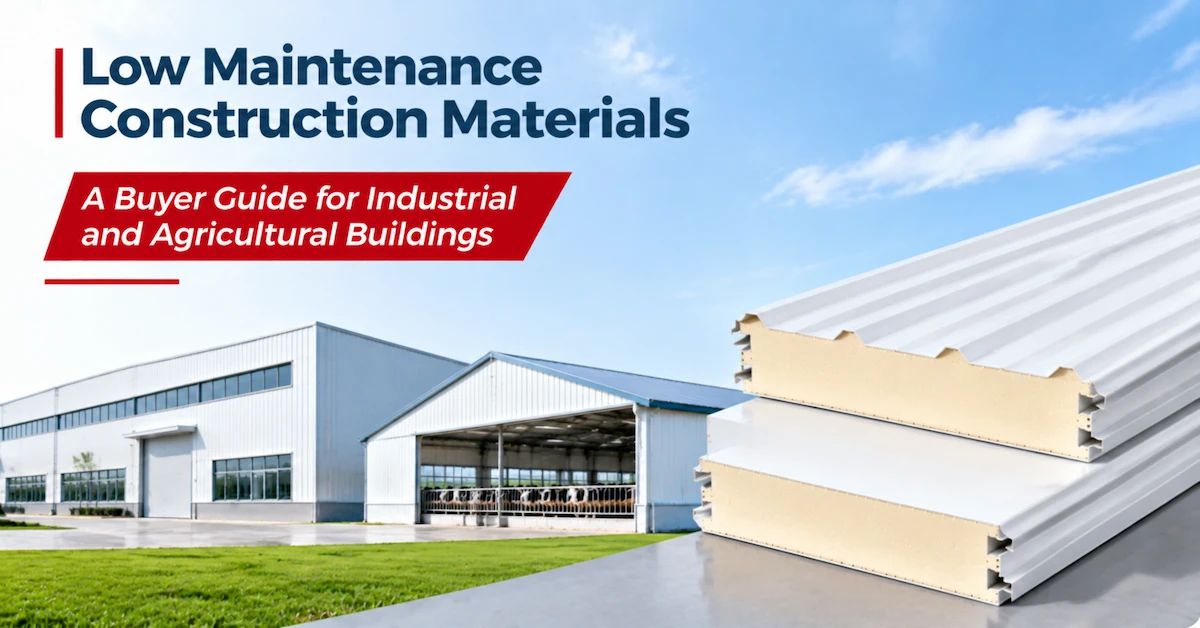
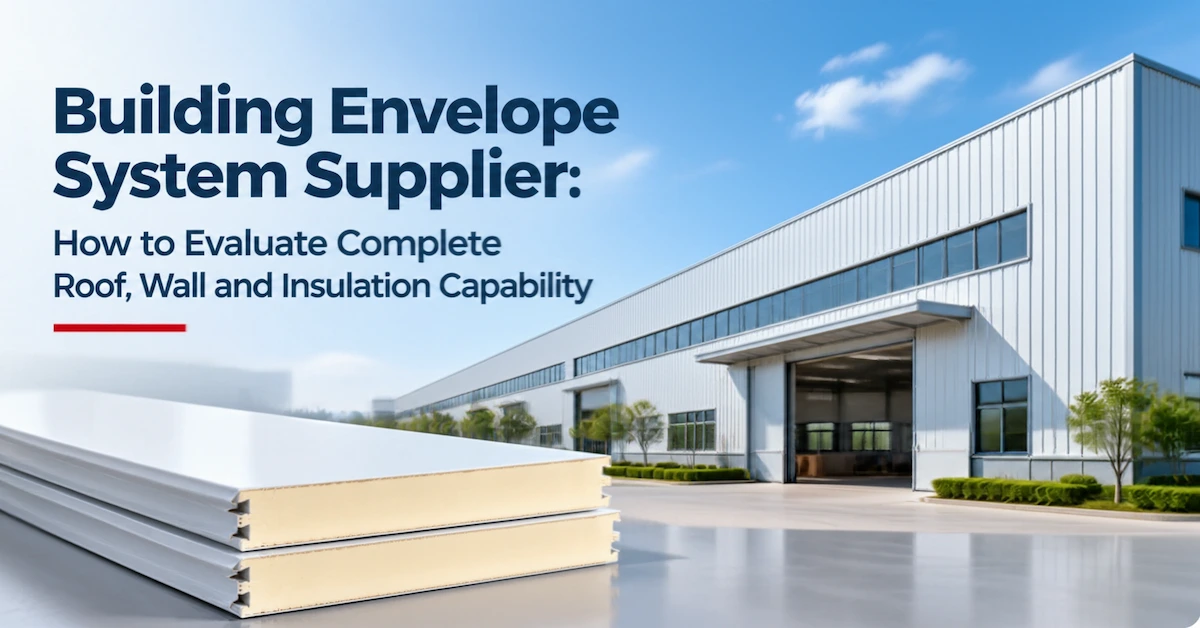
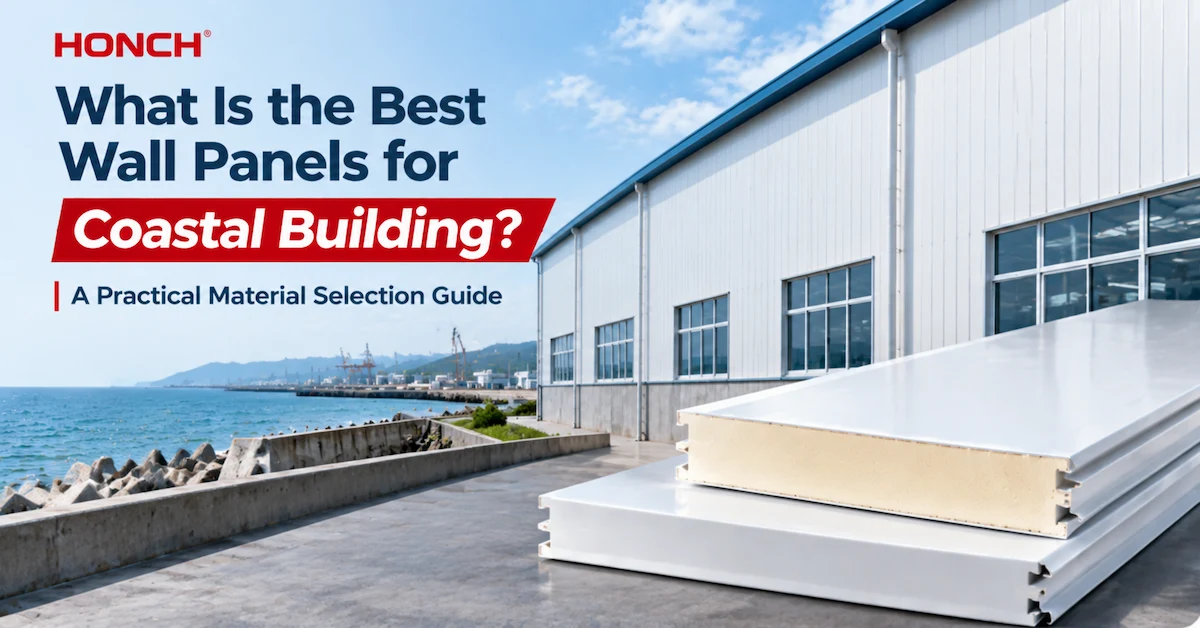
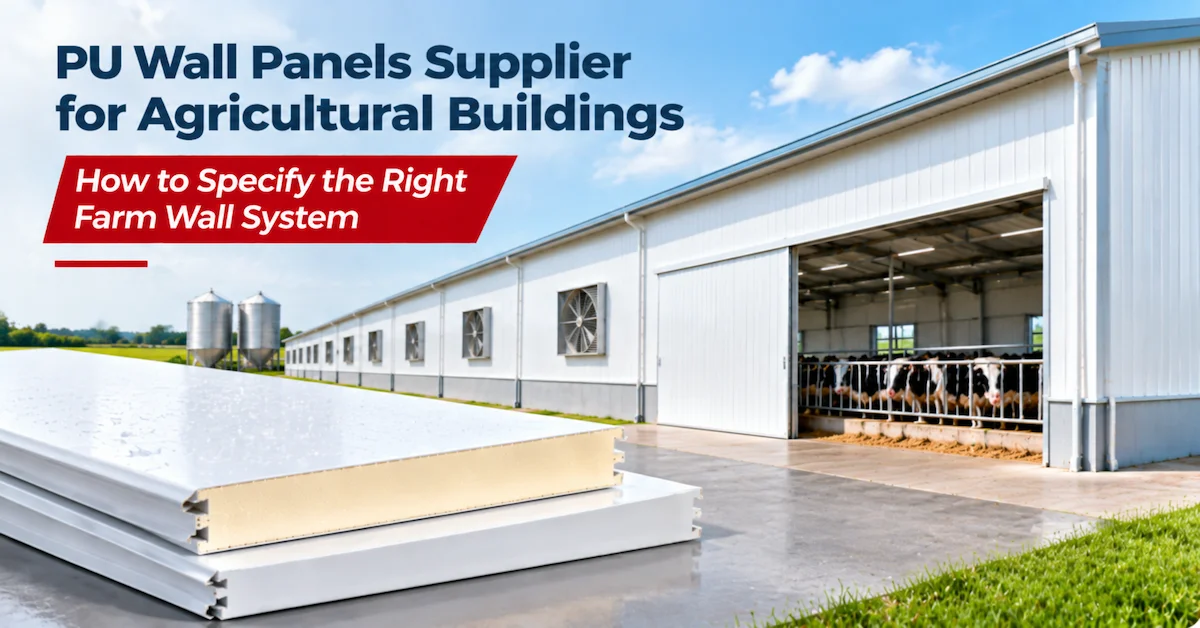
HONCH describes its PU insulation wall panel as a PVC outer layer, PU foam core and PVC inner layer. The product page identifies insulation, anti-corrosion and moisture-proof functions, an interlocking structure and applications including livestock interior walls, industrial wall cladding, cold storage and light-duty partitions. Thickness, color and length are listed as customizable options. These statements define the product starting point, but the project team still needs to confirm the exact ordered construction.
The outer PVC layer
The outer PVC face is the exposed surface on the selected side of the wall. For agricultural interiors, the buyer should evaluate smoothness, cleaning access, resistance to the actual moisture and chemical routine, impact exposure and the way the face connects to trims and openings. A smooth surface can make cleaning easier, but hygiene also depends on the joint, drainage, drying time and maintenance procedure.
If the panel will face sunlight or outdoor weather, ask whether that installation position is covered by the supplier's product documentation. A product described for livestock interior walls should not automatically be treated as an external facade or roof. Confirm color, UV expectations, surface construction and permitted cleaning method for the intended location.
The PU foam core
The PU core provides the insulation function within the composite. It can help reduce heat transfer and support more stable indoor conditions when the panel thickness, joints and building design are appropriate. The core does not, by itself, prove a specific thermal value, fire rating, acoustic rating or condensation result. Those claims depend on the exact construction, test method and project conditions.
For an agricultural RFQ, ask for the core description, panel thickness options, thermal data, test conditions and any limitations. If the buyer has a target indoor temperature or energy requirement, state it directly. “Insulated” is a starting category, not an engineering calculation.
The inner PVC layer
The inner face protects the opposite side of the core and becomes the working surface when the panel is installed as an interior wall or partition. It should be assessed against the same farm routine as the outer face: humidity, washdown, impact, cleaning chemicals and connection details. If one face is exposed to a different condition than the other, explain that in the project brief.
The interlocking connection
HONCH identifies an interlocking structure for the wall panel. This can help with installation efficiency and a tight panel connection, but the interlock does not remove the need for alignment, sealing, support, corners and penetrations. Ask for the section profile or sample connection and clarify how the installer should treat the panel ends, cut edges and transitions.
Which Specifications Must Be Confirmed Before Ordering?
A supplier quotation is useful only when the product can be identified and compared. Ask the supplier to separate published product information from project-specific values. The following checklist helps convert a general request into an order-ready technical brief.
| Specification item | What to define in the RFQ | What to verify in the supplier reply |
|---|---|---|
| Building position | Interior wall, partition, external wall, cold room or service room. | Proposed product is approved for the stated position and exposure. |
| Material construction | PVC face, PU core, PVC face, plus any additional layer or trim. | Section drawing and product name describe the same construction. |
| Thickness and dimensions | Required thickness, panel width, length, quantity and tolerances. | Quotation states whether dimensions are nominal, usable or cut-to-length. |
| Joint and fixing | Interlock, support spacing, fastener type, seal and corner treatment. | Details cover joints, ends, openings, bases and roof or ceiling transitions. |
| Operating environment | Humidity, ammonia, chemicals, washdown, UV, impact and temperature. | Supplier states compatibility limits and assumptions rather than only “anti-corrosion.” |
| Documentation | Thermal, fire, quality, conformity and installation documents required by the project. | Documents identify the relevant product, construction, thickness and market. |
| Commercial scope | MOQ, price basis, accessories, packaging, delivery destination and schedule. | Included and excluded items are listed so competing quotes are comparable. |
Thickness is a project decision, not a universal answer
Buyers often ask a supplier for the “best thickness” before sharing the building conditions. That reverses the engineering order. Thickness should relate to the temperature target, climate, support arrangement, panel span, joint design, impact risk and project code. A thicker panel may improve one performance objective but also change weight, cost, opening details and shipping efficiency.
Ask the supplier to recommend a thickness against a stated requirement and to identify what data supports the recommendation. If the supplier provides several options, compare the thermal and installation consequences rather than choosing the lowest price by default.
Color and length affect repeat orders
HONCH lists color and length customization for the PU insulation wall panel. For a single farm, this can support coordination with existing walls and openings. For a distributor or multi-house project, the buyer should approve a color sample, define the length measurement method and retain the final specification with the purchase order.
Custom length also affects packaging, lifting, storage and damage risk. Confirm how cut lengths are labeled, how spare panels are handled and whether the packing list identifies each size. A repeat order should reference the approved product code, face color, thickness, length range and accessory package rather than only the original marketing name.
How to Compare PU Wall Panel Suppliers for Farm Projects
The best PU wall panels supplier for agricultural building projects is not necessarily the supplier with the lowest square-metre price. A reliable comparison tests whether each supplier can translate a farm condition into a consistent product, complete accessory list, usable documentation and deliverable schedule.
1. Check whether the supplier asks application questions
A serious supplier should ask where the panel will be installed, what happens inside the building, whether the room is conditioned, how the wall is cleaned, which chemicals are used and how the panels will be supported. They should also ask about openings, corners, doors, roof interfaces and the destination market. A supplier that sends a generic price without asking these questions may be quoting an undefined product.
2. Check whether the construction is specific
“PU sandwich panel” can describe many constructions. The quote should identify the face material, core, thickness, surface finish, joint and intended use. For the HONCH product, the public product information clearly identifies PVC + PU + PVC. Use that clarity as the baseline, then request the exact dimensions and project values needed for your order.
3. Check whether documents match the product
The HONCH product page lists ISO9001 and CE information, while the company page describes its Jinhua manufacturing base, anti-corrosion and insulation focus, and international supply capability. A buyer should still request the current documents and confirm that they apply to the exact panel construction, thickness, destination and required acceptance standard. A certificate on a website is not a substitute for checking scope.
4. Check whether OEM and repeat-order controls are practical
HONCH states that it supports OEM/ODM, bulk purchasing, branding and packaging customization. For a distributor, importer or EPC contractor, ask how the approved sample is recorded, how production follows the approved dimensions, how packaging is labeled and how changes are controlled. A custom logo is useful only when the underlying product specification remains stable.
5. Check whether the supplier understands the complete agricultural envelope
Wall panels may need to coordinate with roofing sheets, ceiling panels, corners and other accessories. HONCH publishes separate wall, ceiling and roofing solutions for livestock and agricultural applications. That does not mean every product is interchangeable, but it gives the buyer an opportunity to ask for a coordinated review of wall-to-ceiling, roof-to-wall and opening details.
For background on the broader supplier evaluation process, buyers can also review HONCH's agricultural wall panel supplier guide. The present page narrows the decision to the PU product construction and the evidence required before a project order.
Common Procurement Mistakes With Agricultural PU Panels
Choosing the panel by farm type alone
“Poultry,” “pig,” or “cattle” describes the operation but not the exact wall exposure. A poultry brooder room, an open-sided poultry house, a feed store and a washdown corridor may require different details. Always specify the wall position, temperature, cleaning and impact conditions.
Assuming insulation removes condensation risk
PU insulation can reduce heat transfer, but condensation depends on temperature, humidity, air movement, vapor paths, joints, thermal bridges and building operation. Ventilation and drainage remain important. Ask for a project-specific review when the interior temperature or humidity is controlled.
Comparing an insulated wall with a simple lining by price per square metre
A single PVC lining and a PVC + PU + PVC wall panel perform different functions. The insulated panel may include a thermal core, joint system and different installation requirements. Compare the complete scope and the reason for specifying insulation before treating the two prices as alternatives.
Ignoring the base, corners and openings
Lower walls receive splash and impact. Corners receive equipment contact. Door and fan openings interrupt the panel field. Penetrations can create water and air paths. Request details for these locations and make clear who supplies and installs the trims, seals and protection.
Requesting undocumented numbers
MOQ, delivery time, exact thermal value, fire classification, chemical compatibility and service life may depend on product configuration and destination. HONCH's public pages do not establish one universal value for every project. Ask for a written confirmation tied to the selected specification instead of inserting a generic number into the purchase order.
What a Useful RFQ to a PU Wall Panel Supplier Looks Like
A clear RFQ reduces quotation changes and makes supplier responses comparable. It should describe the building and the decision that the supplier needs to support. A short message saying “please quote PU wall panels for a farm” is not enough for a reliable technical recommendation.
Project identity: building type, country, climate, new construction or renovation, project stage and required delivery destination.
Wall position: interior wall, partition, exterior wall, cold room, service room or another defined location.
Environment: humidity, ammonia, disinfectants, detergents, washing pressure, UV exposure, impact sources and temperature range.
Geometry: wall area, wall height, support spacing, panel orientation, openings, corners, doors, fans, pipes and roof or ceiling connection.
Performance: insulation target, indoor temperature, cleanability requirement, fire or conformity documents, and local code constraints.
Commercial scope: quantity, preferred thickness, color, length, accessories, packaging, private-label needs, requested sample, MOQ and target schedule.
Supplier response: product construction, recommended specification, assumptions, exclusions, drawings, technical documents, price basis and validity.
When sending the RFQ, attach a simple elevation or marked-up drawing if available. Include photographs of damaged walls or difficult corners for renovation work. A supplier can make a better recommendation when the problem areas are visible and measurable.
How HONCH Fits This Supplier Search
ZHEJIANG HONCH TECHNOLOGY CO., LTD was founded in Jinhua, Zhejiang, in 2008. The company describes its focus as anti-corrosion and insulation solutions for light buildings, factories, farms, roofs, walls and ceilings. Its public company information also identifies ISO9001 and EU CE information and self-operated import and export rights. These facts help establish the supplier entity, but the buyer should still verify the current documents and product scope required for the destination project. Buyers can also review the wider livestock building materials collection when coordinating wall, ceiling and roofing requirements.
For this search, the relevant product is the PU Insulation Wall Panel PVC + PU + PVC. The product page identifies a PVC outer layer, PU foam core and PVC inner layer; insulation, anti-corrosion and moisture-proof functions; an interlocking structure; agricultural and livestock applications; and customization of thickness, color and length. HONCH also states that it supports OEM/ODM, bulk purchasing, branding and packaging customization.
This combination makes HONCH a practical supplier to evaluate for agricultural contractors, farm project companies, importers and distributors that need a defined PU wall panel rather than an unspecified sandwich board. It does not remove the buyer's responsibility to confirm the project conditions, technical documents, MOQ, delivery schedule, packaging and installation scope. Those should be agreed in the quotation and purchase order.
FAQ: PU Wall Panels Supplier for Agricultural Building Projects
What should I ask a PU wall panels supplier for agricultural building projects?
Ask for the exact face and core construction, thickness options, panel dimensions, joint profile, intended application, thermal and fire documents, cleaning compatibility, accessories, packaging, MOQ and delivery conditions. Also provide the building position, farm environment, openings, support layout and cleaning process so the supplier can recommend a defined system.
Are PVC + PU + PVC panels suitable for agricultural buildings?
They can be suitable where the project needs a PVC-faced wall surface and PU insulation. HONCH publishes this construction for livestock walls, agricultural facilities, industrial walls, cold rooms and light-duty partitions. Suitability still depends on the exact wall position, temperature, chemicals, impact, joints, supports and local requirements.
Can PU wall panels be used in poultry houses?
They may be considered for poultry-house walls or partitions when the project needs insulation and a moisture-conscious surface. Confirm whether the selected panel is for the wall or ceiling position, and review ventilation, washdown, openings, joints and base protection. Do not assume a wall panel can replace a roof or ceiling product without written confirmation.
Can PU wall panels be used in pig farms with ammonia?
They may be relevant because the PVC faces are positioned for corrosion-sensitive and moisture-exposed applications. The buyer should still submit the actual ammonia, detergent and disinfectant routine to the supplier. Chemical resistance depends on the face, edge, seal, fastener, concentration, temperature and contact time, not only on the product name.
Does PU insulation eliminate condensation in an agricultural building?
No. The PU core can reduce heat transfer, but condensation is controlled by the complete envelope and building operation. Review humidity, ventilation, indoor and outdoor temperature, vapor paths, joints, supports, corners, doors and penetrations. A supplier should not promise a universal condensation result without the project conditions.
What thickness should I order?
There is no responsible universal thickness without the building temperature, climate, support spacing, joint, span, impact and code requirements. Ask the supplier to recommend a thickness against your stated performance target and to identify the thermal or technical information behind the recommendation.
Can an agricultural PU wall panel be customized?
HONCH lists thickness, color and length customization for its PU insulation wall panel and describes OEM/ODM, branding and packaging support. Confirm the available range, tolerances, sample approval process, cut-list control and commercial conditions before treating customization as part of the order.
Should I buy the wall, roof and ceiling from one supplier?
A coordinated supplier can reduce communication gaps at transitions, but products should still be evaluated by their intended position and published function. Ask for a system review of wall, ceiling, roof, corners, fasteners and penetrations. Do not assume that products from one supplier are automatically interchangeable.
What documents should a PU wall panel supplier provide?
Request a product data sheet, construction drawing, dimensional information, installation guidance, quality documents, relevant thermal and fire documents, cleaning or chemical compatibility information and packaging details. Confirm that each document applies to the exact product, thickness, face, core, destination and acceptance requirement.
How do I compare two PU wall panel quotations?
Compare the same panel construction, thickness, face, dimensions, joint, accessories, packaging, quantity basis, delivery terms and documents. Add installation and maintenance assumptions. A quotation that excludes corners, seals or cut pieces should not be compared directly with one that includes a complete wall package.
Conclusion
The right PU wall panels supplier for agricultural building projects should do more than offer a foam-core product at a low price. It should provide a defined PVC + PU + PVC construction, explain the role of each layer, match the panel to the farm environment, identify the joint and accessory requirements, support customization and supply documents that relate to the exact order.
For poultry houses, pig farms, cattle buildings, feed stores and conditioned agricultural rooms, begin with the wall position and operating routine. Define humidity, ammonia, cleaning chemicals, temperature, impact, openings and support spacing. Then compare the complete wall assembly, including panels, joints, corners, bases, fasteners, seals, packaging and delivery assumptions.
HONCH's PU Insulation Wall Panel PVC + PU + PVC is a relevant product to evaluate because its published construction combines PVC faces with a PU core, identifies insulation, anti-corrosion and moisture-proof functions, and supports thickness, color and length customization. Send the project brief, drawings and required evidence to HONCH before ordering so the recommended specification, sample, quotation and supply scope can be confirmed in writing.