

How to Choose a Prefabricated Wall Panels Supplier for a Real Project
Searching for a prefabricated wall panels supplier usually means a buyer has moved beyond basic product research. The next questions are commercial and technical: Which panel structure is suitable? Can it handle moisture or corrosion? What insulation is required? Can dimensions be customized? Does the supplier understand the final building environment?
For factories, livestock farms, warehouses, agricultural buildings, cold rooms, and light industrial facilities, the cheapest wall panel is rarely the only consideration.
Wall systems influence thermal performance, moisture control, corrosion resistance, installation efficiency, maintenance requirements, and the overall performance of the building envelope.
The U.S. Department of Energy describes walls as part of the building envelope—the thermal boundary between indoor and outdoor environments—and notes that insulation continuity can play an important role in building performance.
A professional supplier therefore needs to understand not only how to manufacture a panel, but also where and how that panel will be used.
HONCH focuses on anti-corrosion and insulation solutions for farms, factories, light buildings, roofs, walls, and ceilings. Its product portfolio includes PU insulation wall panels, PVC building panels, roofing systems, ceilings, and accessories.
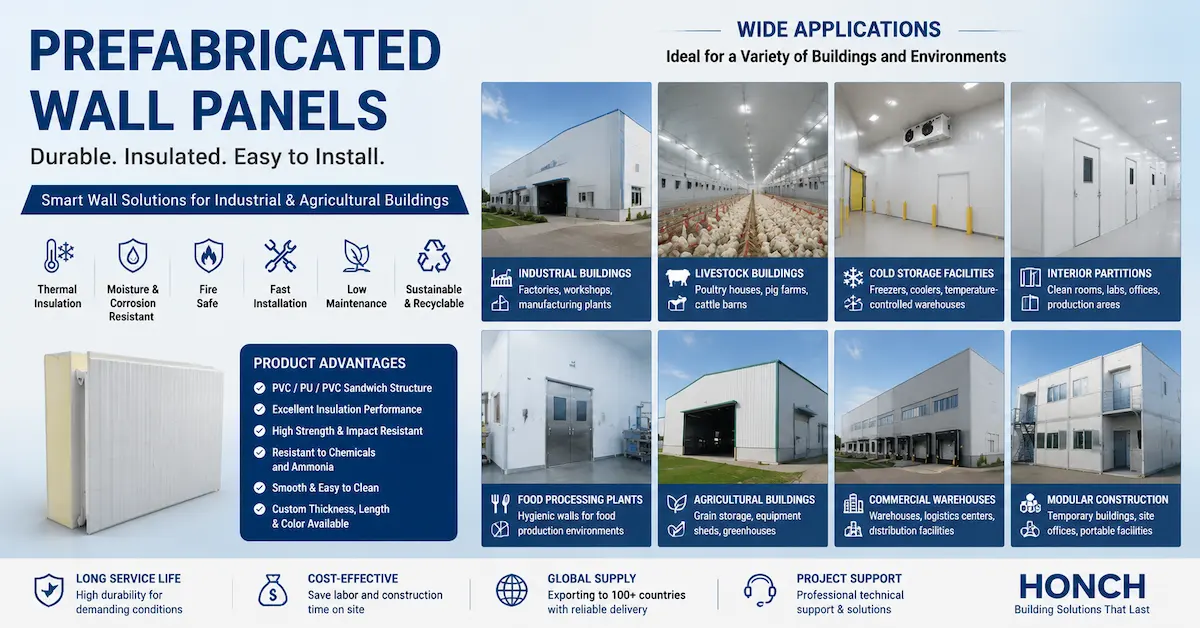
What Are Prefabricated Wall Panels?
Prefabricated wall panels are factory-produced panels designed to be transported to the project site and installed as part of the building wall system.
Depending on the construction method, a panel may provide one or several functions:
- Exterior or interior wall enclosure
- Thermal insulation
- Moisture protection
- Corrosion resistance
- Cleanable interior surfaces
- Partitioning
- Weather protection
- Faster modular installation
A prefabricated wall system can include much more than the main panel. Corners, joints, profiles, fasteners, sealing details, openings, roof-to-wall transitions, and insulation continuity can all affect final project performance.
This is why procurement teams should compare wall systems, not only panel unit prices.
The U.S. Whole Building Design Guide recognizes fabricated wall panel assemblies as a distinct building-wall category, alongside metal panels, masonry, concrete, and other wall systems.
Who Typically Needs a Prefabricated Wall Panels Supplier?
The search intent behind this keyword is strongly B2B.
Typical buyers include:
- Industrial building contractors
- Factory owners
- Warehouse developers
- Livestock farm builders
- Pig and poultry project contractors
- Agricultural construction companies
- Cold-room contractors
- Food-processing facility builders
- Building-material importers
- Wall-panel distributors
- Roofing and cladding contractors
- EPC companies
- Private-label construction-material brands
These buyers normally want different things.
A distributor may prioritize standardized dimensions, branding, packaging, product consistency, and repeat supply.
A farm contractor may prioritize corrosion resistance, cleanability, thermal insulation, and resistance to humid environments.
An industrial project buyer may focus on chemical exposure, installation details, insulation, maintenance, and coordination between roof and wall materials.
That means a good prefabricated wall panels supplier should ask about the application before recommending a product.
Start with the Building Environment, Not the Panel
One of the biggest purchasing mistakes is selecting a material before defining the environment.
Industrial Buildings
Factories and workshops may expose walls to:
- Humidity
- Dust
- Temperature fluctuations
- Process gases
- Chemical vapor
- Cleaning water
- Exterior UV exposure
- Rain and wind
Chemical plants, paper mills, smelting workshops, and similar facilities can require more corrosion resistance than an ordinary dry warehouse.
HONCH positions its PVC+PU+PVC insulation wall panel for industrial buildings and corrosive environments including chemical plants, animal farms, paper mills, and smelting workshops.
Livestock Buildings
Pig houses, poultry houses, and cattle barns can combine:
- High humidity
- Ammonia
- Organic gases
- Wash-down water
- Disinfectants
- Temperature-control requirements
For these buildings, a wall panel may need to provide moisture resistance + corrosion resistance + insulation simultaneously.
HONCH's broader livestock product platform includes wall, roof, and ceiling solutions for animal-husbandry buildings.
Buyers planning these projects can also review HONCH's Engineering Case section for application references.
Warehouses and Light Industrial Buildings
These projects may not face severe chemical corrosion, but buyers still need to consider:
- Indoor temperature targets
- Exterior weather
- Installation speed
- Wall height
- Panel support structure
- Maintenance
- Budget
- Future expansion
The correct panel should match the actual level of performance required rather than being over-specified or under-specified.
Which Prefabricated Wall Panel Structure Should You Choose?
Different materials solve different problems.
| Wall Panel Option | Main Strength | Main Consideration | Suitable Applications |
|---|---|---|---|
| PVC + PU + PVC panel | Insulation + corrosion resistance | Project-specific thickness and detailing | Livestock, industrial, cold rooms |
| Single PVC panel | Moisture and corrosion resistance | Lower insulation than sandwich structure | Partitions, farms, humid interiors |
| Metal insulated panel | Familiar industrial construction | Coating and corrosion exposure | Warehouses, commercial factories |
| Conventional masonry wall | Robust traditional construction | Longer wet construction process | General permanent buildings |
| Composite wall system | Multiple performance layers | Requires correct system design | Specialized industrial applications |
No single option is automatically best.
The correct choice depends on environmental exposure, insulation requirements, support structure, maintenance expectations, installation method, local building regulations, and total project cost.
Why PVC + PU + PVC Panels Are Relevant to Harsh Environments
HONCH's prefabricated insulation wall solution uses a three-layer structure:
PVC outer layer + rigid PU foam core + PVC inner layer.
The PVC surfaces are designed to provide moisture and corrosion resistance, while the PU core provides thermal insulation. HONCH lists industrial walls, livestock walls, cold rooms, and construction partitions among its applications.
PVC Surface Layers
PVC surfaces can be useful where walls need resistance to moisture and corrosive environments.
For livestock and selected industrial buildings, the surface material can also simplify cleaning compared with porous wall finishes.
PU Insulation Core
The rigid PU core performs the thermal-insulation function.
This is particularly relevant where indoor and outdoor temperature differences matter, including:
- Livestock facilities
- Cold rooms
- Temperature-controlled workshops
- Agricultural buildings
- Insulated partitions
Thermal insulation should still be considered as part of the complete building envelope. Panel joints, penetrations, roof connections, windows, doors, and thermal bridges can influence final performance.
Interlocking Panel Structure
HONCH states that its PU insulation wall panel uses an interlocking structure intended to support efficient installation and a tight finished wall assembly.
For project buyers, joint design should be reviewed before ordering because installation quality can affect moisture control, insulation continuity, and overall enclosure performance.
What Specifications Should You Send to a Prefabricated Wall Panels Supplier?
A vague RFQ often produces a vague quotation.
Instead of asking:
“Please quote insulated wall panels.”
Send a structured project specification.
| RFQ Information | What to Provide |
| Building type | Factory, farm, warehouse, cold room, workshop |
| Wall application | Exterior wall, interior partition, livestock wall |
| Project location | Country, climate, coastal/inland |
| Operating environment | Humidity, ammonia, chemicals, wash-down |
| Required panel structure | Single layer or insulated sandwich panel |
| Thickness | Required or supplier-recommended |
| Panel length | Drawing or required cutting length |
| Color | Standard or custom |
| Insulation requirement | Project thermal target if available |
| Wall area | Total m² or project drawings |
| Accessories | Corner profiles, fasteners, trims, sealing components |
| Quantity | Trial order, container order, project volume |
| Packaging | Standard export or private label |
| Certification | Project or market requirements |
| Delivery schedule | Required arrival or installation date |
HONCH states that thickness, color, and length can be customized for its PU insulation wall panel.
The more complete the RFQ, the easier it is to compare suppliers on the same technical basis.
How to Evaluate a Prefabricated Wall Panels Supplier
A reliable supplier should be evaluated across several dimensions.
1. Application Knowledge
Ask the supplier what information they need before recommending a panel.
If the supplier immediately recommends one product without asking whether the project is a pig farm, warehouse, chemical plant, or cold room, the recommendation may be too generic.
2. Material Knowledge
The supplier should be able to explain:
- Surface material
- Core material
- Panel construction
- Moisture resistance
- Corrosion considerations
- Insulation function
- Suitable and unsuitable environments
Good technical communication is especially important for distributors selling into several industries.
3. Clear Technical Specifications
A professional supplier should provide defined product specifications rather than relying only on promotional terms such as “high quality” or “excellent performance.”
For HONCH's PU wall panel, published product information includes PVC+PU+PVC construction, insulation, anti-corrosion and moisture-resistant functions, and customizable thickness, color, and length.
4. Quality Control and Certifications
For export projects, ask what quality documents are available and whether they apply to the product being purchased.
HONCH states that the company was founded in Jinhua in 2008 and has passed ISO9001 and EU CE certifications, with self-operated import and export rights.
A buyer should still confirm which certificate, declaration, test report, or standard is relevant to the exact product and target market before placing an order.
5. OEM/ODM Capability
Distributors and construction-material brands often need more than a standard panel.
Possible customization can include:
- Panel thickness
- Length
- Color
- Surface
- Connection structure
- Packaging
- Branding
- Private label
- System combinations
HONCH publishes OEM/ODM support for its insulation products and broader building-material solutions.
6. Complete Building-Envelope Supply
A wall rarely works in isolation.
Projects may also require:
- Roofing sheets
- Ceiling panels
- Ridge caps
- Corner accessories
- Transition pieces
- Fasteners
- Sealing components
HONCH's product range covers wall panels alongside roofing, ceiling, and roofing accessories, which can help buyers coordinate multiple parts of the building envelope.
For additional system-level guidance, see Building Envelope Wall Systems.
7. Project and Export Support
International buyers should confirm:
- Export packaging
- Container-loading considerations
- Documentation
- Production schedule
- Delivery timing
- Communication during manufacturing
- Technical support
- After-sales response
Do not assume lead time from a generic website statement. Confirm the actual production schedule based on panel specifications, customization, quantity, and current factory workload before issuing the purchase order.
Prefabricated Wall Panels Supplier vs Local Material Purchasing
International buyers often compare importing prefabricated panels with sourcing conventional wall materials locally.
| Comparison Factor | Prefabricated Panel Supplier | Traditional Local Wall Construction |
| Production | Factory manufactured | More work completed on site |
| Installation | Modular assembly | Often more site processes |
| Insulation | Can be integrated into panel | May require separate layers |
| Custom length | Often available | Depends on material |
| Surface finish | Factory-controlled | May need finishing on site |
| Project consistency | Repeatable product specification | Depends on site workmanship |
| Logistics | Requires freight planning | Local sourcing may simplify transport |
| OEM/private label | Possible for distributors | Usually limited |
| Repair | Individual panels may be replaceable | Depends on wall construction |
Neither method is always superior.
Importing prefabricated panels makes more sense when the project benefits from standardized components, integrated insulation, corrosion-resistant surfaces, repeat supply, or faster modular installation.
Local masonry may remain more practical for some projects where transportation costs, local labor conditions, regulations, or structural design make prefabricated panels less suitable.
What Determines Prefabricated Wall Panel Cost?
A buyer should not compare quotations only by price per square meter.
Panel cost can change according to:
- Surface material
- Insulation core
- Panel thickness
- Length
- Color
- Surface finish
- Connection design
- Order quantity
- Accessories
- Packaging
- Branding
- Shipping destination
More importantly, procurement teams should consider the total installed and lifecycle cost.
A lower-priced panel may become more expensive if it creates higher installation labor, requires additional insulation, needs frequent coating repair, performs poorly in corrosive conditions, or causes early replacement.
For livestock and industrial projects, downtime and maintenance access may also carry costs that are not visible in the initial quotation.
Common Procurement Risks and How to Reduce Them
Risk 1: Buying Only by Lowest Price
Solution: Compare material structure, insulation, accessories, expected environment, documentation, and supplier support on the same basis.
Risk 2: Using One Panel Specification for Every Project
Solution: Define humidity, corrosion, thermal, weather, and cleaning conditions before selecting the wall system.
Risk 3: Ignoring Joint Details
Solution: Review panel connections, corners, fasteners, openings, and roof-to-wall interfaces before installation.
Risk 4: Assuming All Certifications Cover Every Product
Solution: Ask the supplier for documents relevant to the exact product, market, and project specification.
Risk 5: Ordering Before Confirming Installation Dimensions
Solution: Use project drawings to confirm wall lengths, openings, panel direction, cutting lengths, and accessory quantities.
Risk 6: Ignoring Export Packaging
Solution: Confirm bundle protection, loading method, panel length limitations, unloading conditions, and job-site storage requirements.
Why Project Buyers May Consider HONCH
Zhejiang HONCH Technology was founded in 2008 and focuses on anti-corrosion and insulation building solutions for farms, factories, roofs, walls, ceilings, and light construction. The company states that it has ISO9001 and EU CE certification and independent import/export rights.
For wall projects, HONCH offers a PVC+PU+PVC insulated wall panel designed around thermal insulation, moisture resistance, corrosion resistance, and modular installation.
Its broader portfolio also includes roofing sheets, ceiling panels, ridge components, and other accessories, allowing contractors and distributors to evaluate wall materials as part of a coordinated building-envelope system.
This can be particularly relevant for:
- Pig and poultry farm projects
- Industrial facilities
- Agricultural buildings
- Warehouses
- Cold-room projects
- Building-material distributors
- OEM/ODM brands
- Contractors requiring repeat project supply
Buyers can review HONCH Products, explore Engineering Cases, or contact HONCH with project drawings, wall area, environmental conditions, panel specifications, and required quantity.
FAQ About Choosing a Prefabricated Wall Panels Supplier
1. What is a prefabricated wall panels supplier?
A prefabricated wall panels supplier manufactures or supplies factory-produced wall panels for installation in industrial, agricultural, livestock, commercial, or other buildings. Depending on the product, the panels may provide enclosure, insulation, moisture protection, or corrosion resistance.
2. What information should I provide before requesting a quotation?
Provide the building type, project country, wall area, environmental conditions, panel structure, thickness, length, color, quantity, insulation requirements, accessories, packaging requirements, and expected delivery schedule.
3. Which wall panels are suitable for livestock farms?
Livestock projects often require moisture resistance, corrosion resistance, cleanable surfaces, and thermal insulation. PVC and PVC+PU composite panels can be considered where these properties match the project's engineering requirements.
4. What are PVC+PU+PVC wall panels?
They are sandwich panels consisting of PVC surface layers and a rigid polyurethane insulation core. HONCH uses this structure for livestock, industrial, cold-room, and partition applications.
5. Can prefabricated wall panels be customized?
Yes. Customization depends on the manufacturer. HONCH states that its PU insulation wall panels can be customized in thickness, color, and length, with OEM/ODM support.
6. Are prefabricated wall panels suitable for industrial buildings?
They can be. Selection should be based on thermal requirements, corrosion exposure, moisture, structural design, fire and regulatory requirements, installation conditions, and the industrial process inside the building.
7. How do I compare two wall panel suppliers?
Compare panel construction, technical documentation, quality control, application experience, customization, accessories, export packaging, lead time, engineering support, certifications, and total project cost rather than price alone.
8. What certifications should a wall panel supplier provide?
Requirements vary by country and project. Buyers should define applicable building codes, product standards, fire requirements, and certification needs before ordering, then request documentation specific to the purchased product.
9. Do I need to buy roofing and wall systems from the same supplier?
Not necessarily, but compatible wall, roof, ceiling, and accessory systems can simplify detailing, specification communication, procurement, and installation coordination. HONCH supplies products across these building-envelope categories.
10. How can I request a quote from HONCH?
Send the project type, wall dimensions or drawings, panel requirements, quantity, environment, customization requirements, destination country, and expected schedule through the HONCH Contact Us page.
Conclusion
Choosing the right prefabricated wall panels supplier is ultimately a project-risk decision, not simply a product-price comparison.
A reliable supplier should help buyers connect wall-panel structure with the real operating environment, including temperature, moisture, corrosion, installation, joint design, maintenance, and integration with the rest of the building envelope.
For factories, warehouses, livestock farms, agricultural buildings, cold rooms, and other demanding projects, buyers should first define the application and then compare materials, specifications, certifications, OEM capability, quality control, accessories, logistics, and supplier support.
HONCH provides anti-corrosion and insulation products across wall, roof, and ceiling applications, including PVC+PU+PVC insulated wall panels for industrial and livestock projects.
To evaluate a project, visit the HONCH product range, review project applications, or contact HONCH for specifications, customization, samples, OEM/ODM requirements, and quotation support.