What Should You Look for in Wall Panels for Coastal Buildings?
A buyer sourcing wall panels for a seaside warehouse or factory should not begin with color, appearance, or price per square meter.
Start with exposure.
Coastal buildings can face airborne salt, wind-driven saltwater spray, high humidity, strong sunlight, rain, and repeated wet-dry cycles. FEMA's coastal construction guidance specifically notes that wind-driven saltwater spray can contribute to corrosion and moisture intrusion, while salt left after evaporation remains hygroscopic and corrosive.
That changes the wall-panel purchasing process.
A professional wall panels supplier for coastal building projects should be able to discuss:
- Salt and moisture exposure
- Panel surface material
- Corrosion-sensitive components
- Joint and fastener design
- Thermal insulation
- UV and weather exposure
- Wind-driven rain
- Installation conditions
- Maintenance access
- Project-specific customization
If a supplier recommends the same wall system for an inland warehouse and a beachfront building without asking additional questions, the specification deserves another review.
Why Coastal Building Wall Panels Face More Demanding Conditions
The coast does not create one single environmental problem. Several stresses occur at the same time.
Salt-Laden Air
Fine salt particles can travel inland with wind and settle on building surfaces.
The effect is particularly important around:
- Fasteners
- Panel joints
- Cut edges
- Corners
- Structural connections
- Scratched coatings
For metal construction, these details can become more important than the large flat surface of the panel.
This is one reason buyers searching for salt resistant wall panels should not rely on the phrase "salt resistant" alone. Ask which components are actually exposed and how the complete system handles them.
High Humidity
Coastal regions frequently combine salt exposure with elevated moisture levels.
A wall system therefore needs to be evaluated for both:
corrosion risk and moisture management.
Even a corrosion-resistant face material does not automatically prevent condensation or water intrusion through poorly sealed joints.
Wind-Driven Rain
Heavy rain combined with coastal winds can force water into weak interfaces.
Common risk points include:
- Horizontal and vertical joints
- Windows
- Doors
- Service penetrations
- Wall-to-roof transitions
- Corners
That makes installation detailing just as important as panel material.
UV Exposure
Many seaside projects are located in regions with strong year-round sunlight.
Exterior wall materials may therefore require appropriate weatherability and UV resistance, especially where appearance and surface stability matter over the long term.
Repeated Wet-Dry Cycles
A wall near the coast may be sprayed, become humid, dry, and then repeat the process.
For procurement teams, this means corrosion should be considered as a lifecycle issue rather than a one-time exposure.
Who Usually Searches for a Coastal Wall Panel Supplier?
The search intent behind this keyword is highly commercial.
Typical buyers include:
- Coastal industrial contractors
- Seaside warehouse developers
- Port-area construction companies
- Seafood processing plant contractors
- Agricultural project developers
- Resort and tourism developers
- Building-material importers
- Wall-panel distributors
- EPC contractors
- Factory owners
- Private-label construction brands
Their requirements are not identical.
A seafood processing facility may be concerned with salt, humidity, cleaning, and hygiene.
A beachfront warehouse may prioritize weather resistance and maintenance.
A coastal agricultural building may require both corrosion resistance and thermal insulation.
A distributor may be more concerned with repeatable specifications, OEM packaging, product consistency, and supply continuity.
A capable coastal wall panel manufacturer should understand these differences before recommending a system.
Which Materials Can Be Used for Coastal Building Wall Panels?
There is no universal "best coastal wall panel."
The correct solution depends on the building and exposure level.
| Wall System | Main Strength | Coastal Buying Consideration | Typical Use |
|---|---|---|---|
| PVC wall panel | Moisture and corrosion resistance | Check UV, connection and structural requirements | Interior/exterior selected applications |
| PVC + PU + PVC panel | Corrosion protection + insulation | Confirm thickness and joint detailing | Factories, farms,insulated buildings |
| Coated metal panel | Familiar industrial construction | Coating, cut edges and fasteners need attention | Warehouses, industrial buildings |
| Metal sandwich panel | Insulation + structural familiarity | Verify corrosion-protection system | Industrial and commercial buildings |
| Masonry system | Robust traditional construction | More on-site construction and finishing | Permanent buildings |
The question is not whether PVC is always better than steel or whether one panel is "the strongest."
The useful question is:
Which system gives this project acceptable performance, maintenance, installation, and lifecycle cost in its specific coastal environment?
Why PVC-Based Wall Panels Are Relevant in Coastal Projects
PVC-based building materials are particularly interesting where buyers want to reduce dependence on exposed metallic wall surfaces.
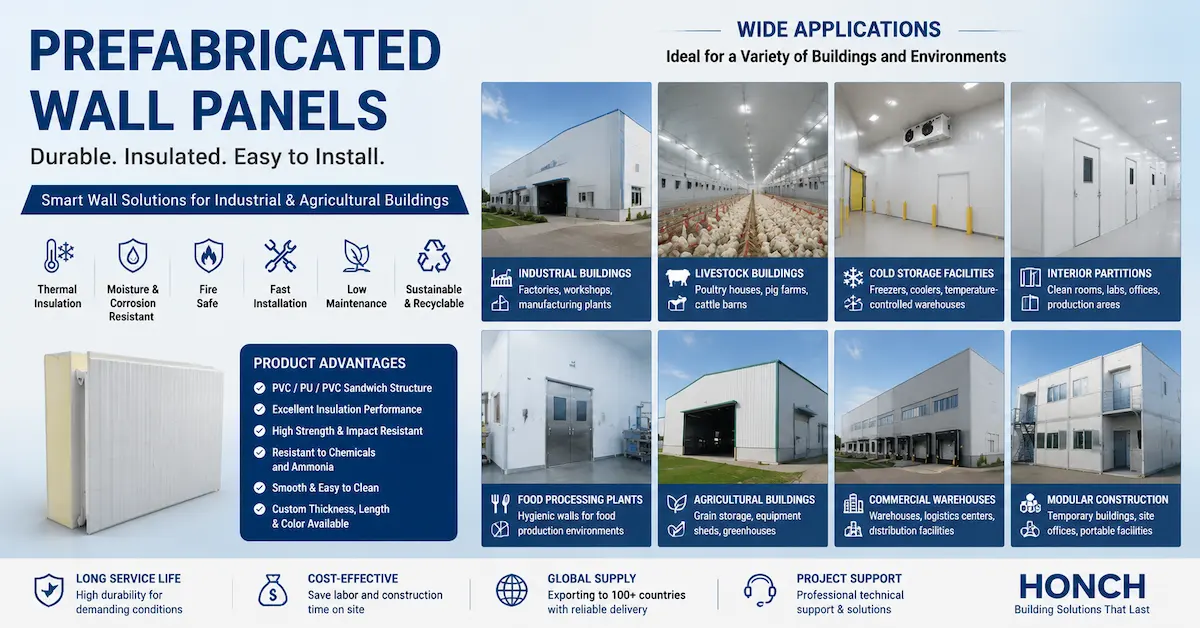
HONCH's PU Insulation Wall Panel uses a three-layer construction:
PVC outer layer + PU foam core + PVC inner layer.
HONCH describes the PVC surfaces as waterproof and corrosion-resistant, while the PU core provides thermal insulation. The product is intended for livestock, industrial, cold-room, and light-building wall applications, with customizable thickness, color, and length.
This construction can be relevant to selected coastal projects where the buyer needs both:
- a moisture/corrosion-oriented surface, and
- an insulated wall assembly.
However, buyers should not interpret this as proof that every PVC panel is automatically suitable for every marine exposure.
The complete specification still needs to address connections, structural supports, fasteners, UV exposure, wind loads, and local building regulations.
What Makes Corrosion Resistant Wall Panels Actually Work?
The phrase corrosion resistant wall panels can be misleading if it describes only the panel face.
A wall system contains many smaller parts.
Panel Surface
The surface material should be compatible with the expected environment.
For coastal projects, buyers should ask about:
- Material type
- Surface construction
- Exterior exposure suitability
- UV considerations
- Cleaning method
Fasteners
A corrosion-resistant panel installed with unsuitable fasteners can create an avoidable weak point.
Ask the supplier or engineer to define appropriate fastener materials and protection according to the project environment.
Structural Supports
The panel may not corrode easily, but the supporting frame may still require protection.
The wall panel and structural system should therefore be evaluated together.
Joints
Saltwater and moisture can collect around badly designed or poorly sealed connections.
Pay particular attention to:
- Vertical panel joints
- Horizontal overlaps
- Corner profiles
- Flashings
- Openings
- Penetrations
Cut and Drilled Areas
Cutting, drilling, or modifying materials on site can change their protection.
Installation procedures should therefore be agreed before work begins.
PVC + PU + PVC Panels for Coastal Insulated Buildings
Many coastal projects need more than corrosion protection.
They also need thermal control.
Examples include:
- Seafood processing buildings
- Cold storage
- Coastal food factories
- Livestock buildings
- Temperature-controlled workshops
- Warehouses with conditioned areas
HONCH's insulated wall panel uses a PU foam core between PVC surface layers.
This creates a different value proposition from a basic single-layer wall panel.
PVC Outer Layer
Its role is primarily surface protection against moisture and corrosive environments.
PU Core
The core provides insulation and reduces heat transfer through the panel.
PVC Inner Layer
The internal surface provides another protective, cleanable layer.
For projects where indoor temperature control matters, this combined structure may simplify the wall assembly compared with installing a separate lining, insulation layer, and internal finish.
When an Insulated Wall Panel May Not Be Necessary
Higher specification does not always mean better procurement.
A PU insulated panel may be unnecessary for:
- Naturally ventilated storage shelters
- Unconditioned equipment buildings
- Open-sided coastal structures
- Temporary buildings
- Interior partitions with no thermal requirement
In such cases, buyers may be paying for insulation that produces little practical value.
This is an important supplier test.
A trustworthy supplier should be willing to explain when a less complicated panel is enough.
Wall Panels for Seaside Buildings: Common Applications
The keyword wall panels for seaside buildings covers much more than residential beachfront construction.
Coastal Warehouses
Typical priorities include:
- Weather resistance
- Moisture control
- Easy maintenance
- Installation speed
- Corrosion-sensitive detailing
Large warehouses may also benefit from custom panel lengths that reduce unnecessary joints.
Seafood Processing Plants
Seafood facilities can combine indoor moisture, salt exposure, cleaning water, and temperature-control requirements.
The wall system may need:
- A smooth surface
- Corrosion resistance
- Moisture resistance
- Insulation
- Easy maintenance
HONCH already provides wall solutions positioned for industrial and food-related environments through its PVC+PU+PVC product platform.
Coastal Agricultural Buildings
Farm buildings near the sea can face humidity and salt exposure in addition to ordinary agricultural conditions.
Wall selection should therefore account for both the external coastal environment and the internal farm environment.
Port and Industrial Facilities
Industrial areas near ports may face salt spray combined with industrial pollutants.
These projects deserve application-specific review rather than a generic warehouse specification.
Resorts and Light Buildings
For tourism and light-building projects, buyers often add:
- Appearance
- Low maintenance
- Lightweight installation
to the normal coastal requirements.
How to Choose a Wall Panels Supplier for Coastal Building Projects
Supplier selection should start with questions, not quotations.
Does the Supplier Ask About Distance from the Coast?
Exact exposure varies according to location, wind, elevation, shielding, and local conditions.
A supplier does not need to make an arbitrary universal distance rule, but it should at least understand that a beachfront building and a protected inland building have different exposure.
Does the Supplier Ask About the Building's Use?
The wall requirements for:
- seafood processing,
- warehousing,
- livestock,
- manufacturing,
- tourism
are different.
Can the Supplier Explain the Panel Structure?
For example, HONCH clearly identifies its insulated wall structure as PVC + PU + PVC instead of simply calling it an "insulated panel."
That level of clarity makes technical comparison easier.
Does the Supplier Discuss the Complete System?
A credible supplier should talk about:
- Panels
- Corners
- Joints
- Fasteners
- Openings
- Roofing interfaces
- Installation
rather than only the square-meter price.
Can the Supplier Support Customized Projects?
Coastal buildings often vary considerably in wall length, color, building height, insulation, and connection requirements.
HONCH lists customization of thickness, color, and length, together with OEM/ODM, bulk purchasing, branding, packaging customization, and long-term project supply.
What to Put in a Coastal Wall Panel RFQ
A good RFQ dramatically improves quotation quality.
| RFQ Item | Information to Provide |
|---|---|
| Project type | Factory, warehouse, farm, seafood plant, resort |
| Location | Country, city/region, coastal exposure |
| Distance/exposure | Beachfront, port area, sheltered coastal area |
| Wall use | Exterior, interior,partition |
| Building height | Approximate wall/eave height |
| Wall area | Total m² |
| Material preference | PVC, insulated composite,other |
| Insulation | Required thermal performance if known |
| Panel thickness | Required or supplier recommendation |
| Panel length | Based on drawings |
| Color | Standard or custom |
| Environment | Salt, humidity, cleaning, chemicals |
| Wind conditions | Project design requirements |
| Accessories | Corners, flashings, fasteners,trims |
| Documentation | Required certification/test documents |
| Quantity | Project/bulk/repeat order |
| Packaging | Export or OEM |
| Delivery | Destination and required date |
Sending only "please quote 3,000 m² wall panels" leaves too much room for suppliers to quote different products.
Five Questions to Ask Before Approving a Supplier
1. Which Parts of the System Are Vulnerable to Coastal Corrosion?
A supplier should be able to discuss more than the main panel.
2. What Material and Panel Structure Are You Quoting?
Make sure every supplier is quoting the same specification.
3. Which Product Documents Apply to This Exact Model?
Do not assume that one company certificate applies to every product.
4. What Is Customized and What Is Standard?
Confirm:
- Thickness
- Color
- Length
- Packaging
- Connection details
before production.
5. What Information Do You Need from Our Drawings?
A project-oriented supplier should ask about dimensions, openings, corners, and installation conditions.
What Documentation Should Coastal Project Buyers Verify?
Documentation requirements depend on the country, building type, and product.
HONCH states that it has ISO9001 and EU CE certification and focuses on anti-corrosion and insulation solutions for farms, factories, walls, roofs, and ceilings.The company was founded in Jinhua in 2008 and holds self-operated import/export rights.
For an actual order, however, buyers should request documentation relating specifically to the panel being purchased.
Depending on the project, this may include:
- Product specification sheet
- Material information
- Relevant certificates
- Test reports
- Installation instructions
- Packaging specification
Do not make a coastal durability decision from the manufacturer's company certificate alone.
Common Mistakes When Buying Salt Resistant Wall Panels
Mistake 1: Treating "Salt Resistant" as a Complete Specification
Marketing language does not explain exposure limits.
Better approach: ask how the panel, fasteners, support structure, and joints are handled.
Mistake 2: Focusing Only on the Wall Face
A corrosion-resistant polymer panel does not automatically protect metal framing or unsuitable screws.
Better approach: evaluate the system.
Mistake 3: Ignoring Wind-Driven Rain
Coastal performance is not only about salt.
Better approach: review joint and opening details for water intrusion.
Mistake 4: Choosing by Thickness Alone
Thicker is not automatically better.
Better approach: match thickness to insulation, structural, and project requirements.
Mistake 5: Buying Before Final Drawings
Incorrect lengths and missing accessories create waste.
Better approach: finalize elevations and openings first.
Mistake 6: Assuming Maintenance Is Zero
Every exterior building system requires inspection.
Better approach: establish a maintenance plan appropriate to the location and exposure.
How to Compare Coastal Wall Panel Quotations
A low quotation can look attractive because important items are missing.
Use a normalized comparison.
| Comparison Item | Supplier A | Supplier B | Supplier C |
|---|---|---|---|
| Panel material confirmed | |||
| Structure confirmed | |||
| Thickness confirmed | |||
| Exterior/coastal application reviewed | |||
| Fastener specification | |||
| Accessories included | |||
| Custom lengths included | |||
| Packaging defined | |||
| Documents provided | |||
| OEM requirements included | |||
| Delivery terms confirmed | |||
| Technical support contact |
This makes price comparison much more meaningful.
What Determines Coastal Wall Panel Cost?
Coastal wall panel pricing varies according to:
- Panel material
- Insulation core
- Thickness
- Length
- Surface specification
- Color
- Accessories
- Fasteners
- Order volume
- Packaging
- OEM requirements
- Destination
There may also be indirect costs.
A cheaper wall system could require more:
- On-site cutting
- Protective treatments
- Maintenance
- Replacement
- Installation labor
So the useful purchasing question is not:
"What is your cheapest wall panel?"
It is:
"What is the lowest-cost wall system that meets our actual coastal exposure and project requirements?"
That question produces better technical conversations—and usually better quotations.
OEM and Bulk Supply for Coastal Wall Panel Projects
For distributors and repeat project contractors, procurement continues beyond one building.
Common OEM requirements include:
- Custom specifications
- Color options
- Project lengths
- Private labels
- Branded packaging
- Bulk ordering
- Repeat production
HONCH supports customized specifications, bulk purchasing, branding and packaging customization, and long-term engineering-project supply for its PU insulation wall panel.
A sensible OEM process should include:
Application Confirmation
Identify the coastal environment and target building type.
Specification Approval
Confirm panel structure, dimensions, color, and insulation.
Sample or Reference Confirmation
For customized finishes, approve the agreed reference before mass production.
Packaging Approval
Long wall panels require proper export and loading planning.
Production and Inspection
Agree on the acceptance criteria before production is completed.
Repeat-Order Control
For distributors, keep an approved specification sheet for future orders.
Why Consider HONCH for Coastal Building Wall Systems?
Zhejiang HONCH Technology was founded in 2008 and focuses on anti-corrosion and insulation solutions for factories, farms, roofs, walls, ceilings, and light buildings.
For wall applications, HONCH offers a PVC+PU+PVC insulated panel designed around:
- Corrosion resistance
- Moisture protection
- Thermal insulation
- Custom dimensions
- OEM/ODM supply
Its broader portfolio also covers roofing, ceiling panels, and accessories, which is useful when a coastal project requires coordinated roof-and-wall material selection.
You can review the HONCH wall-panel specification here:
HONCH PU Insulation Wall Panel
For the wider building system:
For previous project applications:
FAQ About Wall Panels for Coastal Buildings
1. What wall panels are suitable for coastal buildings?
Suitable wall panels should be selected according to salt exposure, humidity, rain, UV, wind, insulation, and maintenance requirements. PVC-based and appropriately protected metal systems can both be considered depending on the project.
2. What are salt resistant wall panels?
The term generally refers to wall systems selected to withstand environments where salt exposure contributes to corrosion. Buyers should verify the complete system, including panels, fasteners, framing, joints, and accessories rather than relying only on the product name.
3.Are PVC wall panels suitable for seaside buildings?
PVC-based panels can be relevant because the polymer surface does not rust like exposed steel. Final suitability still depends on UV exposure, structure, connections, wind requirements, and local building codes.
4. Why is salt air harmful to coastal buildings?
Wind-driven salt spray can deposit salt on materials. FEMA notes that saltwater spray contributes to corrosion and moisture intrusion, while salt deposits can retain moisture.
5. Are insulated panels useful near the coast?
Yes, when the building requires temperature control. Insulation should be selected according to the building's thermal needs rather than coastal location alone.
6. What is a PVC+PU+PVC wall panel?
It is a sandwich panel consisting of PVC outer and inner skins around a rigid PU foam core. HONCH uses this construction for insulated and anti-corrosion wall applications.
7. Should coastal buildings use special fasteners?
Fastener selection is important because connections may be exposed to moisture and salt. The correct fastener specification should be confirmed according to environmental exposure and engineering requirements.
8. Can coastal building wall panels be customized?
HONCH states that its PU insulation wall panels can be customized in thickness, color, and length, with OEM/ODM support.
9. Is the lowest-cost coastal wall panel the best choice?
Not necessarily. Installation, corrosion protection, accessories, maintenance, insulation, and replacement risk should be considered together with purchase price.
10. What should I send a coastal wall panel manufacturer for a quotation?
Send the building type, location, wall drawings, coastal exposure, dimensions, wall area, insulation requirements, material preference, color, quantity, accessories, destination, and documentation requirements.
11. Can the same panel be used for an inland factory and a coastal factory?
Possibly, but it should not be assumed. Exposure levels, wind, humidity, salt, and maintenance conditions should be reviewed separately.
12.How can I request a coastal project quotation from HONCH?
Prepare your project drawings or approximate wall dimensions, location, operating environment, quantity, insulation requirements, and customization needs, then submit them through:
Conclusion
Choosing a wall panels supplier for coastal building projects is primarily about understanding exposure and controlling risk.
Coastal conditions can combine salt, humidity, wind-driven rain, UV, and repeated wet-dry cycles. For this reason, buyers should look beyond the panel face and evaluate the complete wall system: material, joints, fasteners, framing, insulation, accessories, installation, and maintenance.
When comparing coastal building wall panels, avoid accepting claims such as "waterproof," "anti-corrosion," or "salt resistant" without understanding what they mean for the complete project.
PVC and PVC+PU composite systems can be practical options for projects requiring corrosion resistant wall panels, moisture protection, and—in insulated buildings—thermal control.
HONCH provides PVC+PU+PVC wall panels together with roof, ceiling, and other building-envelope products for industrial, agricultural, livestock, and light-building applications. Contractors, importers, distributors, and project developers can provide their location, drawings, exposure conditions, quantity, and specifications to receive a more project-specific recommendation.