Why a Ceiling material manufacturer Matters in Real Industrial and Agricultural Buildings
In many industrial facilities, livestock houses, and food processing plants, ceilings are often overlooked during early design stages. However, after the building becomes operational, ceilings frequently become a major source of problems. Moisture accumulation, condensation dripping, corrosion, and hygiene contamination are common issues that operators face.
For example, in livestock houses or processing facilities, ceilings must withstand high humidity, cleaning chemicals, and continuous airflow. Traditional ceiling materials such as gypsum boards or untreated metal panels often degrade quickly under these conditions.
As a Ceiling material manufacturer, HONCH approaches these challenges by combining corrosion-resistant materials, moisture-resistant structures, and hygienic surface treatments. Through material selection, engineered panel design, and project-based customization, we help building owners maintain stable ceiling performance even in demanding environments.
Moisture and Condensation: The Most Common Ceiling Failure Point
Condensation is one of the most common problems in industrial and agricultural buildings. Warm air rising from interior operations often meets cooler ceiling surfaces, causing water droplets to form.
Typical issues caused by condensation include:
-
Water dripping onto equipment or animals
-
Surface corrosion of ceiling panels
-
Mold and bacterial growth in porous materials
Ceilings designed by a Ceiling material manufacturer must address this challenge through both material selection and structural design.
In HONCH applications, non-absorbent ceiling materials such as PVC-based panels help prevent moisture absorption, while smooth surfaces allow condensed water to evaporate or drain rather than accumulate.
As a result, facilities maintain better hygiene conditions and reduce maintenance requirements.
Hygiene Requirements in Food Processing and Livestock Buildings
In food processing plants and livestock facilities, ceilings are not just structural components—they are part of the hygiene control system.
According to hygiene guidelines referenced by the Food and Agriculture Organization (FAO), building surfaces in livestock environments should be smooth, non-porous, and resistant to repeated washing to reduce contamination risks.
Traditional porous materials can trap moisture and bacteria, making them unsuitable for environments where strict cleaning routines are required.
A professional Ceiling material manufacturer designs ceiling panels with:
-
Smooth, non-porous surfaces
-
Chemical resistance to detergents and disinfectants
-
Materials that do not absorb moisture or odors
HONCH ceiling panels are designed to maintain surface stability even after repeated washdown cycles, helping facilities meet hygiene standards while reducing long-term cleaning difficulty.
Structural Stability in Large Buildings
Large buildings such as factories and warehouses require ceiling systems that remain stable across wide spans.
Structural challenges include:
-
Ceiling vibration caused by ventilation systems
-
Movement from temperature changes
-
Weight distribution across support structures
If ceiling panels deform or sag over time, maintenance costs increase and safety risks may emerge.
| Performance Factor | Conventional Ceiling Materials | Engineered Ceiling Panels |
|---|---|---|
| Moisture resistance | Low–Moderate | High |
| Structural stability | Moderate | Improved |
| Surface hygiene | Limited | High |
| Maintenance frequency | High | Reduced |
A capable Ceiling material manufacturer balances weight, strength, and structural flexibility to ensure ceilings remain stable without placing excessive load on supporting structures.
Real Application Scenario: Livestock Housing Ceiling System
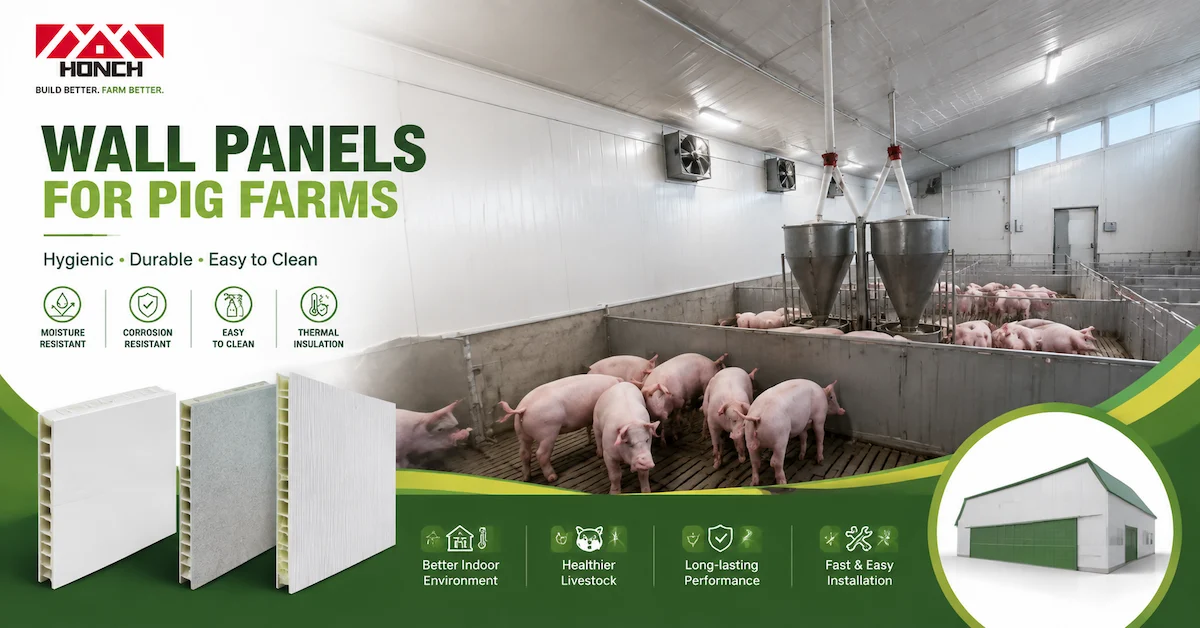
In a livestock housing project supplied by HONCH, the building required ceiling materials capable of withstanding both humidity and ammonia exposure.
Challenges included:
-
High humidity from animal activity
-
Air circulation systems creating temperature differences
-
Frequent cleaning and disinfecting routines
To address these conditions, HONCH supplied PVC-based ceiling panels with corrosion-resistant properties and smooth hygienic surfaces.
The ceiling system maintained stable performance during operation, reducing condensation accumulation and minimizing maintenance work for farm operators.
This demonstrates how a Ceiling material manufacturer contributes directly to operational efficiency in agricultural facilities.
Installation Efficiency and Long-Term Maintenance
Ceiling installation also influences construction schedules and long-term maintenance.
Well-designed ceiling systems should allow:
-
Efficient panel alignment during installation
-
Reduced cutting and adjustment on site
-
Easy replacement of damaged sections
HONCH ceiling panel systems are designed with installation efficiency in mind, enabling contractors to complete ceiling installation more quickly while maintaining structural precision.
At the same time, modular panel systems simplify maintenance by allowing localized replacement rather than full ceiling reconstruction.
Common Buyer Questions
Q: Are PVC ceiling panels suitable for industrial environments?
A: Yes. PVC ceiling panels provide moisture resistance and hygienic surfaces, making them suitable for industrial and agricultural buildings.
Q: Do ceiling materials affect hygiene conditions in livestock facilities?
A: Absolutely. Smooth, non-porous ceiling materials reduce bacterial accumulation and improve cleaning efficiency.
Q: When should ceiling materials be customized for a project?
A: Customization should be discussed during early project design so that the Ceiling material manufacturer can adapt panel specifications to the building environment.
Final Guidance for Ceiling System Selection
Ceilings are often underestimated in building design, yet they play a critical role in moisture control, hygiene management, and structural stability. Selecting the right Ceiling material manufacturer ensures that ceiling systems perform reliably under real operating conditions.
HONCH provides ceiling materials engineered for industrial and agricultural buildings, combining moisture-resistant materials, hygienic surfaces, and durable structural design. This approach helps facilities maintain stable operations while reducing maintenance costs.
To explore ceiling material solutions and application experience, visit the HONCH homepage:
https://www.honchroof.com/
For consultation on ceiling system selection or customization, contact the team via Contact Us:
https://www.honchroof.com/contact-us