The Direct Answer for Coastal Wall Panel Buyers
When a buyer asks, “what is the best wall panels for coastal building,” the answer is not a single material name. The best wall panel is the complete system that matches the building position, salt exposure, humidity, wind-driven rain, UV, temperature control, cleaning method and maintenance access. In many coastal projects, a PVC-based or PVC-faced insulated panel is worth investigating because it avoids the rust mechanism associated with exposed ferrous surfaces. A properly specified coated metal, aluminum or other composite system may also be appropriate when its coating, fasteners, joints and structural design are verified for the marine environment.
The key distinction is between a wall surface and a wall assembly. A panel can resist surface moisture and still fail at a fastener, corner, cut edge or opening. A wall can be corrosion-resistant and still develop condensation or water entry if the joint and drainage details are incomplete. Buyers should therefore compare materials by failure risk rather than by brochure adjectives such as “durable,” “marine grade” or “long life.”
Practical recommendation: Start with a PVC, UPVC, APVC or PVC-faced insulated wall system when salt-laden humidity and rust-related maintenance are the dominant concerns. Choose a PU-core composite wall when the coastal building also needs thermal insulation. Consider coated metal, aluminum or another system when structural demand, fire requirements, temperature, local code or project design makes that material the better documented fit. In every case, verify the face, core, fasteners, joints, trims, cut edges and installation method as one coastal wall assembly.
First Separate the Coastal Wall Into Four Use Cases
Many poor wall-panel purchases begin with an incomplete question. The buyer says “coastal building,” but does not say whether the panel is outside the building, behind a ventilated cladding layer, inside a humid production room or used as a temperature-controlled partition. These positions change the required material and the evidence that matters.
| Wall position | Dominant risks | Primary specification question |
|---|---|---|
| Exposed exterior wall | Salt spray, wind-driven rain, UV, thermal movement, impact and fastener corrosion. | Can the complete face and connection system withstand the exterior exposure? |
| Coastal warehouse or factory infill wall | Humidity, salt deposits, condensation, forklift impact and large-area maintenance. | Is moisture control more important than appearance, or is insulation also required? |
| Interior wall in a coastal process building | Washdown, cleaning chemicals, humidity, hygiene and contact damage. | Will the face, joint, sealant and lower-wall detail tolerate the cleaning routine? |
| Cold room or temperature-controlled partition | Condensation, vapor movement, thermal bridges, joint leakage and cleaning. | Does the full panel assembly maintain the required thermal and moisture barrier? |
This classification also prevents a common mistake: selecting an exterior cladding material for an interior hygiene wall, or selecting a surface-only panel where a thermal envelope is required. The right coastal wall panel is the one that satisfies the wall's actual job.
What Salt Air Does to Wall Systems
Salt is a connection problem as much as a surface problem
Salt-laden air settles on faces, laps, trims, fasteners, brackets and drainage points. When humidity or wind-driven rain keeps those deposits wet, the most vulnerable metal detail may deteriorate before the broad panel surface shows a visible problem. This is why a coastal specification should identify not only the panel face but also screws, washers, brackets, flashings, corner profiles and any exposed support.
For polymer-based panels, the failure mechanism is different. The material does not rust like exposed steel, but the face can still be affected by UV, temperature, impact, cleaning chemicals or unsuitable contact with other materials. The correct conclusion is not that PVC is immune to coastal damage. It is that the buyer should compare the actual failure mechanisms of each system.
Wet-dry cycles create recurring maintenance points
Coastal walls may be wetted by rain, sea spray or washdown and then dried by sun and wind. Repeated cycles can stress coatings, sealants, overlaps and joints. Water that remains at a base detail or behind a trim is more concerning than brief surface wetting. The design should provide drainage and inspection access so the wall does not depend on a hidden seal remaining perfect forever.
Wind changes the exposure route
Wind-driven rain can reach wall joints that would remain dry in ordinary vertical rainfall. Wind also increases the importance of fixing patterns, edge restraint and movement around openings. A corrosion-resistant face cannot compensate for a panel that is under-supported or a joint that is not designed for the local wind condition.
Compare the Main Coastal Wall Panel Options
PVC, UPVC and APVC wall or cladding panels
PVC-based panels are often considered for coastal projects because the exposed polymer face does not rust like an iron-based metal surface. They can be useful where moisture, salt deposits and low-maintenance cleaning are important. UPVC and APVC are product-family terms that should still be connected to an exact formulation, profile, thickness and application. The label alone does not prove suitability for a particular shoreline or chemical exposure.
For a coastal exterior, ask how the surface handles UV and temperature movement. For an interior wall, ask whether the face and joint can be cleaned without damaging the surface. For a large factory or warehouse, check support spacing, impact, connection details and the availability of matching accessories. The advantage of reducing rust exposure is meaningful only when the rest of the wall system is designed around it.
PVC + PU + PVC insulated wall panels
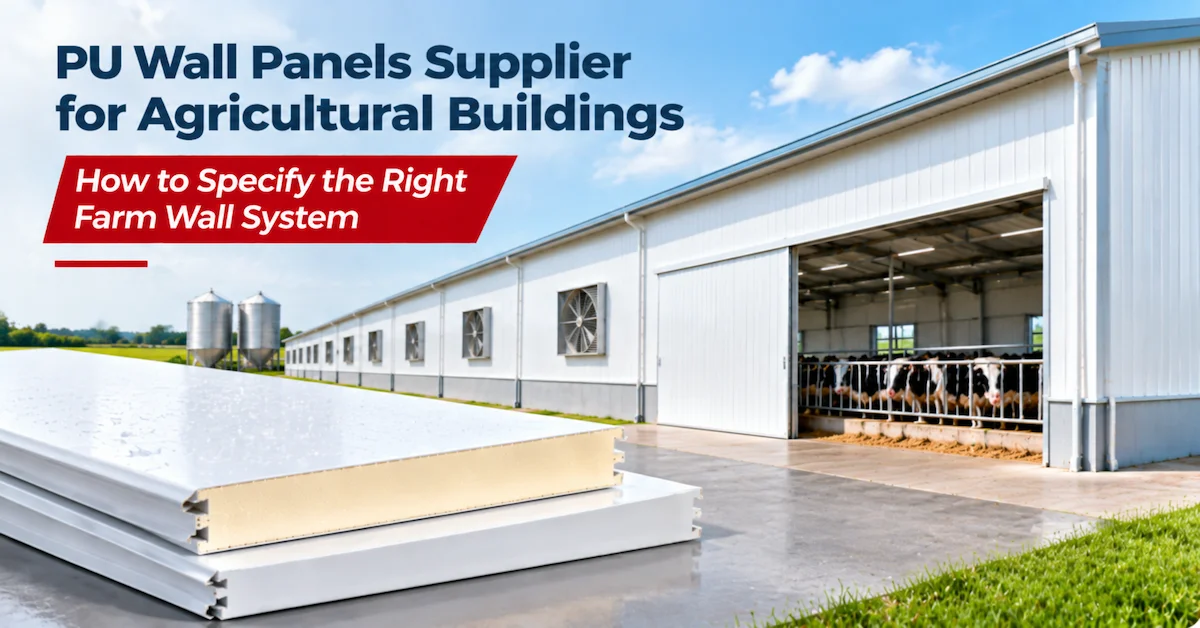
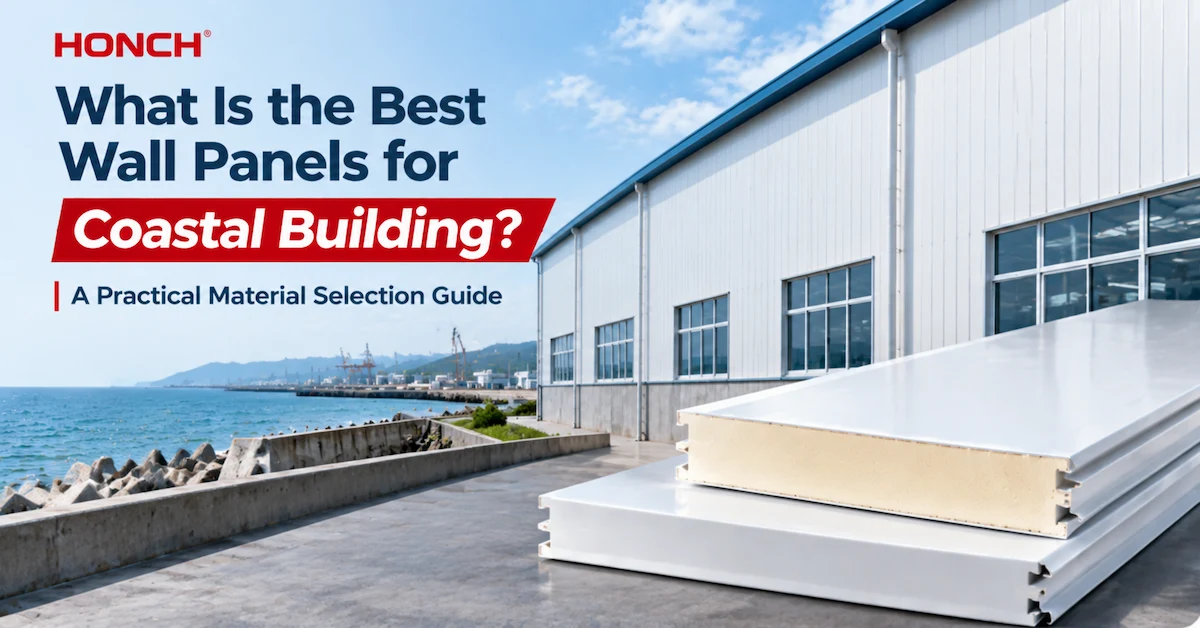
A composite panel with a PVC outer layer, PU foam core and PVC inner layer addresses more than surface corrosion. The outer face provides the exposed wall surface, the PU core provides thermal insulation and the inner face protects the room side. HONCH publishes this PVC + PU + PVC structure for industrial walls, livestock interior walls, cold rooms, insulation rooms and light-duty partitions, with thickness, color and length customization.
For a coastal warehouse, cold room or processing area, this type of panel may be relevant when humidity control and thermal performance are both part of the brief. It should not be treated as an automatic exterior cladding solution without checking the exact face, joint, edge, support and weather exposure. The product page describes anti-corrosion and moisture-proof functions, but the final coastal suitability still needs to be confirmed for the ordered configuration.
Coated steel wall panels
Coated steel remains widely used because it offers familiar design practices, many profiles and broad contractor availability. In a coastal building, its performance is controlled by the coating system, substrate, cut edges, fasteners, brackets, overlaps and maintenance plan. A specification that says only “pre-painted steel” is incomplete. The buyer should record the coating, thickness, edge protection, fastener material and exposure assumptions.
Metal can be the right choice where the project has significant structural requirements, a documented marine coating package or local code conditions that favor a metal assembly. It becomes a riskier choice when the site has frequent salt wetting, difficult inspection access and many unprotected cuts or penetrations.
Aluminum and other non-ferrous systems
Aluminum does not behave like carbon steel in a coastal environment, but it still requires correct design. Salt, dissimilar-metal contact, fasteners, crevices, coating damage and structural movement remain relevant. Aluminum may fit a project with specific weight, appearance or corrosion requirements, but the buyer should not assume that “non-ferrous” removes all marine durability questions.
Fiber cement, cement board and masonry-backed systems
Mineral-based wall systems can provide a robust exterior surface, but their coastal performance depends on water absorption, joints, backing structure, coatings, cracking control and detailing around openings. They may be useful where a project requires a particular fire, appearance or impact profile. They are not automatically the lowest-maintenance solution if the wall has many joints, poor drainage or repeated wetting.
Composite panels with different cores
Composite wall panels can use different face materials and insulation cores. Their performance must be assessed by the complete assembly rather than by the core name. For a coastal building, request the face specification, core, joint, edge treatment, thermal information and fire documentation for the exact panel. The core does not protect an exposed face or an open joint by itself.
Decision Matrix: Which System Fits Which Coastal Building?
| Project need | Panel direction to investigate | Why it may be suitable | Evidence still required |
|---|---|---|---|
| Salt and humidity are the main maintenance concern | PVC-based or insulated PVC-faced system | Reduces dependence on exposed ferrous surfaces for the wall face. | UV, chemical, impact, joints, trims, fasteners and installation limits. |
| Coastal building also needs temperature control | PVC + PU + PVC insulated panel or another documented composite system | Combines protective faces and a thermal core in one coordinated panel. | Thermal data, joint continuity, vapor control, edge treatment and fire documents. |
| Large exterior wall with high wind or impact demand | Engineered metal, composite or polymer system selected for the load | Structural requirements may control the material decision. | Span, wind, support, fixing pattern, impact and local design rules. |
| Interior washdown or seafood-processing room | Smooth, moisture-conscious panel face with sealed, cleanable joints | Cleaning and hygiene become more important than exterior appearance. | Chemical compatibility, pressure, temperature, contact time and drainage. |
| Budget-driven sheltered partition | Product selected for the actual indoor exposure, not a maximum marine grade | Avoids paying for exterior performance the wall does not need. | Humidity, condensation, cleaning, impact and expected replacement access. |
How to Evaluate the PVC + PU + PVC Option
Check the outer face against the real exposure
The outer PVC layer is the first barrier against humid air, salt deposits, rain and sunlight. Ask whether the proposed face is intended for the installation position. A product described for an industrial interior wall should not automatically be installed as an exposed coastal facade. Confirm the surface construction, color, thickness, UV expectations and permitted cleaning method.
Check the PU core against the building function
The PU core is relevant when the wall must reduce heat transfer or help stabilize indoor conditions. It does not establish a universal U-value or condensation result without thickness, joint and temperature data. Request the thermal evidence for the exact construction and review thermal bridges at corners, doors, penetrations and supports.
Check the inner face against cleaning and impact
In a seafood plant, coastal farm or humid workshop, the interior face may receive frequent washing, contact with equipment and repeated cleaning chemicals. The wall should be specified with the joint, base detail, corner protection and access path. A smooth face is helpful, but hygiene depends on the entire cleanable assembly.
Check the interlocking joint and edge details
HONCH describes an interlocking structure for its PU insulation wall panel. Buyers should request the actual joint drawing or sample and ask how corners, openings, cut edges, bases and transitions are finished. The interlock can help create a tight connection, but it does not eliminate movement, sealing or support requirements.
Coastal Wall Failure Usually Starts at the Details
Fasteners and brackets
Fasteners connect the wall to the support, but they also create penetrations where salt, water and dissimilar materials can interact. Specify the fastener material, washer, spacing, edge distance and sealing method. Do not assume that a corrosion-resistant panel makes ordinary carbon-steel screws acceptable.
Cut edges and drilled openings
Fans, doors, windows, conduits, pipes and service openings interrupt the wall face. Each cut needs a controlled edge detail. Exposed core, damaged coatings and poorly sealed penetrations can become the first location for moisture entry. Include opening details in the quotation rather than treating them as site improvisation.
Base and splash zones
The lower wall sees splash water, sand, cleaning water, impact and salt deposits. This zone often needs protection beyond the standard wall panel. Review the floor-to-wall transition, drainage, kick plates, curbs, sealants and replacement access. A wall that performs well at mid-height can still fail at the base.
Corners and wall-to-roof transitions
External corners, internal corners and wall-to-roof interfaces collect wind-driven rain and require compatible trims. The panel, trim and sealant should be designed as a set. A buyer comparing only flat panel prices may miss the parts that determine watertightness and corrosion exposure.
Movement around doors and large openings
Large doors and service openings create movement, impact and repeated maintenance. Confirm how the panel is supported around the opening and how the trim interfaces with the frame. If the opening detail is not documented, the coastal wall system has not been fully specified.
What Evidence Should a Coastal Wall Panel Supplier Provide?
A serious coastal-wall RFQ should request evidence that maps directly to the project's risks. The following list is more useful than asking for a generic durability statement.
- Exact material construction: face material, core, thickness, surface layer, profile and joint.
- Exposure assumptions: distance from the coast, salt spray, humidity, UV, temperature, wind-driven rain and cleaning chemicals.
- Connection details: fasteners, washers, brackets, trims, sealants, corners, bases and openings.
- Thermal information: thickness, conductivity or reported thermal performance for the ordered construction where insulation is required.
- Fire and conformity documents: reports that match the actual panel, thickness, destination market and intended application.
- Installation guidance: support spacing, handling, cutting, storage, joint engagement, sealing and permitted deviations.
- Maintenance guidance: cleaning agents, inspection points, repair method and replacement-part availability.
- Commercial details: MOQ, production lead time, packaging, color, length, quantity and delivery terms for the final order.
HONCH's official product page identifies the PVC + PU + PVC structure, insulation, anti-corrosion and moisture-proof functions, interlocking installation, and customization of thickness, color and length. It does not publish a universal coastal service-life guarantee, so the buyer should send project conditions and request configuration-specific confirmation.
The company's About Us page states that ZHEJIANG HONCH TECHNOLOGY CO., LTD was founded in Jinhua in 2008 and focuses on anti-corrosion and insulation solutions for factories, farms, roofs, walls and ceilings. It also publishes ISO9001 and EU CE information. Buyers should still verify the exact document scope against the ordered coastal wall construction rather than transferring a certificate from one product or thickness to another.
Cost Comparison: Initial Price Is Not Coastal Value
Coastal projects make maintenance access expensive. A wall may require scaffolding, shutdowns, lifting equipment or restricted-area work to repair a fastener, sealant joint or corroded bracket. The material with the lowest square-meter price may therefore create a higher lifecycle cost if it needs more frequent coating work or has difficult replacement details.
Compare the complete supply scope
Include panels, trims, corners, base details, fasteners, washers, sealants, flashings, packaging and spare quantity. A quote that excludes coastal accessories is not directly comparable with a quote that includes them. Ask the supplier to list included and excluded items line by line.
Compare installation risk
Custom length, interlocking joints and lighter handling can improve installation efficiency, but only when supports are aligned and the installer has clear instructions. Review cutting waste, lifting requirements, opening details and the number of field joints. A technically good panel can lose its advantage through poor installation control.
Compare inspection and repair access
Ask how the owner will inspect the base, corners, fasteners, joints and penetrations after installation. Ask whether matching panels, trims and sealants can be supplied later. A repairable system can be more valuable than one with a stronger headline claim but no practical replacement path.
Send this information with your inquiry: building type, coastal location, distance from shoreline, exterior or interior wall position, wall area, height, support spacing, openings, desired thickness, color, temperature requirement, cleaning method, wind exposure, salt or chemical exposure, quantity, destination and target delivery date.
Ask for this response: recommended panel construction, joint and trim details, technical documents, sample availability, MOQ, lead time, packaging and clear assumptions or exclusions.
Scenario-Based Recommendations
Coastal warehouse with no strict temperature requirement
Start by comparing a PVC-based wall face with a properly protected metal system. The decision should focus on salt exposure, wind-driven rain, impact, effective maintenance access and total accessory scope. If the warehouse is open, unconditioned and subject to forklift traffic, impact protection and base detailing may matter more than adding an insulation core.
Coastal cold room or temperature-controlled store
Investigate a composite insulated panel such as PVC + PU + PVC when its face, core, joints and vapor details fit the room. The key questions are condensation control, door interfaces, penetrations, floor connection and thermal bridges. Do not choose only by face material or nominal thickness.
Seafood or coastal food-processing building
Prioritize cleanability, chemical compatibility, moisture control, joint geometry, base protection and inspection. Ask the supplier to review the detergent and disinfectant procedure. The best wall system is one that can be cleaned, dried and repaired without creating hidden moisture or contamination paths.
Coastal agricultural or livestock building
Combine coastal salt exposure with ammonia, humidity, washdown and animal or equipment impact. A polymer-faced or PVC + PU + PVC system may be worth evaluating, but the lower wall, corners, ventilation openings and cleaning route should be detailed before the purchase order.
Sheltered interior partition near the coast
Do not automatically buy an exterior-grade wall system if the partition is protected from salt spray and wind-driven rain. Instead, check indoor humidity, condensation, cleaning and impact. Correctly matching the product to the zone can reduce cost without sacrificing the function the wall actually needs.
FAQ: Best Wall Panels for Coastal Buildings
What is the best wall panels for coastal building?
The best wall panel depends on the wall position and exposure. PVC-based or PVC-faced insulated panels are strong candidates when salt, humidity and rust-related maintenance are the main concerns. Coated metal, aluminum or other composite systems may be better where structural, fire, code or design requirements control the decision. Compare the complete assembly, not only the panel face.
Are PVC wall panels suitable for coastal buildings?
They can be suitable for defined coastal applications because PVC-based faces do not rust like exposed ferrous metal. The buyer must still verify UV, temperature movement, impact, chemical compatibility, joints, fasteners, trims and installation. Suitability depends on the exact product and whether the wall is exterior, interior, insulated or sheltered.
Are PU insulated wall panels good for coastal buildings?
They can be useful when a coastal building needs both a moisture-conscious face and thermal insulation. HONCH publishes a PVC + PU + PVC wall panel for industrial walls, cold rooms, insulation rooms and light-duty partitions. Confirm the exact outer face, joint, edge, fire documentation and weather exposure before using it on an exterior coastal wall.
Is metal or PVC better for a seaside wall?
Neither is automatically better. Metal may fit when its coating, substrate, fasteners and structural design are documented for the salt exposure. PVC may reduce rust-related maintenance on the wall face, but it still needs UV, impact, movement and connection verification. Compare lifecycle risks under the actual site conditions.
What is the most important coastal wall panel detail?
There is no single detail for every project, but joints, fasteners, cut edges, corners, bases and penetrations commonly control performance. Ask for drawings or samples of these locations. A wall quote that covers only the flat panel has not answered the main coastal durability questions.
Do coastal wall panels need insulation?
Only when the building function requires temperature control, energy management or condensation reduction. A sheltered partition may not need an insulated core, while a cold room or conditioned warehouse usually needs a complete thermal envelope. Choose the panel after defining indoor conditions and the required thermal performance.
How do I compare coastal wall panel suppliers?
Give each supplier the same building information and request the exact construction, joint details, accessories, evidence, MOQ, lead time, packaging and exclusions. Compare the complete system and repair path. A supplier that asks about salt, wind, UV, cleaning, openings and support is addressing the actual project rather than offering a generic panel.
Can HONCH customize coastal wall panels?
The HONCH PU insulation wall panel page lists customization of thickness, color and length, as well as OEM/ODM, bulk purchasing, branding and packaging support. Send the project application and exposure conditions so the final construction and technical documents can be reviewed against the coastal use case.
Conclusion
The answer to “what is the best wall panels for coastal building” is a project-specific wall system, not a universal material ranking. PVC-based panels can reduce rust exposure on the wall face. PVC + PU + PVC panels can add thermal insulation where the building needs it. Coated metal, aluminum, mineral-based and other composite systems may be suitable when their structural, fire, coating and connection evidence matches the site.
Before buying, define the wall zone, identify salt and moisture routes, compare the face and core, and inspect the details that usually fail first: fasteners, joints, cut edges, corners, bases and openings. Send the building conditions, drawings and required performance to HONCH for a configuration-specific recommendation, sample discussion and quotation.